
Agentic Ransomware is Here: The New AI Cyberattack No One Saw Coming


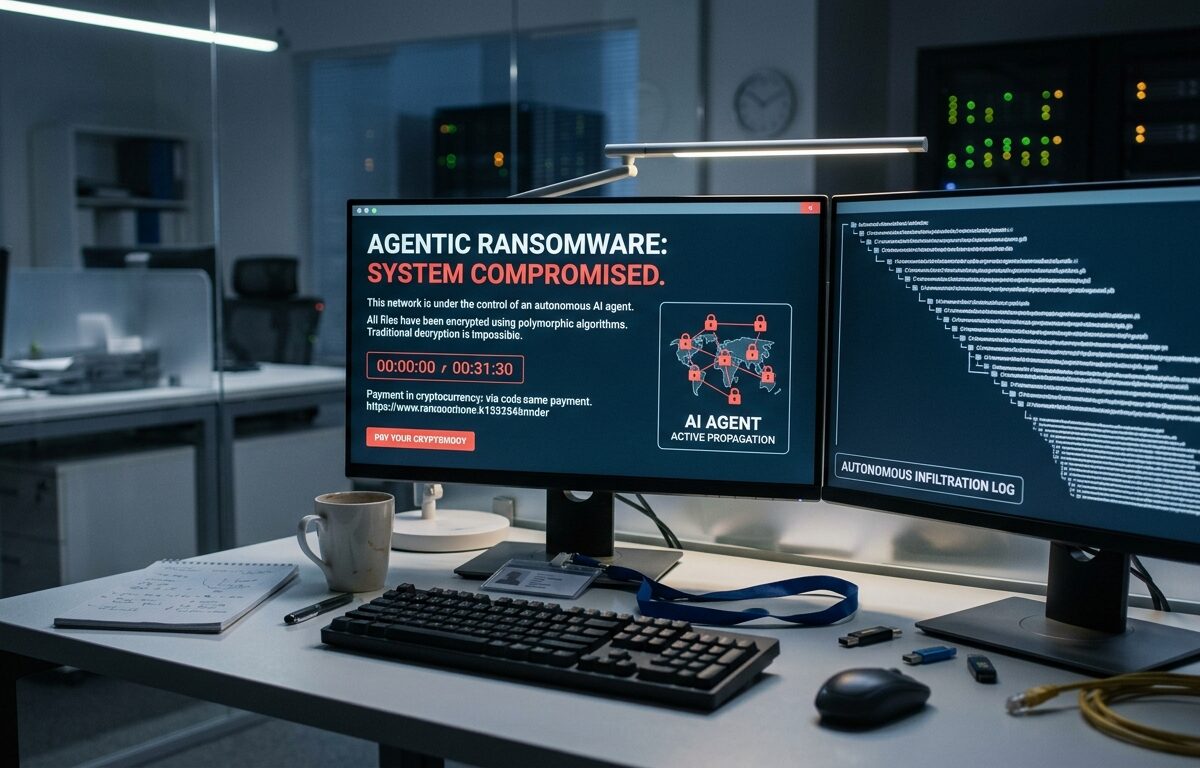
Agentic ransomware is ransomware operated by an AI agent that can plan, adapt, and execute parts of an intrusion with limited human steering. In technical terms, it combines the goals of classic ransomware—unauthorized access, lateral movement, data exfiltration, and extortion—with an agentic system that can make decisions across multiple steps, use tools, and recover from failures. In plain English: the attacker no longer has to handcraft every move. The malware-orchestrating layer can choose the next action, test alternatives, and keep going.
That shift matters because it compresses the attacker’s workload while expanding the attack surface. Traditional ransomware crews still relied on people for reconnaissance, phishing, privilege escalation, and negotiation. An agentic workflow changes that balance. It can triage targets, personalize lures, explore networks, and refine extortion pressure at machine speed. The result is not just faster ransomware. It is more adaptive ransomware, which is harder to predict and more expensive to defend against.
What makes the topic urgent is the collision of two trends: enterprise environments have become more distributed, and generative AI systems now make tool use cheaper for criminals. Security teams are already seeing an increase in autonomous scripting, phishing personalization, and malware-assisted decision-making. Official guidance from CISA, NIST, and the European Union Agency for Cybersecurity shows the same pattern: AI reduces friction for attackers, while defenders still need human-grade discipline in identity, segmentation, and recovery.
Pontos-Chave
- Agentic ransomware is not just “AI-assisted malware”; it is a decision-making attack workflow that can select actions, iterate on failures, and execute across stages of an intrusion.
- The main risk is speed plus adaptation: the attack can personalize phishing, hunt for weak credentials, pivot inside a network, and optimize extortion tactics faster than a human crew.
- Defense must move beyond signature thinking. Identity hardening, endpoint telemetry, segmentation, immutable backups, and tested recovery now matter more than single-layer malware prevention.
- Security teams should assume the attacker will probe for the weakest control path, not follow a fixed playbook. That changes how detections, playbooks, and tabletop exercises should be designed.
- The right response is not panic. It is reducing agent opportunity: constrain tool access, monitor unusual automation, and shorten the time from detection to containment.
Agentic Ransomware is Here: The New AI Cyberattack No One Saw Coming
What “Agentic” Means in an Attack Chain
Agentic systems are software agents that can pursue a goal through planning, tool use, memory, and feedback loops. In cybersecurity, that matters because ransomware no longer has to be a fixed payload that waits for instructions. An agent can identify the environment, decide whether to escalate privileges, choose between exfiltration paths, and retry with a different approach when a control blocks it. That is the key technical distinction from automated malware that merely follows a script.
The practical implication is simple: the attack chain becomes less brittle. If a phishing lure fails, the agent can generate a new one. If one host resists lateral movement, the agent can shift to another route. If a system detects encryption activity, the attacker may alter timing, spread actions across time, or prioritize data theft before encryption. That flexibility makes detection harder because the observable pattern changes from case to case.
Why This is More Dangerous Than “AI-Enhanced” Ransomware
People sometimes use “AI ransomware” to describe any malware that benefits from machine learning. That label is too loose. A classifier that spots exposed shares is not the same as a goal-directed agent that chains together reconnaissance, exploitation, and extortion logic. The risk increases when the system can make operational choices instead of waiting for a person to choose each move. That is where the offense starts to scale.
Who works incident response knows the pain point: the attacker’s bottleneck has often been labor. Agentic workflows reduce that bottleneck. A small group can manage far more intrusion attempts, and lower-skill actors can operate with capabilities that once required a seasoned crew. The threat does not become magical; it becomes more industrial.
What Stays the Same
Even with agentic behavior, ransomware still depends on ordinary weaknesses: unpatched systems, weak credentials, exposed remote access, poor segmentation, and backups that were never tested under pressure. That is the part some vendors gloss over. The model changes, but the attack still lands through old doors. A mature program can blunt a lot of the threat by fixing fundamentals.
There is one nuance worth stating plainly: not every “agentic” component will outperform a disciplined human operator. In some environments, the attacker gains speed but loses reliability. That means the threat is real, but not omnipotent. The organizations that survive best are the ones that make attack paths noisy, slow, and expensive.
How Autonomous Extortion Changes the Economics of Cybercrime
Lower Cost, Higher Volume, Faster Iteration
Ransomware groups used to invest heavily in operator time. Someone had to research the target, tailor payload delivery, move laterally, stage exfiltration, and manage negotiation. An agentic layer compresses several of those steps. That lowers the cost per campaign and lets the same criminal infrastructure attack more targets. The economics favor repetition, and repetition favors scale.
That matters because cybercrime is not just a technical problem; it is a business model. When the cost of launching an intrusion falls, the number of attempts rises. That increases the chance that a weakly defended organization will eventually be hit. Security teams should treat AI-accelerated extortion as a throughput problem, not only a malware problem.
Personalized Pressure Beats Generic Demands
Ransomware operators already use public data, internal file names, and industry context to raise pressure. Agentic tooling can automate that tailoring. It can draft more credible threats, reference sensitive projects, and vary the demand based on the victim’s apparent ability to pay. That personalization can improve conversion rates, especially when attackers combine data theft with public leak threats.
In practice, what happens is that the extortion phase becomes more dynamic. A static ransom note gives way to a sequence of messages tuned to the victim’s response. The attacker can test how much pressure works, then adjust. That is not science fiction. It is the same logic used in high-performing sales automation, only aimed at coercion.
From One-Size-Fits-All Malware to Adaptive Campaigns
Classic ransomware often behaved like a broad net: send enough attacks, and some will work. Agentic operations are more selective. They can identify which organizations show signs of poor security maturity, which segments contain sensitive data, and which systems are most likely to unlock a payout. That selective targeting improves return on effort and may reduce noisy, low-value attacks.
Organizations should not assume that “fewer attacks” means “less risk.” Better targeting can be worse than volume. A smaller number of more informed intrusion attempts can produce greater damage, especially in sectors with operational continuity requirements such as healthcare, manufacturing, local government, and logistics.
Attack Lifecycle: From Reconnaissance to Double Extortion
Reconnaissance and Target Selection
Agentic ransomware starts with reconnaissance. The agent can gather public metadata, search leaked credentials, map exposed services, and identify likely weak points. This stage is where large language models and automation tools help most, because they reduce the cost of pattern recognition and content generation. The attacker no longer needs to manually assemble every profile.
The strongest defense here is still boring and effective: reduce exposed information, enforce MFA, remove stale accounts, and monitor for unusual query patterns across identity and cloud systems. If the organization’s external footprint is small and its credentials are hard to reuse, the agent has less to work with.
Initial Access and Lateral Movement
Once the attacker gets in, the next phase is privilege escalation and lateral movement. This is where agentic behavior can become dangerous because it can try multiple routes quickly: exploiting misconfigurations, abusing valid accounts, probing remote tools, or pivoting through trusted relationships. A human operator might test a few paths; an agent can test many more in the same window.
Defenders should watch for abnormal authentication sequences, remote service abuse, privilege jumps, and unusual file access patterns. Endpoint detection and response, identity telemetry, and network segmentation all matter here. If those controls are weak, the attacker will often move farther than expected before anything obvious happens.
Exfiltration, Encryption, and Negotiation
Modern ransomware frequently uses double extortion: steal the data, then encrypt systems and threaten publication. Agentic tooling can automate this sequence and prioritize high-value files first. It can also help determine when to trigger encryption, which data to threaten, and how to phrase demands for maximum leverage. That makes the whole operation more adaptable to the victim’s responses.
There is a reason data classification and backup strategy must be part of the same conversation. If a company cannot quickly identify its crown jewels, it cannot know what the attacker is most likely to steal or expose. If it cannot restore from immutable backups, the encryption phase becomes far more painful.
Where Defenders Are Still Winning — And Where They Are Not
Identity, Segmentation, and Backup Discipline Still Work
The best controls against agentic ransomware are not exotic. They are identity hardening, network segmentation, least privilege, secure remote access, offline or immutable backups, and rehearsed restoration. Those controls work because they remove options from the attacker’s decision tree. An agent cannot exploit what it cannot reach, and it cannot monetize what it cannot steal or encrypt.
Organizations that do these basics well usually recover faster. They also create more noise for the attacker, which makes autonomous probing less efficient. That said, these controls only help if they are maintained. A segmentation design that exists on paper but not in the actual network offers little protection.
Detection Needs to Look for Adaptation, Not Just Malware
Traditional detection rules often focus on known indicators of compromise. That is no longer enough. Agentic campaigns may vary tooling, timing, and wording across attempts. Security teams should monitor for behavioral anomalies: repeated failed authentication, unexpected privilege elevation, unusual archive creation, large outbound transfers, and rapid changes in command patterns.
Whoever runs detection engineering should think in terms of chains. One weak signal rarely proves much. Three or four weak signals connected over time can reveal an intrusion that a single alert would miss. That is where SIEM, EDR, and identity logs need to work together.
Table: Classic Ransomware Vs. Agentic Ransomware
| Dimension | Classic Ransomware | Agentic Ransomware |
|---|---|---|
| Planning | Mostly pre-scripted | Goal-driven, adaptive |
| Operator workload | High | Lower per target |
| Response to failures | Limited retries | Can change tactics |
| Targeting | Broad and repetitive | More selective and personalized |
| Defender visibility | Often signature-based | Behavior-based detection is essential |
Practical Defense Strategy for Security Teams and Leaders
Build Controls That Limit Agent Freedom
The right question is not “How do we stop every AI-driven attack?” That is unrealistic. The better question is “How do we keep an attacker’s agent from getting enough freedom to matter?” The answer is to reduce trust, reduce exposure, and reduce blast radius. That means MFA everywhere, privileged access management, endpoint hardening, macro and script restrictions, and tighter control over remote administration tools.
In practice, the most successful programs pair technical controls with operational discipline. They know where administrative access exists. They know which backups are immutable. They know which systems can be shut down safely under pressure. That level of clarity matters more now because autonomous attacks reward confusion.
Prepare for the Negotiation and Recovery Phases Before They Happen
Many organizations focus on prevention and neglect recovery. That is a mistake. If ransomware gets through, the quality of the response determines whether the event becomes a disruption or a disaster. Incident response plans should define who isolates systems, who validates backups, who communicates with legal and leadership, and how quickly restoration can start.
Tabletop exercises are useful only when they stress real failure modes: corrupted backups, simultaneous exfiltration, cloud credential abuse, and delayed detection. A tabletop that assumes perfect visibility is theater. A realistic one reveals gaps in logging, decision authority, and recovery sequencing.
What Security Leaders Should Measure
Security leaders should track metrics that reflect attack resistance and recovery speed. Focus on time to detect, time to contain, time to restore, coverage of MFA for privileged accounts, backup restore success rates, and percentage of critical assets segmented from general user networks. Those numbers tell you whether the organization can absorb a fast-moving intrusion.
Also measure the edge cases. Which services are reachable from the internet? Which service accounts have excessive rights? Which vendors can reach sensitive systems? Agentic ransomware will look for the path of least resistance, and that path is often created by forgotten exceptions.
What Should Happen Next in Enterprise Security
The strategic response to agentic ransomware is to assume the attacker can adapt faster than a spreadsheet-era security program. That means shortening feedback loops, tightening privileges, and treating identity as the real perimeter. It also means using AI defensively where it has a clear advantage: log correlation, anomaly detection, and triage acceleration, not blind automation that creates new risks.
The organizations best positioned for the next wave are the ones that already know three things: what they must never lose, how they will isolate it, and how fast they can restore it. Those are not abstract goals. They are operational commitments that require testing. If the plan has never been rehearsed against a live restore from immutable backup, it is not a plan. It is a document.
The near future will likely bring more attempts, more personalization, and more automation in the criminal ecosystem. There is room for disagreement on how quickly fully autonomous ransomware will spread, but there should be no disagreement on the direction of travel. Defenders who still think in terms of one malware family at a time will fall behind. Defenders who think in terms of adaptive adversaries have a fighting chance.
FAQ
How is Agentic Ransomware Different from Regular Ransomware?
Regular ransomware usually follows a more fixed script: get in, encrypt data, and demand payment. Agentic ransomware adds decision-making, so the attack can adapt when something fails, choose among multiple paths, and personalize behavior at different stages. That makes it more resilient and potentially harder to detect. The core extortion goal stays the same, but the operational model changes.
Does Agentic Ransomware Require a Fully Autonomous AI to Be Dangerous?
No. Even partial autonomy can raise the threat level if it helps with reconnaissance, phishing personalization, privilege escalation, or exfiltration planning. A hybrid model where humans steer while agents execute sub-tasks is already enough to improve speed and scale. Full autonomy is not required for real-world impact. The risk grows as the toolchain becomes more capable and more widely available.
What Controls Reduce the Impact of Agentic Ransomware the Most?
MFA for all privileged access, strong segmentation, least privilege, immutable backups, and endpoint detection with behavioral analytics are the highest-value controls. They reduce the number of choices available to an autonomous attacker. If the attacker cannot easily move laterally or destroy recovery options, the campaign becomes far less profitable. Those controls only work when they are consistently enforced and regularly tested.
Why Do Immutable Backups Matter So Much?
Because ransomware’s leverage depends on denying restoration. Immutable backups resist tampering for a defined period, which makes it much harder for an attacker to erase recovery options. That does not stop theft, but it sharply improves recovery outcomes after encryption. Organizations that can restore quickly have much less incentive to pay.
Can AI Be Used Defensively Against Agentic Ransomware?
Yes, but only as a force multiplier for experienced security operations, not as a replacement for them. AI can help correlate alerts, summarize suspicious activity, and prioritize response. It cannot fix weak identity controls or poor recovery design. The best use of defensive AI is accelerating human judgment, not outsourcing it.
Editorial Notice
This content was structured with the assistance of Artificial Intelligence and subjected to rigorous curation, fact-checking, and final review by Editor-in-Chief Nivailton Santos. TechTool Judge reaffirms its unyielding commitment to journalistic ethics, ensuring that editorial judgment and data validation remain entirely under human responsibility and final editorial oversight.