
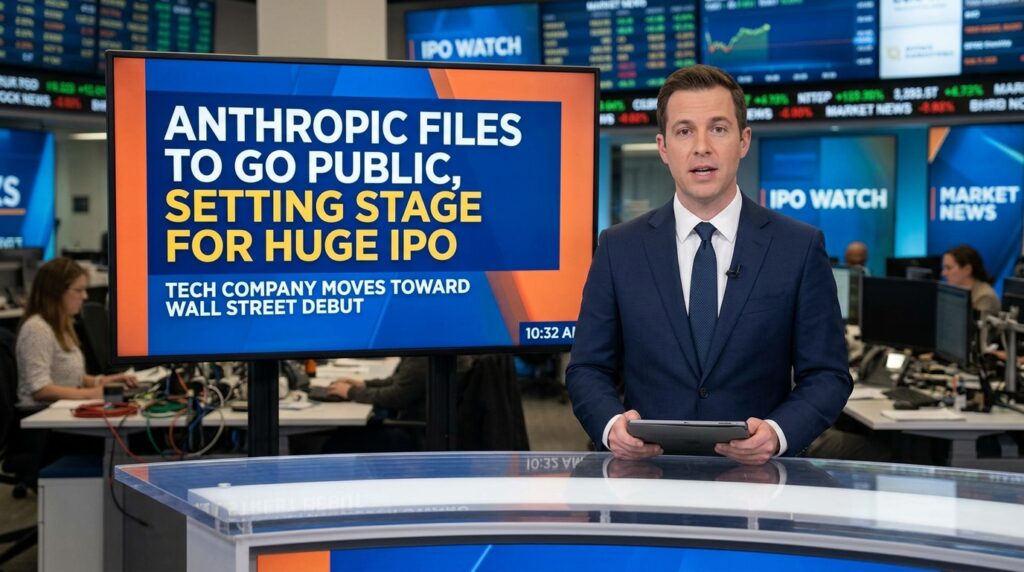
Anthropic Files to Go Public, Setting Stage for Huge IPO


Anthropic Files to Go Public, Setting the Stage for a Huge IPO is a signal that the market’s next major AI listing may be moving from speculation to execution. In technical terms, this refers to a private AI company preparing the regulatory, financial, and governance infrastructure required for an initial public offering, including disclosures, audit readiness, capital structure review, and investor-facing risk framing. In plain English: Anthropic is positioning itself to sell shares to public-market investors, and that changes how the company is valued, monitored, and constrained.
This matters because Anthropic sits in the center of one of the most capital-intensive races in modern technology: frontier AI model development. That race is not financed like a typical software startup. It requires enormous compute budgets, long training cycles, specialized talent, and distribution alliances with firms like Amazon and Google. Once a company like Anthropic starts moving toward the public markets, the conversation shifts from product momentum alone to durability, margin quality, governance discipline, and the economics of scaling artificial intelligence without destroying return on capital.
The timing is also strategic. Public markets have become more selective after years of easy money, which means an AI company cannot rely on hype to carry a flotation. If Anthropic proceeds, the IPO process will be read as a test case for whether investors still believe frontier model providers can justify premium valuations before they are consistently profitable. That is why this filing is more than a procedural step. It is a referendum on the business model behind advanced AI.
Pontos-Chave
- An IPO filing would shift Anthropic from a private, narrative-driven valuation model to a public-market framework centered on audited financials, governance, and disclosed risk.
- Frontier AI companies face a different scaling problem than standard SaaS firms: inference and training costs can rise faster than revenue unless usage, pricing, and compute efficiency improve together.
- Strategic partners such as Amazon and Google matter because they influence cloud capacity, distribution, and perceived durability of the business model.
- Public investors will likely focus less on model benchmarks and more on concentration risk, customer mix, cash burn, and regulatory exposure.
- The success of an Anthropic listing could reset expectations for other AI companies considering public markets, including OpenAI-adjacent peers and model infrastructure vendors.
Anthropic Files to Go Public, Setting the Stage for a Huge IPO: Why the Filing Matters Now
The Technical Meaning of an IPO Filing
An initial public offering begins when a company prepares to register securities with regulators, typically through a prospectus or similar filing process, depending on jurisdiction and structure. At that point, the company must disclose business risks, financial statements, governance arrangements, and use-of-proceeds details. The filing is not the IPO itself. It is the formal opening of the capital-markets process, where the company begins converting private valuation into a public price discovery event.
For Anthropic, this matters because the company operates in a sector where valuation depends heavily on expected future scale rather than current profitability. Investors will not treat it like a mature enterprise software vendor. They will treat it like a frontier infrastructure platform with unusually high operating leverage if it works, and unusually high burn if it does not. That is a very different underwriting story.
Why Public Markets Care More About AI Economics Than AI Demos
Benchmarks, model launches, and developer enthusiasm matter, but they are not enough to sustain a public listing narrative. Public-market buyers want evidence that the company can turn expensive compute into recurring, expanding revenue. That means they will examine gross margin, retention, enterprise adoption, and the relationship between model capability and unit economics. If those do not improve together, the market will compress the multiple quickly.
Who works with this space knows that the hardest part is not training the model once; it is serving millions of requests at a cost structure that does not eat the business alive. In practice, the real question is whether inference costs fall fast enough as usage rises. That is where many AI stories become fragile.
The Regulatory and Disclosure Threshold is a Feature, Not a Formality
Companies rarely move toward an IPO without internal readiness across finance, legal, and controls. They need clean audits, reliable revenue recognition, board structures that satisfy public-investor expectations, and a risk section that can survive scrutiny from analysts and institutions. For an AI company, the disclosure burden is even heavier because it must explain model safety, customer concentration, third-party cloud dependencies, and potential policy constraints.
For context on the SEC’s registration process, see the U.S. Securities and Exchange Commission’s offering and registration guidance. For broader capital-markets mechanics, Investor.gov’s IPO glossary gives a useful primer. And for AI policy pressure that could shape public-company disclosures, the NIST AI Risk Management Framework resources are a strong reference point.
How Anthropic Would Be Valued in Public Markets
From Story Stock to Discounted Cash Flow Discipline
Private markets can tolerate a broader narrative spread. Public markets usually narrow it. The valuation of an AI company like Anthropic would likely sit at the intersection of revenue growth, margin path, and strategic scarcity. Investors would ask whether the company is a durable model provider, a high-end enterprise AI platform, or a research-led frontier lab with commercialization upside. Each of those implies a different multiple.
The first scenario supports a software-like valuation framework. The second can justify a growth premium if customer expansion is strong. The third tends to get discounted because research prestige does not automatically convert into cash flow. This is where the market will press hardest: what exactly is the economic engine?
What Public Investors Will Measure First
Analysts will probably focus on several variables before they care much about model release cadence. Those include annual recurring revenue, enterprise customer concentration, gross margin trend, cash burn, and committed cloud spend. The combination tells a clearer story than headline usage alone. A company can have strong demand and still fail public-market standards if the cost base expands too aggressively.
Metric Why It Matters What Investors Will Infer Revenue growth Shows demand expansion Whether adoption is broadening or plateauing Gross margin Reveals compute efficiency Whether scaling improves economics or worsens them Cash burn Indicates financing pressure How much capital the company needs before breakeven Customer concentration Shows resilience Whether growth depends on a small number of whales Cloud dependencies Reflects strategic leverage and risk Whether margins and access can be controlled externally
Why the Market May Assign a Premium Anyway
Even in a tighter market, Anthropic could attract a premium if it demonstrates differentiated enterprise traction, strong model reputation, and credible governance. Frontier AI has a winner-take-most dynamic in some use cases. If a public investor believes the company sits among the few providers capable of shaping enterprise adoption for years, the valuation framework can look more like a strategic platform than a conventional software line item.
That said, there is a limit. A premium is earned, not assumed. If growth depends on expensive incentives, custom deployments, or cloud-backed economics that do not hold up under scrutiny, the multiple compresses. The public market has a short memory for narrative and a long memory for margins.
The Operating Risks Behind a Large AI IPO
Compute Economics Can Overpower Growth
The central risk in a frontier AI IPO is that demand can outpace efficiency. Training large models is costly, but serving them at scale is often costlier over time because inference volume compounds. If pricing does not keep up with token consumption or enterprise seat expansion, gross margin can get trapped below what public investors expect from a high-growth software business.
Viable AI economics depend on a widening gap between revenue per customer and cost per request. That gap does not appear automatically. It requires model optimization, routing efficiency, better hardware utilization, and product design that encourages profitable usage patterns. A good product can still be a bad public equity if the cost curve stays steep.
Governance and Safety Disclosures Will Matter More After Listing
Once a company enters public markets, governance stops being internal housekeeping and becomes part of the equity story. For Anthropic, that includes how it manages model safety, red-teaming, release policies, and any concentration of control around founders and early backers. Investors will want to know whether the company can scale responsibly without creating headline risk every quarter.
This is where the company’s reputation for safety-oriented research may actually help. But the same reputation can raise expectations. If a firm markets trust and alignment as core differentiators, any safety incident, policy breach, or controversial model output can hit both trust and valuation. The brand premium cuts both ways.
Dependence on Hyperscalers is a Double-edged Advantage
Anthropic’s relationships with Amazon and Google give it access to capital, infrastructure, and distribution. That is a real advantage. It can accelerate deployment, expand compute availability, and help the company reach enterprise customers faster than a stand-alone startup could. In a capital-intensive market, that support can be decisive.
But dependence also narrows strategic freedom. If cloud terms change, if pricing power shifts, or if platform partners become competitors in adjacent layers, the economics can tighten quickly. This is one of those areas where the story works well in expansion mode but becomes more fragile in a downturn. Nem todo caso se aplica — it depends on contract structure, exclusivity, and the leverage of each partner.
What Anthropic’s Move Signals for OpenAI, Cohere, and the REST of the Market
The Public Markets May Reward a Few, Not Many
If Anthropic succeeds, it will not mean that every AI lab should rush toward an IPO. It will mean the market is willing to underwrite a small number of frontier AI winners that can prove scale, control costs, and maintain credibility. That would reinforce a tiered market structure: a few model leaders, a larger field of application companies, and an even larger group of infrastructure providers.
OpenAI, Cohere, Mistral, and other closely watched model developers will be compared against that benchmark, even if their capital structures differ. The lesson is not that the market loves AI. The lesson is that the market rewards AI businesses that can explain how the economics survive contact with public scrutiny.
Enterprise Buyers Will Read the IPO as a Stability Signal
Customers do not always say this out loud, but they care about vendor durability. A public filing can reduce counterparty anxiety because it forces disclosure, audit discipline, and capital-market oversight. For enterprise buyers, that can make a vendor feel more reliable. It may also accelerate procurement cycles for larger deployments, especially in regulated industries.
There is a practical upside here. I have seen cases where a company’s move toward public markets unlocked larger enterprise deals because procurement teams preferred vendors with more transparent financials and stronger governance. That does not guarantee better products, but it changes how risk committees behave.
The AI Supply Chain Will Get Repriced Too
When a leading AI company approaches the public markets, investors do not just revalue the issuer. They also reprice the ecosystem around it: cloud providers, GPU suppliers, enterprise AI middleware, and compliance tooling. If the IPO narrative emphasizes efficient inference, the market may rotate toward hardware and infrastructure winners. If the story emphasizes demand explosion, it may strengthen the case for data-center capacity, networking, and orchestration layers.
That spillover effect is one reason this filing matters beyond a single ticker. It is a macro signal for how capital should be allocated across the AI stack. The market is trying to decide whether the era of unlimited model spending is sustainable or whether efficiency has become the new moat.
How Investors and Operators Should Read the Filing Process
Separate Signal from Theater
Not every IPO rumor means a company is ready. Some filings are timing devices. Some are credibility devices. Some are used to create optionality with later-stage investors or strategic partners. The real test is whether the company can show a clean business model, a disciplined burn profile, and a believable route to public-company reporting quality.
That is why it helps to read the filing process as an operational audit, not a media event. If the disclosures are specific, consistent, and economically coherent, the company is probably serious. If the language stays vague, the business may still be a long way from the public markets.
Practical Checklist for Analyzing the Deal
- Check whether revenue growth is paired with improving gross margin, not just more usage.
- Look for disclosure on cloud commitments, because compute is often the hidden liability in AI balance sheets.
- Review customer concentration to see whether growth is broad-based or dependent on a small set of contracts.
- Compare governance language with the company’s public safety posture; the gap between the two often reveals hidden risk.
- Watch whether the company positions itself as a research leader, a platform business, or an enterprise software vendor, because valuation depends on that framing.
The strongest filings do one thing well: they tell a financially coherent story without pretending uncertainty does not exist. Weak filings overemphasize breakthrough capability and underexplain the path to durable economics. In public markets, that gap is punished quickly.
For a broader view of how public offerings are evaluated, the NYSE IPO Center provides useful listing context, while the SEC’s investor education materials help frame the disclosure standards that matter after the filing.
Próximos Passos Para Implementação
The right way to interpret this move is not as a headline about a single company, but as a stress test for the entire frontier AI sector. If Anthropic can translate technical leadership into durable public-company economics, the path opens for a new class of AI issuers that are valued on operating discipline as much as on model capability. If it cannot, the market will draw a sharper line between research prestige and investable business quality.
For operators, the lesson is direct: prepare the financial story before the capital event. For investors, the discipline is just as clear: separate model quality from business quality, and never confuse usage growth with profitable scale. The companies that win the next phase of AI will be the ones that make compute economics, governance, and enterprise trust reinforce each other.
The market will not reward aspiration alone. It will reward proof.
FAQ
What Does It Mean When Anthropic Files to Go Public?
It means the company has begun the formal process of preparing for an initial public offering, which usually includes regulatory registration, financial disclosure, and governance review. The filing itself is not the sale of shares; it is the stage where the company becomes visible to public-market scrutiny. For a frontier AI company, this step matters because it exposes the economics behind model development, compute spending, and long-term capital needs. It also signals that management believes the business is ready for institutional-level review.
Why Would a Huge IPO Be Unusual for an AI Company Like Anthropic?
Because frontier AI companies are capital intensive in a way most software firms are not. They can burn large amounts of cash on training, inference, and cloud infrastructure before profits become visible. Public investors tend to accept that only if the company shows a believable path to margin expansion and recurring revenue. That is why a large IPO in this segment is rare: it requires both strong growth and a credible economic model.
What Metrics Will Analysts Focus on Most If Anthropic Goes Public?
Analysts will likely prioritize revenue growth, gross margin, cash burn, customer concentration, and cloud dependency. Those numbers reveal whether the company is scaling efficiently or simply spending faster to keep pace with demand. For AI firms, model performance matters, but it is not enough on its own. The economics of serving the model to customers at scale are what usually determine whether a public valuation holds up.
How Do Amazon and Google Affect the Investment Case?
They strengthen the case by providing cloud capacity, strategic support, and broader distribution. That can reduce execution risk and help Anthropic scale faster than a standalone startup could. At the same time, those relationships can create dependency risk if pricing, access, or competitive incentives shift. Public investors will want to know how much control Anthropic really has over its infrastructure costs and strategic flexibility.
Could Anthropic’s Public Listing Affect the REST of the AI Market?
Yes. A successful listing would likely reset expectations for how frontier AI companies are valued, especially those with strong enterprise demand and credible governance. It could also influence how investors price cloud infrastructure, GPU supply chains, and AI compliance tools. If the market likes the filing, peers may gain credibility. If it finds the numbers weak, the whole sector may face tighter valuation discipline.
Editorial Notice
This content was structured with the assistance of Artificial Intelligence and subjected to rigorous curation, fact-checking, and final review by Editor-in-Chief Nivailton Santos. TechTool Judge reaffirms its unyielding commitment to journalistic ethics, ensuring that editorial judgment and data validation remain entirely under human responsibility and final editorial oversight.