
10 Games That Were a Hit in Brazil

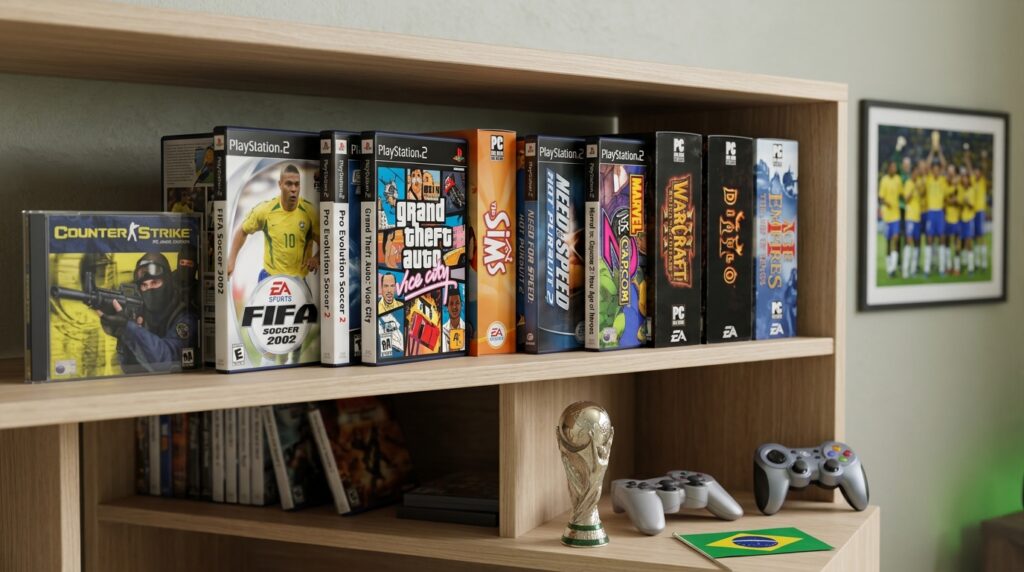
10 games that were a hit when Brazil won its last World Cup refers to the video games that were widely played, heavily discussed, or commercially dominant in Brazil around the 2002 FIFA World Cup, the tournament Brazil won in Japan and South Korea. In practice, that means titles that defined the country’s gaming culture at the time: console blockbusters, arcade-style sports games, and PC staples that were everywhere in rentals, cybercafés, and living rooms.
This matters now because 2002 was a turning point. It marked the peak of the sixth console generation, when the PlayStation 2 was spreading fast, the Xbox had just entered the market, and Brazil’s game audience was growing through retail, piracy, rentals, and local clubs. If you want to understand what Brazilian players cared about in that era, you have to look at the games that actually moved the market, not just the global critical favorites.
That distinction matters. A game could be a global success and still not feel culturally dominant in Brazil, and some titles became local fixtures without winning international prestige. The list below focuses on that intersection: relevance, popularity, and historical fit with the 2002 moment. I’m also using the 2002 context deliberately, because Brazil’s last World Cup title is fixed history, while “hit games” depends on sales, visibility, and memory.
Key Takeaways
- The most important frame is historical, not nostalgic: the games on this list were prominent around Brazil’s 2002 World Cup era, when the PlayStation 2 era was accelerating.
- Sports titles, racing games, and accessible action games dominated because they were easy to learn, easy to share, and easy to replay.
- Brazil’s gaming ecosystem in 2002 was shaped by retail availability, rental culture, and a strong informal market, so local popularity did not always match official sales rankings.
- If you are mapping the period accurately, the right question is not “what was the best game?” but “what was visible in Brazilian player culture at the time?”
- For historical context, the strongest sources are FIFA for the tournament timeline, Britannica for Brazil’s football milestone, and contemporary market reporting from IGN or similar archives.
10 Games That Were a Hit When Brazil Won Its Last World Cup: The 2002 Snapshot
1. Pro Evolution Soccer 2 And the Winning Eleven Phenomenon
If one franchise defined football gaming in Brazil in 2002, it was Konami’s Winning Eleven lineage, known globally as Pro Evolution Soccer 2 in many markets. The technical definition here is a simulation-focused football game built around animation fluidity, ball physics, and tactical control rather than license-heavy presentation. In plain terms: it felt closer to playing football than watching a broadcast menu.
Who worked in game culture at the time knew this already. The title spread through dorms, rental shops, and local tournaments because it rewarded skill, not just spectacle. Brazil’s football obsession made the series a social default, and the lack of full licensing mattered far less than passing, through balls, and manual finishing. The game also fit the 2002 mood perfectly: Brazil was winning on the pitch, and football games were winning at home.
For historical context on the tournament itself, FIFA’s own archive remains the cleanest reference point: FIFA’s 2002 World Cup archive.
2. FIFA 2002
FIFA 2002 was the big licensed alternative, and that mattered a lot. Its defining feature was official teams, authentic branding, and a presentation layer that made it instantly legible to casual players. Where Winning Eleven drew competitive players, FIFA pulled in everyone else, including fans who wanted Brazil, Ronaldo, Rivaldo, and Ronaldinho in a familiar package.
That split says a lot about Brazilian gaming behavior. The market did not choose one football game in isolation; it segmented by taste. FIFA won on accessibility and official presentation, while Konami won on mechanical depth. In a World Cup year, those two demands coexisted. A game could be a hit without being the most refined one, and FIFA 2002 proved that.
3. Grand Theft Auto III
Grand Theft Auto III turned open-world design into a mainstream language. The technical shift was enormous: a fully 3D city, mission-based structure, emergent chaos, and player freedom that older action games simply did not offer at scale. That structure made it one of the most talked-about games of the era, including in Brazil, where anything that pushed the boundaries of the PlayStation 2 became a reference point fast.
Why did it work? Because it offered density. You were not just completing missions; you were exploring a system that reacted to you. In practice, what happens is that players remember the game less for one mission and more for the feeling of possibility. That kind of design has staying power, and it helped make GTA III a cultural event far beyond its sales numbers.
4. Tekken 4
Tekken 4 was a visible fighter in 2002 because fighting games still mattered as social hardware. The genre’s value was local and immediate: short matches, high replayability, and a steep but learnable skill curve. Tekken’s 3D movement and character diversity gave players enough depth to master specific mains without needing a long onboarding process.
Brazil had a strong arcade and couch-fighting tradition, so games like this traveled well. A title did not need a massive single-player campaign to become a hit; it needed a strong versus mode and a roster people could argue about. Tekken 4 delivered both. Even now, that kind of game design remains a case study in how competitive accessibility creates community.
5. Metal Gear Solid 2: Sons of Liberty
Metal Gear Solid 2 was not a casual blockbuster, but it was a prestige hit. Its technical identity rested on stealth systems, cinematic direction, and narrative ambiguity, all wrapped in a level of production polish that set a standard for the generation. In Brazil, that kind of game mattered because the PS2 audience was maturing quickly and wanted more than short-session entertainment.
What made it memorable was not only the story twist and spectacle, but the fact that it treated players as observers of systems. Lighting, guard vision cones, movement timing, and environmental awareness all mattered. That complexity gave the game long-term respect, even if it did not dominate every circle the way football titles did.
6. Need for Speed: Hot Pursuit 2
Racing games were a reliable hit in Brazil because they were intuitive. Need for Speed: Hot Pursuit 2 used pursuit fantasy, speed, and police-chase structure to make every session feel immediate. The game’s appeal was not abstract; it gave players an easy emotional loop: accelerate, escape, win, repeat.
That formula translated well in a market where multiplayer, rentals, and quick sessions shaped behavior. A racing game could be picked up by a newcomer and still reward a veteran through better lines, vehicle handling, and chase management. This is one reason the franchise stayed culturally sticky for so long. It did not require genre literacy to be fun.
7. Final Fantasy X
Final Fantasy X represented the JRPG’s cinematic peak on PlayStation 2. Its systems combined turn-based combat, character progression, and a heavily authored story structure. For a Brazilian audience exposed to fantasy games through magazines, imported discs, and word of mouth, it felt like a premium event rather than a routine release.
Not every player finished it, and that’s part of the point. A hit game does not need universal completion; it needs visibility, aspiration, and conversation. Final Fantasy X had all three. It was the sort of title people talked about because it signaled what next-generation gaming could look like when narrative and presentation were treated as core design pillars.
8. Winning Eleven 6 International
This entry is worth separating from PES 2 because in Brazil these football games often lived as distinct cultural objects. Winning Eleven 6 International sharpened the simulation identity even further, with better AI behavior, tighter passing lanes, and a more competitive meta. It was the version players sought when they wanted the “serious” football experience.
That distinction matters because local popularity often depended on which edition people had access to, not just the franchise name. In a market with uneven retail distribution, version identity mattered. Players remembered the specific disc on the shelf, the roster updates, and the balance changes, not only the brand.
9. Max Payne
Max Payne stood out because it introduced a new kind of action grammar to many players: bullet time, cinematic shooting, noir framing, and a protagonist whose inner monologue drove the tone. It was mechanically accessible, but stylistically sharp enough to feel unlike the average shooter of the period.
Why did that resonate in Brazil? Because it was easy to understand and hard to forget. A game like this spreads through recommendation quickly: one dramatic slow-motion dive, one memorable set piece, and one distinct mood are enough to create demand. That’s how a title becomes part of the era’s memory even when it is not the top seller in every channel.
10. The Sims
The Sims belongs on any honest list of 2002-era hits because it reached beyond the usual gamer profile. Its technical core was life simulation: autonomy, object management, relationship systems, and player-driven storytelling. That formula opened gaming to audiences who did not care about reflex-heavy mechanics or competitive scorekeeping.
In Brazil, that mattered. A game with broad social reach can become a quiet giant, especially in households where one machine served multiple preferences. The Sims also foreshadowed a larger truth about game culture: not every hit looks loud from the outside. Some dominate because they let players build routines, households, and narratives that feel personal.
Why These Games Fit Brazil’s 2002 Moment
The Sixth Console Generation Changed the Center of Gravity
By 2002, the market had moved into the sixth generation: PlayStation 2, Nintendo GameCube, and Xbox were shaping the new baseline. In Brazil, the PS2 became the most visible symbol of that shift because it sat at the crossroads of affordability, desirability, and software variety. That mattered more than raw hardware specs. A console wins culturally when it gets played, discussed, copied, rented, and shown to other people.
The result was a library that mixed mass-market sports games with prestige action titles. That blend explains why the list above is so football-heavy at one end and so cinematic at the other. Brazilian players were not choosing between genres in a vacuum; they were choosing within a living ecosystem.
Brazil’s Gaming Market Was Shaped by Access, Not Only Sales Charts
Official sales data can tell part of the story, but not all of it. In 2002, Brazilian game consumption was influenced by rental stores, imported stock, magazine coverage, cybercafés, and an informal distribution network that changed what people actually played. A title could be culturally dominant even if its tracked retail footprint looked uneven.
This is where many retrospective lists fail. They assume that the loudest international blockbuster was automatically the most important local hit. That’s not how Brazilian game culture worked in the early 2000s. Visibility and access often mattered more than official chart position.
Football Culture Amplified Certain Games Immediately
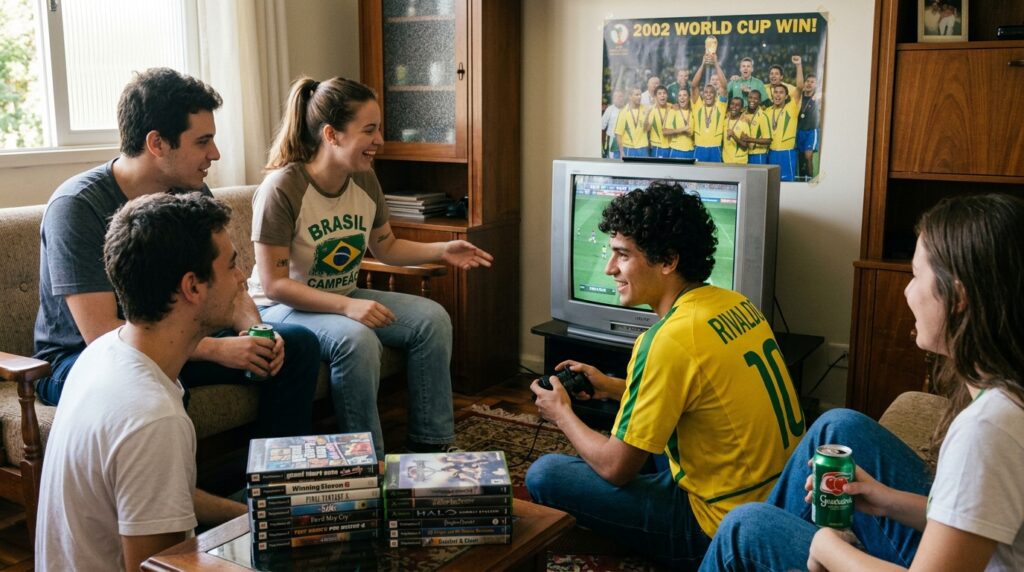
Brazil’s football identity gave sports games an enormous advantage. A football title did not need to explain its appeal; it inherited the country’s emotional structure. When Brazil won the World Cup in 2002, that energy spilled into gaming culture. People wanted to control the players they had just watched on television.
That is why Konami’s football series and FIFA remained so central. They were not just games; they were extensions of a national conversation. If you want a precise historical reading of the moment, you have to understand that the World Cup and the console market were reinforcing each other, not operating separately.
Game Core Genre Why It Broke Through in Brazil Pro Evolution Soccer 2 Football simulation Skill-based gameplay and strong local football culture FIFA 2002 Licensed football Official teams and broad casual appeal Grand Theft Auto III Open-world action Freedom, novelty, and PS2-era buzz Tekken 4 Fighting Social versus play and low-session friction Metal Gear Solid 2 Stealth action Cinematic prestige and mechanical depth Need for Speed: Hot Pursuit 2 Racing Immediate fun and accessible chase fantasy
What Made a Game a “Hit” in Brazil in 2002
Accessibility Beat Complexity in the Mass Market
A hit game had to be easy to enter. That does not mean it had to be shallow. It means the first five minutes had to communicate value fast. Racing, football, fighters, and action games did this better than niche genres because they offered immediate feedback: goals, laps, combos, or visible movement through space.
The pattern is consistent across the period. Players in shared environments needed games that worked with minimal setup. That is why shorter loops and local multiplayer often outperformed deep systems that required long tutorials. The best hits were the ones people could explain to a friend in one sentence.
Magazines and Word of Mouth Were the Recommendation Engine
Before social feeds and video platforms, discovery depended on magazines, store clerks, forums, and friends. A game became a hit when it circulated through those channels quickly enough to create anticipation before purchase or rental. That’s why imagery, screenshots, and demo impressions mattered so much. The game had to look worth the money before anyone booted it up.
Whoever worked in that environment knew the difference between hype and staying power. A flashy title could spike fast and disappear. A real hit kept showing up in conversations months later, because it had either competitive depth, replayability, or a memorable style hook. The titles on this list had at least one of those traits, often two.
There is One Important Limit to This Kind of List
No retrospective can be perfectly exhaustive. Brazil is a large market, and 2002 was a fragmented period in which region, income, and platform ownership changed what people played. A title that was huge in São Paulo could be less visible in smaller cities, and a PC favorite could matter more in internet cafés than in console households.
That nuance matters. Lists like this are best read as historically grounded reconstructions, not universal truth claims. They work well for identifying the center of gravity, but they should not be mistaken for a complete census of every player preference in the country.
Using This 2002 Game List as a Cultural Reference
For Writers and Researchers, the Right Lens is “ecosystem,” Not Nostalgia
If you are using 10 games that were a hit when Brazil won its last World Cup as a reference point, avoid treating it like a simple best-of ranking. The stronger approach is to read it as a snapshot of platform transition, football influence, and player access. That gives you a better map of the period than a nostalgia-driven list ever could.
From a research standpoint, the most useful entities are the PlayStation 2, Konami, EA Sports, Rockstar Games, Tecmo, Square, and the broader Brazilian retail and rental environment. Those names tell you how culture moved. The games themselves are only the visible surface.
For Marketers and Content Creators, the Lesson is About Timing and Context
Timing can turn a normal product into a cultural marker. In 2002, Brazil’s World Cup win created a national memory that gave certain games extra resonance, especially football titles. The lesson is not to copy the era; it is to understand how shared public events amplify adjacent media.
That effect still exists. Big sports moments, console launches, and franchise peaks continue to reinforce one another. The mechanism changes, but the principle does not: when people gather around a national or cultural milestone, they also gather around the entertainment that fits that moment.
For the historical record on Brazil’s 2002 championship, Britannica provides a concise overview: Britannica’s 2002 World Cup summary. For a broad archival frame on games journalism from the same era, IGN’s historical coverage remains useful context: IGN’s archive and legacy coverage.
How to Apply This Historical Snapshot Today
The most practical way to use this list is as a benchmark for cultural relevance. If you are building retro content, a documentary script, a classroom presentation, or a gaming history essay, start with the 2002 context first and the game titles second. That ordering keeps the analysis honest. Brazil’s last World Cup win was not just a sports event; it was a media moment that shaped what kinds of games felt central.
If you are comparing eras, test your claims against three filters: platform access, local genre preference, and media visibility. A game that passes all three probably belongs in the conversation. A game that fails two of them may still be excellent, but it was not a broad hit in the Brazilian market of that time.
Use the list as a historical lens, then validate it with archival sources, magazine scans, and contemporaneous coverage. That is the difference between a repeatable reference and a vague nostalgia piece.
FAQ
Was Brazil’s 2002 World Cup Win Directly Linked to Football Game Sales?
Yes, but the relationship was indirect rather than mechanical. Brazil’s victory increased football’s cultural presence, which made games like FIFA 2002 and Winning Eleven feel more relevant and socially sticky. The real driver was not the trophy alone; it was the combination of national celebration, console growth, and a football-obsessed audience already primed to play those titles.
Why Do People Often Mention Winning Eleven Instead of FIFA in Brazil?
Winning Eleven built a stronger reputation among players who cared about mechanics, ball control, and competitive matches. FIFA remained popular because of licenses and accessibility, but Konami’s series had a deeper grassroots status in many Brazilian gaming circles. The split is technical: FIFA sold the experience of football branding, while Winning Eleven sold the feel of football interaction.
Were These the Only Games People Played in Brazil in 2002?
No. They were the most culturally visible part of the market, not the entire market. PC strategy games, PC shooters, and older console libraries still mattered, especially in homes and internet cafés with different access patterns. Any honest historical reading has to accept that “hit” is a visibility claim, not a total consumption map.
Why is Grand Theft Auto III Included If It Was Not a Sports Game?
Because it represented a generational shift in what a blockbuster could be. GTA III introduced a 3D open-world structure that changed player expectations globally, including in Brazil. Its importance lies in design influence and cultural buzz, which were enough to make it a major hit even without football branding.
What is the Best Way to Verify Which Games Were Popular in Brazil at That Time?
Use multiple sources: archived game magazines, contemporaneous retail reporting, player communities, and publisher coverage. Official sales data is useful, but it rarely captures the full picture in a market shaped by rentals and informal distribution. The best historical answer usually comes from triangulating evidence rather than relying on one chart.
Editorial Notice
This content was structured with the assistance of Artificial Intelligence and subjected to rigorous curation, fact-checking, and final review by Editor-in-Chief Nivailton Santos. TechTool Judge reaffirms its unyielding commitment to journalistic ethics, ensuring that editorial judgment and data validation remain entirely under human responsibility and final editorial oversight.