ChatGPT Vs Google Gemini: Which AI Model is Winning in 2026?

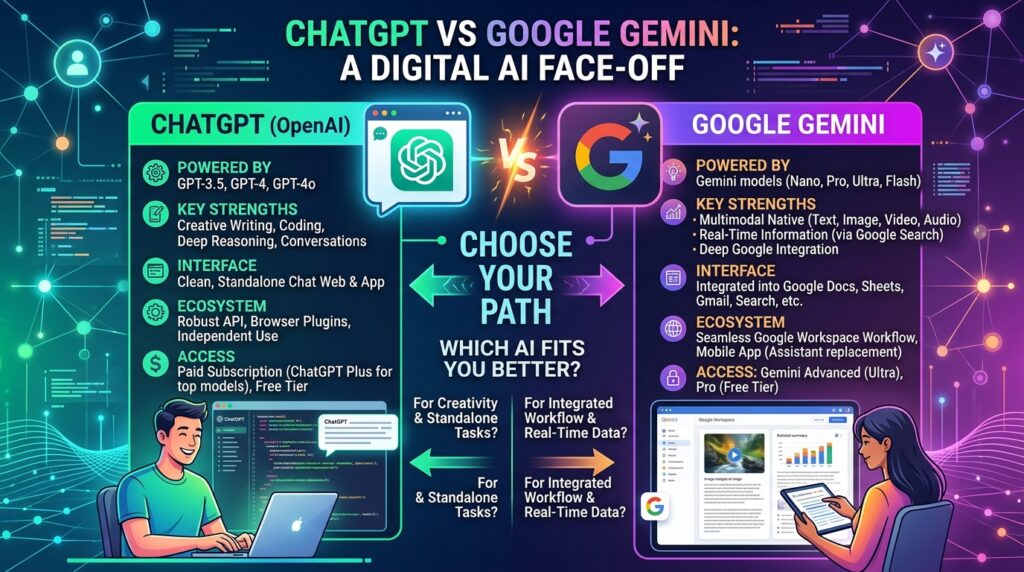
The real answer to ChatGPT vs Google Gemini: Which AI Model Is Winning in 2026? is not a single winner—it depends on whether you care more about reasoning, multimodal workflows, long-context analysis, or ecosystem fit. By 2026, both models have become capable enough that the gap shows up less in “raw IQ” and more in how each one handles everyday work: drafting, coding, research, spreadsheets, voice, images, and deeply connected apps.
If you are choosing one model for real use, that difference matters. ChatGPT still feels like the stronger general-purpose assistant for polished output and flexible workflows, while Gemini tends to shine when you live inside Google’s stack and need large-context processing with tight integration across Docs, Gmail, Drive, and Search-adjacent tasks. This article breaks down the comparison in practical terms so you can decide which one is winning for your use case, not just in a benchmark screenshot.
O Que Você Precisa Saber
- ChatGPT remains the better all-around choice for writing quality, tool orchestration, and consistent “first draft to final draft” workflows.
- Gemini is strongest when your work depends on Google Workspace, multimodal input, and very large context windows.
- Benchmarks matter, but they do not predict daily usefulness as well as latency, integrations, and error style.
- The winner in 2026 is different for creators, analysts, developers, and enterprise teams.
- If your workflow is already in Gmail, Docs, and Drive, Gemini’s advantage is real; if you want a broader assistant, ChatGPT still leads.
ChatGPT Vs Google Gemini in 2026: The Real Difference Behind the Headlines
Technically speaking, both are frontier large language models (LLMs): neural-network systems trained on large corpora to predict and generate text, code, images, and structured outputs. In plain English, they are both advanced reasoning engines with assistants layered on top. The practical difference is that ChatGPT has matured into a very strong generalist product, while Gemini has been designed to work more naturally across Google’s ecosystem and multimodal tasks.
That distinction sounds subtle until you use them side by side. ChatGPT often gives you cleaner prose, more predictable instruction-following, and a smoother “assistant” feel. Gemini often feels more native to work that starts in the browser, passes through Gmail or Drive, and ends in a document or presentation.
In 2026, the best AI model is not the one with the flashiest benchmark win; it is the one that reduces friction in your actual workflow.
What “winning” Really Means
For a solo user, winning may mean better answers and fewer edits. For a team, it may mean faster adoption, lower switching costs, and stronger integration. For developers, it may mean better tool use, code generation, and fewer broken outputs. That is why the question is commercial, not purely technical: the right model is the one that pays back its cost in saved time.
Why Benchmarks Only Tell Part of the Story
Benchmarks can show progress in reasoning, coding, or multimodal understanding, but they rarely capture the messy reality of daily work. A model can score well and still annoy users by hallucinating citations, missing instruction hierarchy, or handling uploads poorly. That is why you should read benchmark news alongside usage reports and product docs, such as OpenAI’s product and model documentation and Google’s Gemini announcements.
Where ChatGPT Still Has the Edge
If your day includes writing, editing, coding assistance, or turning rough ideas into something usable, ChatGPT still has the clearest advantage. It tends to produce more coherent first-pass copy, cleaner summaries, and better conversational continuity over multi-step tasks. That matters when you are moving from “I have an idea” to “I need something publishable.”
Strongest Use Cases for ChatGPT
- Long-form writing and editing with a consistent tone.
- Code explanation, debugging support, and iterative prompts.
- Tool-based workflows that mix text, files, and structured outputs.
- Brainstorming where you want a model that keeps momentum across several turns.
Who works with AI every day knows the pattern: the model that saves you the most time is often the one that makes fewer weird choices in the middle of the task. ChatGPT is still better at staying on rails. It is not perfect—source citation can still be shaky, and highly technical tasks can require verification—but its failure modes are usually easier to catch.
ChatGPT’s biggest advantage in 2026 is not one single feature; it is the consistency of its output across messy, multi-step work.
Here is a concrete example. A content strategist might ask for a comparison matrix, a SEO outline, then three ad variations, then a revision to match brand voice. In practice, ChatGPT usually keeps the thread together more reliably than most competitors, including Gemini, especially when the work moves from ideation to production.
Where Google Gemini Pulls Ahead
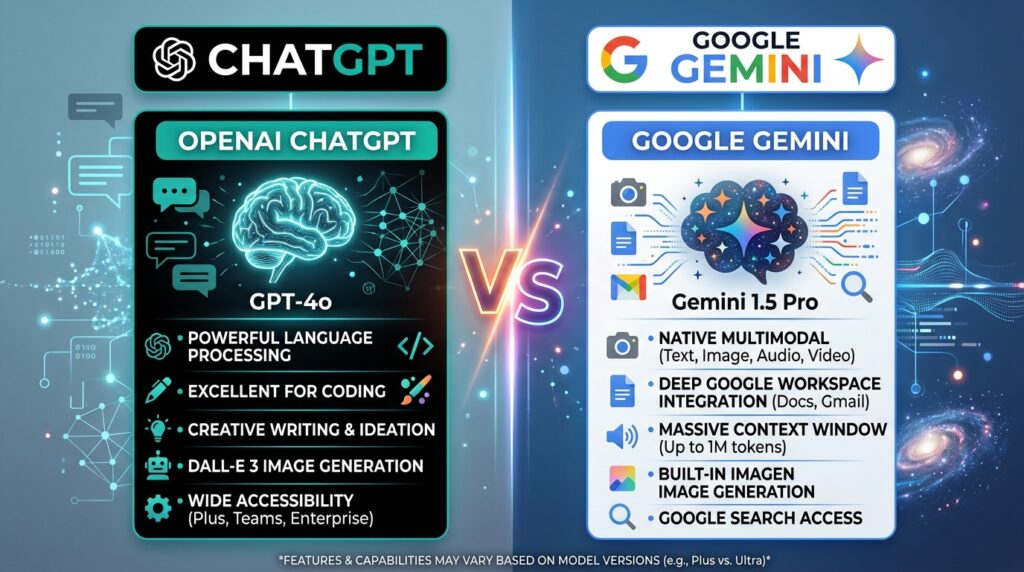
Gemini’s best argument is not that it beats ChatGPT at everything. It is that it performs extremely well in the workflows Google users already have. If your documents live in Drive, your meetings happen in Meet, your messages sit in Gmail, and your research starts in Search, Gemini can feel more embedded in the job instead of bolted on.
Why Google Workspace Users Notice the Difference
Gemini is strongest when it can help inside the tools you already use. That includes summarizing long email threads, working with document context, and handling broad background material without forcing you to chop it into tiny prompts. For enterprises already standardized on Google Workspace, this is a serious adoption advantage.
Its Technical Sweet Spot
Gemini has also been notable for large-context processing and multimodal input. When you need to analyze long documents, mixed media, or a large batch of internal material, that broader context can matter more than a slightly prettier paragraph. The tradeoff is that the output can feel less polished on the first pass, so you may need one more round of editing.
For independent validation of model safety and evaluation direction, it is worth looking at outside sources such as Stanford’s AI Index and, when relevant, benchmark discussions from research groups and universities. Those sources will not tell you which assistant feels better in daily use, but they do help separate product marketing from broader AI trends.
Benchmarks, Context Windows, and Multimodal Workflows
By 2026, the comparison has moved well beyond “which one writes better.” The more useful criteria are context window, multimodal capability, latency, and tool use. Context window means how much text, code, or mixed input a model can consider at once. Multimodal capability means it can process more than text, such as images, screenshots, audio, or documents.
The Criteria That Actually Change Outcomes
Criterion Why It Matters Who Benefits Most Context window Lets the model work with larger documents or longer threads Researchers, analysts, legal teams Multimodal input Allows images, screenshots, and mixed media analysis Designers, marketers, support teams Tool use Lets the model act across apps and structured workflows Operators, developers, knowledge workers Latency Determines how fast the model feels in real time Everyone, especially frequent users
Here is the nuance: a huge context window is valuable only if the model uses it well. A model can accept more input than its competitor and still perform worse on synthesis, prioritization, or exact instruction following. That is why some specialists prefer a smaller but more disciplined assistant for final output.
The difference between a useful AI assistant and a frustrating one appears when the task is long, mixed, and slightly ambiguous.
Which Model Wins for Different Users in 2026
This is where the answer becomes practical. If you are a writer, marketer, founder, or general knowledge worker, ChatGPT usually wins because it delivers more polished output with less prompting. If you are deep in Google Workspace or handling large volumes of mixed-source material, Gemini can be the smarter pick. Neither model is universally better for every job.
Best Choice by Use Case
- Writers and editors: ChatGPT.
- Google Workspace teams: Gemini.
- Developers iterating on code: ChatGPT, with Gemini close behind for specific workflows.
- Analysts handling long documents: Gemini often has the edge.
- Everyday users wanting the most balanced assistant: ChatGPT.
One limit worth admitting: no model is the best choice if your organization has weak review habits. If people copy AI output into customer-facing work without checking facts, both systems will fail you. The safer workflow is model plus verification, not model alone. That is where human judgment still matters more than the brand name on the interface.
How to Make a Decision Without Wasting Time
Run both systems on the same three tasks: a writing task, a research task, and a workflow task tied to your actual tools. Score them on output quality, time to final version, and number of corrections required. That simple test usually reveals the winner faster than reading ten comparison posts.
Bottom Line: The Winner Depends on the Job, but ChatGPT Leads Overall
If you want one answer, here it is: ChatGPT is still the overall winner in 2026 for most individuals because it remains stronger as a general-purpose assistant. Gemini is the better specialist for Google-native workflows and broad-context processing, and that makes it a serious contender in teams that already live in Workspace. The market is no longer about novelty; it is about fit.
So the right move is not to chase the loudest claim. Test both on your real workflow, then pick the one that saves the most time with the fewest corrections. If your work is writing-heavy or mixed across many tasks, start with ChatGPT. If your work revolves around Gmail, Docs, Drive, and long internal material, start with Gemini.
FAQ
Is ChatGPT Better Than Google Gemini for Everyday Use in 2026?
For most people, yes. ChatGPT tends to feel more polished, more reliable in long conversations, and better at turning rough instructions into usable output. That said, Gemini can be the better choice if your daily work is deeply tied to Google Workspace or large document analysis. The “better” model depends on where you spend your time and what kind of mistakes you can tolerate.
Which Model is Better for Writing and Content Creation?
ChatGPT usually wins for writing because it produces cleaner prose, stronger structure, and a more consistent tone. It is often faster to move from outline to draft to final edit. Gemini can still help with ideation and summarization, but many writers prefer ChatGPT when the final output needs to sound natural and deliberate. If content quality is the main goal, ChatGPT is the safer first pick.
Does Gemini Have an Advantage in Long-context Tasks?
Yes, Gemini has often been favored for tasks that involve very large inputs, such as long reports, document sets, or mixed media. That does not mean it always produces better answers, but it does make the model attractive for research-heavy or enterprise workflows. The catch is that a larger context window is only useful if the model synthesizes the material well. In practice, users still need to verify conclusions.
Which AI Model is Better for Business Teams?
Business teams should choose based on workflow alignment, not brand popularity. If the team works inside Google Workspace, Gemini can reduce friction and speed up adoption. If the team needs broad writing help, brainstorming, and general task support, ChatGPT is usually the stronger default. The best decision comes from testing both on internal documents, email drafts, and repeated recurring tasks.
Will One Model Clearly Dominate the Other in 2026?
Probably not in a universal sense. The market is moving toward specialization, where different models win in different environments rather than one model crushing all others. ChatGPT appears stronger as a broad assistant, while Gemini looks especially competitive in Google-centered workflows. For users, the winning strategy is to match the model to the task instead of assuming one tool will dominate every category.
Editorial Notice
This content was structured with the assistance of Artificial Intelligence and subjected to rigorous curation, fact-checking, and final review by Editor-in-Chief Nivailton Santos. TechTool Judge reaffirms its unyielding commitment to journalistic ethics, ensuring that editorial judgment and data validation remain entirely under human responsibility and final editorial oversight.