
How AI agents Will Remake Work, Search, and Daily Life by 2026, The Biggest Technology Shift and What Businesses, Consumers, and Policymakers Must Do

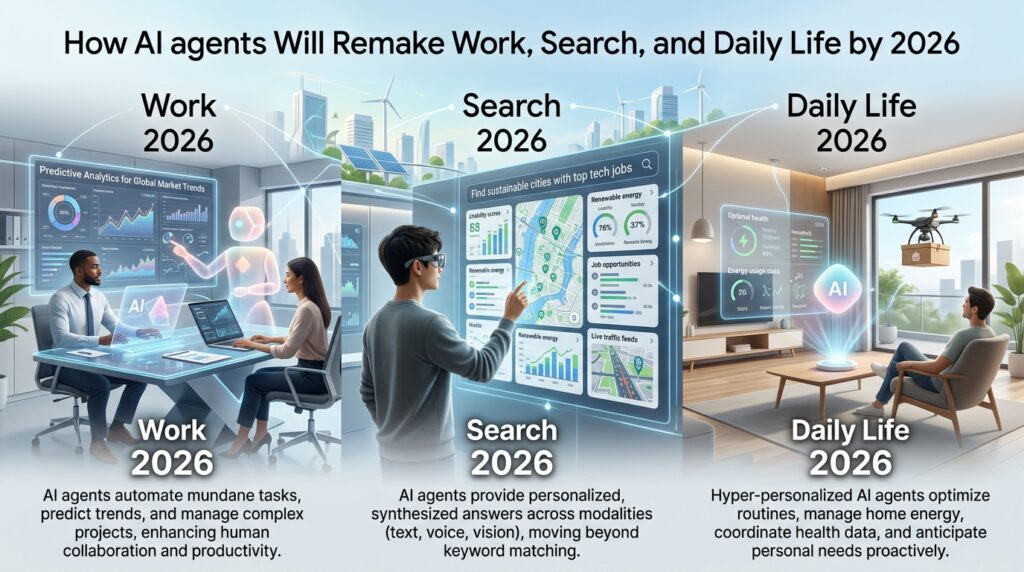
By 2026, AI agents will move from assistants to autonomous collaborators, reshaping jobs, products, and online discovery, creating winners and urgent risks to manage
Adoption of AI agents is accelerating, and the technology is starting to act with more autonomy, completing tasks without step by step human prompts.
That shift is changing how companies design software, how people search for information, and how some jobs are organized, while raising new questions about safety and oversight.
The next sections break down what this change means for work, search, consumers, and policy, and suggest practical steps for organizations and individuals to prepare,
According to AI Agents Are Taking Over: The Biggest Technology Shift of 2026.
What exactly are AI agents doing now
AI agents are software programs that can act on behalf of users, chaining together actions, calling tools, and adapting to feedback, instead of only replying to single prompts.
Today, they can manage calendars, draft messages, summarize documents, and automate routine workflows, and their capabilities are improving rapidly, with many systems integrating multimodal inputs and third party plugins.
Why this is considered the biggest tech shift of 2026
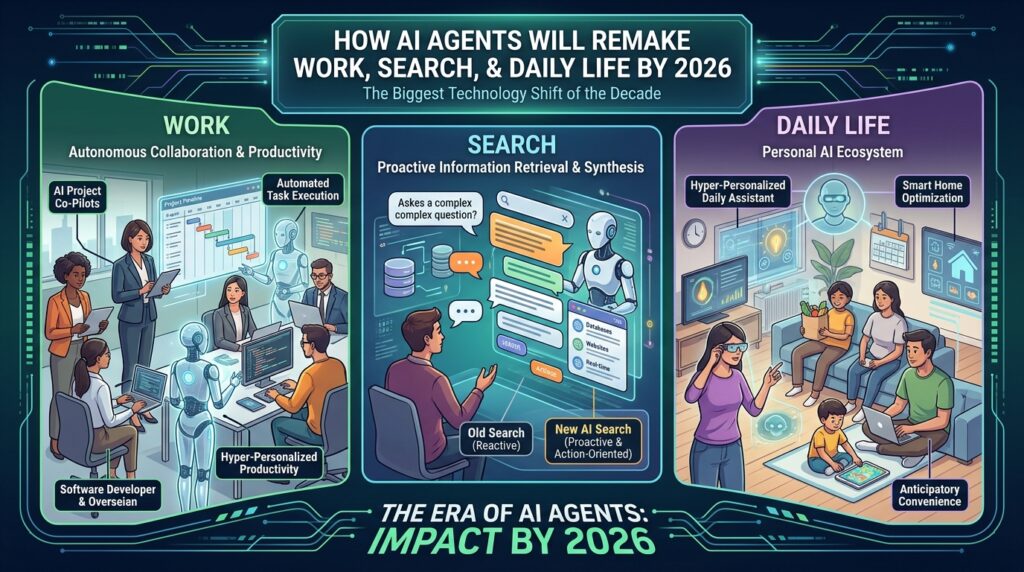
The key change is autonomy, not just intelligence, because AI agents can take initiative across apps and services, reducing friction and multiplying productivity gains for users and businesses.
That autonomy turns individual features into programmable, persistent assistants, which can alter how people find information, how teams coordinate, and how products deliver value, often without visible UI changes.
Economic and workplace impact
For workers, AI agents will shift the balance from repetitive tasks to oversight, strategy, and exception handling, creating demand for new skills and supervision roles.
Businesses that move quickly can embed agents into customer service, sales automation, and internal tools, achieving cost reductions and faster response times, while laggards risk falling behind.
At the same time, the transition poses disruption risks, including job displacement in some roles, and uneven benefits across sectors and regions.
Search, software, and consumer experience
Search is changing because AI agents can act as intermediaries, querying multiple services, synthesizing answers, and completing transactions, which challenges current ad and ranking models.
Software will adapt around agent APIs and connectors, with products exposing capabilities rather than screens, and consumers will expect more proactive, personalized digital helpers.
Risks, governance, and practical steps
Greater autonomy brings new risks, such as unwanted actions, privacy exposures, and misuse, so companies must invest in guardrails, transparency, and robust testing for AI agents.
Policymakers, organizations, and users should demand clear accountability, standardized safety checks, and privacy-preserving data practices, to ensure agents are reliable and controllable.
Practically, leaders should inventory repetitive processes that agents can augment, retrain staff to supervise agents, and adopt monitoring to detect errors early.
What to watch next
Expect fast iteration in agent capabilities, broader integrations across enterprise software, and early regulatory guidance focusing on safety and consumer protection.
Adapting to AI agents means embracing change, investing in human oversight, and prioritizing user trust, so businesses and individuals can capture benefits while managing the risks.
Editorial Notice
This content was structured with the assistance of Artificial Intelligence and subjected to rigorous curation, fact-checking, and final review by Editor-in-Chief Nivailton Santos. TechTool Judge reaffirms its unyielding commitment to journalistic ethics, ensuring that editorial judgment and data validation remain entirely under human responsibility and final editorial oversight.