The Future of Software Development with AI-Native Platforms: What Changes First

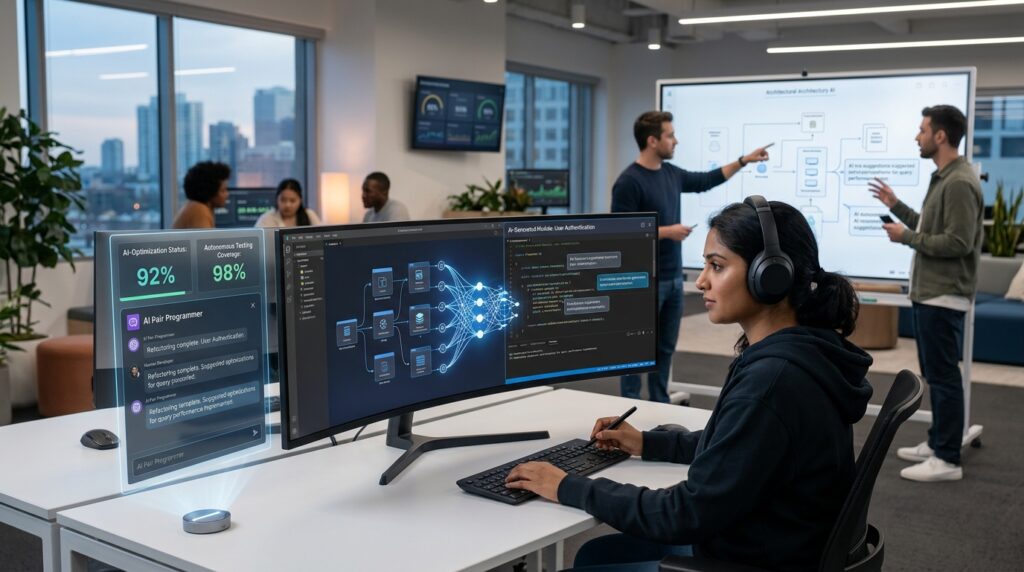
The Future of Software Development with AI-Native Platforms is a shift from using AI as an auxiliary tool to building software platforms where AI is native to the architecture, workflow, and delivery model. In technical terms, an AI-native platform treats foundation models, orchestration layers, retrieval systems, evaluation pipelines, and human oversight as core product components rather than add-ons. In plain language: software is no longer just written with AI support; the platform itself is designed so AI can generate, test, adapt, and operate large parts of the development lifecycle.
This matters now because the bottleneck in software has changed. The limiting factor is no longer only typing speed or framework familiarity. It is coordination, integration, quality control, and the ability to ship reliable systems faster than requirements change. Teams using AI-native platforms can compress prototyping cycles, reduce repetitive implementation work, and surface defects earlier, but only if they redesign process, governance, and architecture together.
Who works with this daily knows the pattern: the organizations that win are not the ones asking a model to “write more code,” but the ones building disciplined systems around code generation, test generation, traceability, and policy enforcement. That is where the real competitive advantage sits.
Key Takeaways
- AI-native platforms change software development from a linear coding process into a continuous system of generation, verification, and feedback.
- The biggest gains come from workflow redesign, not from isolated copilots or one-off prompt usage.
- Engineering teams still need strong architecture, evaluation, and governance because model output is probabilistic, not authoritative.
- Platform teams will matter more, not less, because they must standardize model access, observability, security, and release controls.
- The near-term winners will be organizations that combine AI orchestration with human review, domain constraints, and automated testing.
The Future of Software Development with AI-Native Platforms: What Changes First

From Code Assistance to Platform Intelligence
The most important technical distinction is between AI-assisted development and AI-native development. AI-assisted tools help an engineer inside an existing workflow. AI-native platforms embed model inference, context retrieval, and execution policies into the platform itself. That means the platform can infer intent from tickets, repositories, logs, and product rules, then generate code, tests, and deployment actions with traceable constraints.
GitHub Copilot popularized the idea of AI as a coding companion, but AI-native platforms go further. They connect source control, CI/CD, observability, security scanning, and knowledge retrieval into one loop. The result is not just faster typing; it is shorter feedback cycles. A good platform can produce a feature branch, run unit and integration tests, check policy boundaries, and ask for human approval only where uncertainty is high.
Why Architecture Must Become Model-aware
Traditional software architecture assumed deterministic code paths and relatively stable service contracts. AI-native systems introduce probabilistic behavior, context windows, and model drift. That changes the design of APIs, state management, and testing. For example, a retrieval-augmented generation layer must control what documents enter the prompt, which vector database stores embeddings, and how the system handles stale or conflicting context.
In practice, the architecture has to be model-aware. Teams need guardrails for prompt injection, structured outputs, and fallback behavior when model confidence drops. This is where platforms such as OpenAI, Anthropic, and Azure AI Studio fit into enterprise stacks: they are not just endpoints for text generation, but parts of a broader orchestration model that includes policy, monitoring, and evaluation.
The Business Implication is Cycle-time Compression
The main payoff is not a vague promise of “productivity.” It is compressed cycle time across the entire delivery pipeline. Requirements become executable faster. Prototypes become testable earlier. Regression analysis becomes more automated. On high-velocity teams, that matters more than raw code volume because product advantage often depends on how quickly a company can validate or discard an idea.
That said, not every team will see the same gains. Mature products with heavy legacy constraints, brittle dependencies, or regulatory controls will benefit less from pure generation and more from AI-supported analysis, documentation, and migration planning. The technology helps, but the organizational context sets the ceiling.
How AI-Native Platforms Reshape the Software Lifecycle
Discovery, Specification, and Planning Become Machine-readable
Software development has historically suffered from a gap between product language and engineering language. AI-native platforms narrow that gap by turning user stories, acceptance criteria, and architecture notes into structured artifacts that models can consume. A well-designed platform can ingest a Jira ticket, map it to domain entities, and suggest implementation paths that respect existing services and schemas.
This does not eliminate product judgment. It changes where judgment is applied. Product managers and engineers spend less time translating vague requirements into code-ready steps and more time validating edge cases, priorities, and tradeoffs. When the system is disciplined, the specification itself becomes part of the execution pipeline rather than a static document that drifts out of date.
Implementation Shifts Toward Generation Plus Verification
The old model asked engineers to write every line. The new model asks them to supervise generation, then verify behavior with tests, static analysis, and runtime checks. That is a more scalable use of human attention. A developer reviewing AI-generated code should look for architectural fit, hidden state, error handling, and dependency risk rather than line-by-line syntax alone.
Who has done this at scale knows the tradeoff: generation accelerates routine work, but it can also produce plausible-looking mistakes. That is why test coverage, contract tests, property-based testing, and code review remain central. The best AI-native platforms do not replace these controls; they amplify them.
Deployment and Operations Become Feedback-rich
Once software reaches production, AI-native platforms can connect telemetry, incident data, and user behavior back into the development loop. Observability tools such as Datadog and OpenTelemetry become more valuable when paired with models that can summarize anomalies, cluster failures, and suggest likely causes. A release is no longer the end of the workflow. It is another source of structured learning.
That feedback loop is where the future gets practical. If a feature triggers a spike in latency or support tickets, the platform can surface the relevant commits, trace spans, and recent prompt changes. The development process becomes more adaptive, but only if teams invest in data quality and instrumentation. Bad telemetry leads to bad recommendations.
Lifecycle Stage Traditional Workflow AI-Native Workflow Planning Manual tickets and static specs Structured requirements, model-readable context, and automated refinement Implementation Human-written code from scratch Generated code with human review and policy controls Testing Mostly manual test authoring Test generation, regression targeting, and automated evaluation Operations Reactive monitoring and incident response Telemetry-driven feedback, anomaly summarization, and continuous improvement
The Technical Stack Behind AI-Native Development
Foundation Models Are Only One Layer
A common mistake is to equate AI-native development with the model alone. The model is important, but it is not the platform. The real stack includes a foundation model, a retrieval layer, prompt management, an agent orchestration framework, evaluation tooling, and governance controls. If any of those pieces are missing, the system becomes fragile.
For enterprise teams, this is where products like LangChain, LlamaIndex, and Azure AI Studio enter the picture. They help connect documents, APIs, and model calls into workflows that can be tested and monitored. The technical challenge is to make every output traceable back to source data, prompt version, and execution path. Without that, debugging becomes guesswork.
Retrieval-augmented Generation and Vector Search Matter a Lot
RAG, or retrieval-augmented generation, is a method that gives a model access to external knowledge at runtime. Instead of relying only on pretraining, the system retrieves relevant documents from a knowledge base, often indexed in a vector database, and uses them to ground the response. This reduces hallucination risk and improves relevance for proprietary codebases and internal documentation.
In software development, RAG is especially useful for code search, architecture guidance, incident response, and API documentation. But it has limits. If the source material is stale, incomplete, or badly chunked, the output will degrade. The method works well when knowledge is curated and constrained; it fails when teams treat the retrieval layer as a dumping ground.
Evaluation, Observability, and Policy Are Now Core Engineering Work
AI systems need evaluation pipelines the way distributed systems need monitoring. Teams should measure factual accuracy, task success, latency, token cost, safety violations, and regression against prior versions. This is not a theoretical concern. Small prompt changes can alter behavior in ways that code review alone will miss.
Policy control is equally important. Enterprises need guardrails for sensitive data, role-based access, and model usage boundaries. The National Institute of Standards and Technology has pushed this conversation forward with its AI Risk Management Framework, which is a useful reference for governance design: NIST AI Risk Management Framework. For teams building serious production systems, compliance and evaluation are not afterthoughts; they are part of the engineering surface.
Where the Real Gains Appear — And Where the Hype Breaks Down
High-value Use Cases Are More Specific Than Most Vendors Claim
The best early use cases are not “AI writes the whole app.” They are narrower and more valuable: scaffolding services, generating repetitive CRUD layers, creating unit tests, summarizing pull requests, explaining legacy code, and converting requirements into draft implementations. These are tasks with high repetition and clear success criteria, which makes them a good fit for model assistance.
In legacy modernization, AI-native platforms can also accelerate code translation and documentation. That is useful in organizations with COBOL, Java monoliths, or sprawling internal tools. The gain comes from reducing analysis overhead and exposing hidden dependencies, not from blindly replacing experienced engineers.
Security, Compliance, and IP Risks Are Real
There is a reason some teams stay cautious. AI-generated code can introduce licensing ambiguity, insecure patterns, or subtle vulnerabilities if the review process is weak. Data leakage is another concern, especially when proprietary source code or regulated information enters third-party model services. In financial services, healthcare, and public-sector systems, those risks can outweigh the convenience of rapid generation.
That is why responsible adoption requires more than usage policy. Teams need secrets management, scoped permissions, audit trails, and model-specific controls for data handling. OWASP has published useful guidance for AI security, including prompt injection and model abuse patterns: OWASP Top 10 for Large Language Model Applications. Those risks are not hypothetical. They show up when platforms are deployed faster than controls mature.
The Human Role Becomes More Selective, Not Smaller
AI-native platforms do not eliminate engineering judgment. They concentrate it. Humans spend less time on repetitive construction and more time on design, review, data modeling, and exception handling. That changes team composition as well. Product engineers, platform engineers, and ML-minded architects become more valuable because they can connect software goals with model behavior.
There is disagreement among specialists about how far this shift will go. Some argue that agentic coding systems will eventually automate most routine development. Others believe the limits of context, verification, and accountability will preserve a large human role. The conservative view is more credible today: AI will take over a larger share of implementation tasks, but ownership of architecture, correctness, and risk will remain human.
How Engineering Teams Should Prepare for the Next Platform Shift
Redesign the Workflow Before Buying the Tool
The wrong approach is to purchase an AI product and hope adoption follows. The better approach is to map where time is lost in the current workflow. Look at specification churn, code review delays, test bottlenecks, incident resolution, and knowledge lookup. Those are the leverage points where AI-native platforms deliver measurable value.
A practical rollout starts with one bounded domain, not the entire company codebase. Pick a service with good test coverage, clear ownership, and repeated work. Instrument it, set evaluation criteria, and compare cycle time, defect rate, and review load before and after adoption. That creates evidence instead of hype.
Build Platform Governance Into the Engineering Backlog
Governance should not sit in a policy document that nobody reads. It needs to be in the backlog as real engineering work: prompt versioning, approval workflows, secret redaction, evaluation thresholds, and rollback procedures. Platform teams should own the shared primitives so product teams can move quickly without reinventing controls every time.
Public guidance from CISA’s AI security resources is useful here because it frames AI as an operational risk surface, not just a productivity tool. That framing matters. When a model touches production systems, governance becomes part of system reliability.
Invest in Literacy Across the Whole Delivery Chain
Engineers need more than prompt skills. They need to understand embeddings, token limits, structured outputs, eval sets, and failure modes such as hallucination and prompt injection. Product managers need to understand where AI can shorten discovery and where it will distort requirements. Leaders need to know how to measure gains without confusing activity with value.
The organizations that prepare best will treat AI literacy as a shared capability. Not every team member needs to build models, but everyone involved in delivery should know how model behavior affects quality, risk, and release decisions. That is the difference between experimentation and capability.
The next generation of software platforms will not be judged by how many prompts they support, but by how reliably they convert intent into safe, testable, production-grade behavior.
Próximos Passos Para Implementação
Teams that want to move forward should start by classifying their work into three buckets: repetitive, judgment-heavy, and regulated. Repetitive tasks are the best candidates for AI-native automation. Judgment-heavy work benefits from AI support but still needs strong human review. Regulated work requires the most conservative controls and the clearest audit trail. That segmentation prevents overreach and keeps adoption grounded in reality.
From there, define the platform capabilities that matter most: retrieval quality, test generation, observability, access control, and eval automation. Measure each one. If a model saves time but increases defect rates, the net value may be negative. If it speeds up prototyping but weakens compliance, the adoption strategy needs revision. The future belongs to teams that treat AI-native development as an engineering discipline, not a demo.
One reason this shift will endure is that it aligns with how modern systems are already evolving: more APIs, more data, more telemetry, and more automation. The winning organizations will not chase AI everywhere. They will place it where the platform can enforce standards, shorten feedback loops, and keep humans focused on the decisions that still matter most.
FAQ
What Exactly is an AI-native Software Platform?
An AI-native platform is a development environment where AI is built into the architecture, not added as a separate assistant. It typically includes a foundation model, retrieval layer, orchestration logic, evaluation tools, and governance controls. The main difference from conventional tools is that AI participates in planning, coding, testing, and operations as part of the system’s core workflow.
How is AI-native Development Different from Using Copilot-style Coding Tools?
Copilot-style tools help individual developers write code faster inside an existing process. AI-native development changes the process itself by connecting models to requirements, repositories, tests, deployments, and telemetry. That creates a closed loop where the platform can generate work, verify it, and learn from production feedback.
What Are the Biggest Technical Risks of Adopting AI-native Platforms?
The main risks are hallucinated output, prompt injection, data leakage, insecure code generation, and poor evaluation. These issues become more serious when teams skip guardrails or use models without traceability. Strong testing, scoped permissions, and source-grounded retrieval reduce the risk, but they do not remove it entirely.
Where Do AI-native Platforms Deliver the Most Value First?
They tend to deliver the fastest returns in repetitive engineering work: scaffolding services, generating test cases, summarizing code changes, documenting legacy systems, and accelerating internal knowledge lookup. Teams with clear standards and high volumes of routine tasks usually see the strongest gains. Highly regulated or poorly instrumented environments need a slower rollout.
Will AI-native Platforms Replace Software Engineers?
Not in the near term. They will change the balance of work by automating more routine implementation and increasing the importance of architecture, review, and system design. Engineers who understand how to control model behavior, evaluate outputs, and integrate AI into delivery pipelines will become more valuable, not less.
Editorial Notice
This content was structured with the assistance of Artificial Intelligence and subjected to rigorous curation, fact-checking, and final review by Editor-in-Chief Nivailton Santos. TechTool Judge reaffirms its unyielding commitment to journalistic ethics, ensuring that editorial judgment and data validation remain entirely under human responsibility and final editorial oversight.