
Humanoid Robots Are Becoming a Reality Faster Than Expected: Why the Field Just Crossed a Threshold

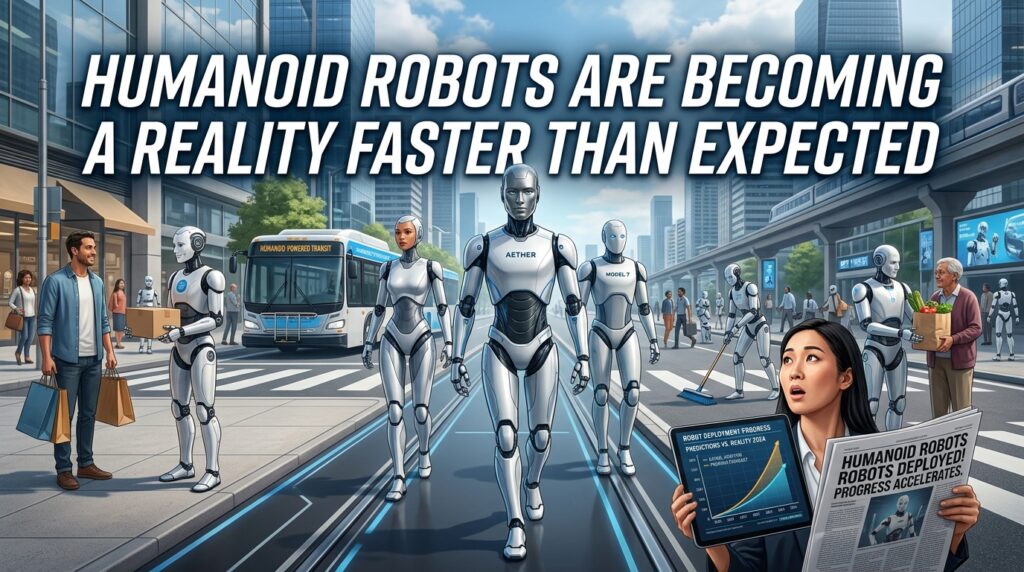
Humanoid robots are embodied machines built with a human-like form factor, usually featuring a torso, head, arms, hands, legs, sensors, and software that lets them perceive, balance, manipulate objects, and operate in spaces designed for people. The technical goal is not “to look human” for its own sake; it is to match the geometry, tools, and workflows of human environments so the robot can work where infrastructure already exists. That is why humanoid robots are becoming a reality faster than expected: the bottleneck has shifted from proving the concept to engineering systems that can survive real-world motion, power, and task demands.
This matters now because three curves are moving at the same time: foundation models are improving robot perception and planning, battery and actuator systems are becoming more capable, and venture-backed manufacturers are pushing hardware into pilot deployments instead of lab demos. In practice, what happens is that a robot no longer needs a fully custom factory or warehouse to be useful; it needs reliable navigation, grasping, and safety controls. That is a major commercial difference, and it changes how fast companies can justify deployment.
We are also seeing a shift in expectations. A few years ago, most serious teams treated general-purpose humanoids as a long-horizon research problem. Today, the conversation is about task reliability, service intervals, fleet management, and integration with existing operations. That does not mean mass adoption is around the corner. It does mean the field has crossed an inflection point where prototypes are no longer the main story; execution is.
Pontos-Chave
- The core advantage of a humanoid robot is compatibility with human-built environments, not imitation of human appearance.
- Recent progress comes from the convergence of AI perception, dexterous manipulation, improved actuators, and better energy storage.
- Most deployments will start with constrained tasks in warehouses, manufacturing, inspection, and logistics before moving into broader service roles.
- Safety certification, uptime, and total cost of ownership will decide winners more than viral demos or raw speed alone.
- The near-term market is likely to favor robots that are task-capable and serviceable, even if they are not fully autonomous in every scenario.
Humanoid Robots Are Becoming a Reality Faster Than Expected: Why the Field Just Crossed a Threshold
What “humanoid” Means in Engineering Terms
In robotics, a humanoid is a mobile manipulator with a body layout that approximates human dimensions and joint ranges. That includes bipedal locomotion, upper-body manipulation, onboard sensing, and control software that can coordinate all of it in real time. The technical payoff is clear: a humanoid can use stairs, ladders, doors, carts, shelves, tools, and workstations that were designed around the human body.
The common mistake is to think humanoids must duplicate human motion exactly. They do not. A useful humanoid only needs enough anthropomorphic structure to solve task access problems. If a robot can walk through a narrow aisle, reach a high shelf, grasp a standard handle, and carry a box safely, it has already earned its place in many operations. That is why the category has moved from science-fiction imagery to systems engineering.
The Real Inflection Point: Software, Not Just Hardware
For years, hardware lagged behind ambition. Legs were unstable, hands were fragile, and autonomy failed outside carefully prepared demos. What changed is that modern robot stacks now borrow from large-scale machine learning, simulation, and sensor fusion. Teams can train policies in simulation, adapt them with real-world data, and use vision-language models to improve task interpretation and recovery from edge cases.
That shift matters because the hardest part of robotics is often not one spectacular movement; it is consistency. A robot that can pick up a package 99 times and fail unpredictably on the 100th is still expensive theater. The systems getting attention now are the ones that improve recovery behavior, detect uncertainty, and degrade safely rather than catastrophically.
Why the Pace Looks Faster Now Than Even Optimistic Forecasts

There are several reasons the timeline compressed. Battery density and power electronics continue to improve. Actuator suppliers have become more specialized. Simulation tools have reduced iteration cycles. And investors, especially in industrial automation, are funding real production pathways instead of one-off prototypes. When those pieces align, progress compounds.
There is also a demand-side reason. Warehousing, manufacturing, and logistics still face labor shortages, rising wage pressure, and high turnover in repetitive roles. That does not mean robots replace people wholesale. It means firms are increasingly willing to buy partial autonomy if it improves throughput, safety, or shift coverage. NIST has long emphasized measurement, reliability, and standards as prerequisites for deploying advanced systems, and humanoid robots are now entering exactly that phase.
What’s Driving the Breakthrough: AI, Actuators, Sensors, and Power Systems
Foundation Models Are Improving Task Understanding
The biggest software change is that robots can now use richer representations of the world. Instead of hard-coding every condition, engineers can connect perception pipelines to models that infer intent, recognize objects, and reason about sequences of actions. In a warehouse context, that may mean understanding the difference between a pallet, a bin, a shrink-wrapped load, and an obstructed path without custom rules for every variant.
This does not create magic autonomy. A model can still misread clutter, lighting changes, reflective surfaces, or unfamiliar object geometry. But it reduces the amount of brittle hand-engineering needed for each task. That is why labs and startups are combining classical control with learned planning rather than replacing one with the other.
Hands, Wrists, and Force Control Finally Matter as Much as Locomotion
Early humanoid systems obsessed over walking. That was necessary, but it was never sufficient. A commercially useful robot must also manipulate objects with acceptable force control, tactile feedback, and wrist dexterity. If it can move but not load a crate, open a latch, or position a part accurately, its labor value stays narrow.
Who works with this knows the failure modes: a grasp that slips because the object surface changed, a wrist that saturates under torque, a hand that overheats after repeated cycles. These are not glamorous problems, but they decide whether a pilot becomes a product. The companies that solve manipulation reliability will usually outperform those that only show impressive walking sequences.
Power Density and Thermal Management Set the Ceiling
Battery systems are still a major constraint. A humanoid can have great motion control and still be operationally weak if it needs constant recharging or frequent cooling breaks. Energy density, thermal dissipation, and duty-cycle planning define whether the robot can complete a shift, cover a route, or hold a useful schedule.
That is why comparisons should include not just speed or payload, but also runtime, swap time, recharge strategy, and mean time between failures. This is where the economics become real. A robot that performs impressively for fifteen minutes is a demo. A robot that survives repeated shifts with manageable maintenance is a business asset.
Capability Why It Matters Common Failure Mode Locomotion stability Enables movement through human infrastructure Falls on uneven flooring, thresholds, or clutter Dexterous manipulation Lets the robot perform useful work, not just move Slippage, poor force control, weak grasp recovery Perception Supports object recognition and obstacle avoidance Lighting sensitivity, occlusion, reflective surfaces Energy system Determines duty cycle and deployability Short runtime, overheating, long recharge intervals
Where Humanoid Robots Will Be Deployed First, and Why Those Sites Make Sense
Warehouses and Logistics Are the Most Natural Early Market
Warehouses already contain structured aisles, repeatable workflows, and measurable productivity metrics. They also contain a lot of human-shaped infrastructure: carts, racks, bins, conveyor interfaces, and loading areas. That makes them ideal for early humanoid deployments because the robot does not need a perfect world; it needs a controlled one with a finite set of tasks.
The first jobs will likely be the unglamorous ones: tote handling, staging, replenishment, simple picking, and material movement between stations. That is not a weakness. It is the correct sequencing for technology that is still climbing the reliability curve. Every hour spent on these tasks produces data on grasp quality, navigation, and exception handling.
Manufacturing Plants Want Flexibility More Than Novelty
Factories are already automated in many areas, but they still rely on people for changeovers, inspection support, part handling, and non-standard work. A humanoid robot fits there because production environments change more often than fixed automation can handle. Reprogramming a robot arm on a fixed cell is costly; sending a mobile robot to perform a sequence of adaptable tasks can be cheaper when product variety is high.
That said, manufacturing deployments have a narrow tolerance for error. A robot that knocks over parts, misreads a label, or interrupts a line creates cost fast. This is why many plants will start with low-risk support roles before moving to more valuable production tasks. Adoption will be incremental, not dramatic.
Inspection, Maintenance, and Remote Operations Are Overlooked but Powerful
Some of the strongest use cases are not about replacing labor but extending reach. Think facility inspection, routine patrolling, valve checks, visual diagnostics, or hazardous-area support. In these settings, humanoids can leverage human tools and spaces without a full redesign of the environment.
NASA and university labs have explored mobile manipulation for years, and that research matters because the same principles apply to industrial inspection and remote work. The robot does not need to be perfect if the task is dangerous, repetitive, or done in inconvenient places. The value comes from keeping humans out of risky environments while preserving operational continuity.
Business Reality Check: Costs, Safety, and the Limits of Near-Term Autonomy
Unit Economics Will Decide Whether the Hype Converts Into Deployments
A humanoid robot is not judged by engineering elegance alone. Buyers will ask what it costs per hour of productive work, how often it needs service, and whether the robot can be integrated into current workflows without redesigning the facility. The total cost of ownership includes hardware depreciation, support, software updates, operator training, spare parts, and downtime.
In practice, the winning offer may not be the most advanced robot. It may be the one that can be purchased, maintained, and scaled with predictable support. That is why industrial buyers often prefer boring reliability over flashy capability. The market rewards boring when the machine is supposed to work every day.
Safety is a Systems Problem, Not a Sticker on the Chassis
Humanoid robots move in spaces built for people, which means the safety bar is high. Collision avoidance, torque limits, emergency stop behavior, fall mitigation, and fault detection all matter. A robot with strong autonomy but weak safety controls is not deployable in most commercial settings.
IEEE standards and related safety frameworks are relevant here because they shape how manufacturers think about validation, interoperability, and risk. The real challenge is not only preventing harm; it is proving that the robot behaves predictably across thousands of edge cases. That proof takes time, and not every company will clear it on the same schedule.
The Limits Are Real, and the Timing Still Varies by Task
There is no honest case for pretending humanoid robots will replace general labor across all industries in the immediate term. Structured tasks in controlled sites may scale first. Household labor, dense urban service work, and chaotic public environments are much harder. Many systems will also remain partially teleoperated or supervised for a long time.
That limitation does not weaken the thesis. It clarifies it. Humanoid robots are becoming useful sooner than expected because the first wave of value does not require full human-level generality. It requires enough adaptability to solve expensive, recurring labor gaps in environments designed around people.
How Organizations Should Prepare Now, Before the Market Matures
Start by Mapping Tasks, Not by Shopping for Hardware
Organizations that rush to buy a robot often start in the wrong place. The better approach is to map tasks by frequency, physical demands, risk level, and variability. Look for work that is repetitive, measurable, and currently performed in human-designed spaces. Those are the candidates most likely to justify early humanoid adoption.
A good internal assessment asks four questions: Can the task be described in steps? Does it happen often enough to matter? Is the environment stable enough for a robot to navigate? And does failure remain recoverable without shutdown? If the answer is yes, the task belongs on the shortlist.
Build Around Pilot Design, Data Capture, and Exception Handling
Early deployments should be instrumented like experiments. Log task completion rates, intervention frequency, recharge cycles, and recovery from unexpected events. That data becomes the baseline for deciding whether the robot improves over time or merely looks impressive in a demo room.
Teams that do this well discover that exception handling is where the value lives. The robot may be fine on the standard path and fail on the awkward path, which is usually where hidden cost sits. When pilots are designed correctly, they expose those costs before scaling commitments are made.
Plan for Human-robot Collaboration, Not Replacement Narratives
The strongest near-term model is collaborative: robots handle the repetitive, heavy, or timing-sensitive work, while humans manage oversight, edge cases, and exceptions. That reduces risk and increases adoption speed because it fits existing operations instead of demanding a total redesign.
There is also a workforce angle. Teams that frame robots as tools that reduce strain and increase consistency get better operational buy-in than teams that frame them as instant replacements. Labor adoption is as much about trust and workflow fit as it is about technical performance. That is a lesson many automation programs learn the hard way.
Próximos Passos Para Implementação
The strategic takeaway is that the humanoid robot market is leaving the proof-of-concept phase and entering the reliability phase. That transition changes the questions professionals should ask. Instead of asking whether a humanoid can walk, the right question is whether it can complete a useful task set at a predictable cost, with predictable supervision, in a real facility.
Organizations should respond with discipline. Define tasks, measure failure modes, evaluate serviceability, and compare productivity against existing workflows. If a vendor cannot explain runtime, maintenance burden, safety logic, and recovery behavior, the system is not ready for a serious rollout. If it can, then the discussion has moved from novelty to operations. That is the point where strategy starts to matter more than spectacle.
For readers tracking the broader landscape, authoritative references such as NIST’s robotics and standards work, IEEE’s engineering and safety ecosystem, and labor-market context from the U.S. Bureau of Labor Statistics help separate engineering possibility from operational readiness. The next winners will be the teams that treat humanoids as infrastructure, not as a headline.
FAQ
What is the Biggest Technical Barrier for Humanoid Robots Today?
The hardest problem is not walking; it is dependable full-body coordination under uncertainty. A humanoid must perceive the environment, plan actions, maintain balance, and manipulate objects without frequent intervention. Power management, heat, and failure recovery still limit how long the robot can work before it needs support or a recharge cycle.
Why Are Warehouses and Factories Leading the First Deployments?
They offer structured environments, repetitive tasks, and clear productivity metrics. That combination makes it easier to validate whether a humanoid robot actually creates value. Human-designed infrastructure also reduces the need for expensive facility redesign, which is a major reason these sectors move first.
Will Humanoid Robots Replace Industrial Workers?
Not in the near term, and not in a simple one-to-one way. The more realistic pattern is task substitution: robots take over repetitive, heavy, or high-precision work while humans handle exceptions, oversight, and higher-variability tasks. The result is usually workflow redesign, not wholesale replacement.
How Should Companies Evaluate a Humanoid Robot Vendor?
They should look at uptime, service intervals, safety architecture, integration effort, and total cost of ownership. A polished demo means very little if the robot cannot complete real shifts or handle common exceptions. Buyers should ask for performance data under operating conditions that resemble their own.
What is the Main Risk of Overhyping Humanoid Robotics?
The biggest risk is confusing demonstration quality with deployability. A robot that performs a narrow set of tasks in a controlled environment may still fail in production because of edge cases, maintenance load, or safety constraints. Markets punish that gap quickly once real operations begin.
Editorial Notice
This content was structured with the assistance of Artificial Intelligence and subjected to rigorous curation, fact-checking, and final review by Editor-in-Chief Nivailton Santos. TechTool Judge reaffirms its unyielding commitment to journalistic ethics, ensuring that editorial judgment and data validation remain entirely under human responsibility and final editorial oversight.