
NVIDIA Stock Surges as Demand for AI Chips Explodes: What the Market is Really Pricing In

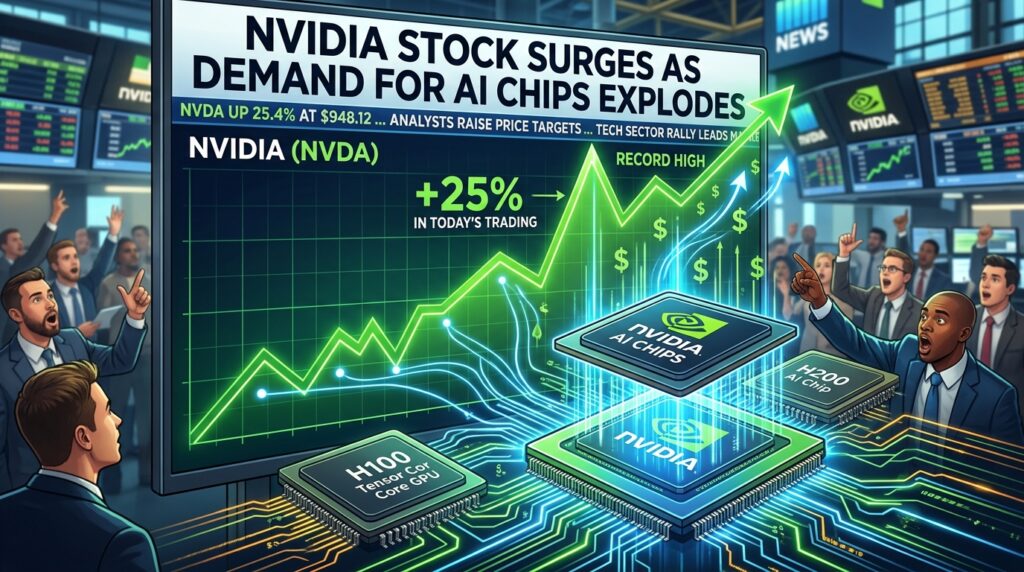
Search intent: [A] Informational. The right way to read NVIDIA stock surges as demand for AI chips explodes is as a market signal, not a headline to chase blindly. The formal concept is a re-rating of a semiconductor company’s equity value driven by accelerating revenue expectations, expanding gross margins, and sustained hyperscaler demand for accelerated computing hardware. In plain English: Wall Street is pricing NVIDIA less like a cyclical chip maker and more like critical infrastructure for the AI economy.
This matters now because AI spending is not a one-quarter story. Cloud providers, enterprise software vendors, and governments are all pushing capital into data centers built around NVIDIA’s GPU stack, CUDA software layer, and networking products such as InfiniBand and high-speed Ethernet. The result is a demand profile that differs from normal semiconductor cycles: supply constraints, long lead times, and product transitions can support pricing power longer than investors expect.
That does not make the stock cheap, and it does not eliminate risk. It does mean the market is reacting to a structural change in compute demand, not a temporary fad. Investors who understand that distinction are in a far better position to evaluate whether NVIDIA’s valuation is justified, stretched, or vulnerable to a correction.
Key Takeaways
- NVIDIA’s stock performance is tied to one central driver: AI inference and training demand require massive GPU compute, and the company controls a large share of that stack.
- The most important variables are not just chip shipments, but datacenter revenue, gross margin, supply availability, and whether hyperscaler spending remains elevated.
- CUDA, Blackwell, H100, Grace Hopper, and NVLink are not buzzwords; they are part of NVIDIA’s competitive moat and explain why customers often stay within its ecosystem.
- The thesis is strong, but not risk-free: valuation, export restrictions, customer concentration, and competition from AMD and custom silicon can pressure returns.
- The correct framework is to analyze NVIDIA as an AI infrastructure company with semiconductor economics, not as a consumer-tech momentum trade.
NVIDIA Stock Surges as Demand for AI Chips Explodes: What the Market is Really Pricing In
The Core Definition Behind the Rally
At a technical level, the market is repricing NVIDIA’s future cash flows because demand for accelerated computing has outpaced prior expectations. In the semiconductor industry, that means customers are buying specialized processors—primarily GPUs—optimized for parallel workloads such as model training and inference. When the order book expands faster than supply can adjust, revenue visibility improves, pricing power strengthens, and equity markets typically reward the stock with a higher multiple.
What makes this case unusual is the breadth of demand. This is not only about one AI model or one customer. It spans Microsoft Azure, Amazon Web Services, Google Cloud, Meta, Oracle, and a long tail of enterprises building internal AI stacks. The market is not just reacting to unit sales; it is pricing the possibility that NVIDIA becomes the default compute layer for large-scale generative AI.
Why the Stock Behaves Differently from a Normal Chip Name
Who works in semiconductors knows that cyclical names usually rise and fall with inventory corrections, memory pricing, and handset demand. NVIDIA, by contrast, now trades partly on software lock-in and platform economics. CUDA, its proprietary computing framework, creates switching friction for developers and data scientists who have already built tooling around the ecosystem. That is not a guarantee of permanence, but it is a real moat.
In practice, what happens is that investors stop valuing the company only on last quarter’s shipments and start valuing it on how long AI infrastructure spending can compound. That explains why the stock can rise even when management warns about supply bottlenecks: the market interprets those bottlenecks as evidence that demand still exceeds capacity.
The Entities That Matter Most Right Now

The most relevant names in this story are NVIDIA, AMD, Microsoft, Amazon Web Services, Google Cloud, Meta, TSMC, and the U.S. Department of Commerce. TSMC matters because advanced packaging and leading-edge manufacturing capacity constrain output. The Commerce Department matters because export controls can affect sales into China and other restricted markets. AMD matters because competitive pressure on the accelerator market is real, even if NVIDIA still holds the lead.
That is why this trade cannot be understood as “AI is hot, so the stock goes up.” The price reflects a layered bet on architecture leadership, manufacturing capacity, software adoption, and policy risk. Strip away any one of those, and the narrative becomes much less durable.
Why AI Chip Demand is Expanding So Fast
Training is Expensive, and Inference is Now the Bigger Story
AI model training is the process of teaching a large model using enormous datasets and compute clusters. Inference is the deployment phase, where the model answers user prompts, generates text, classifies data, or powers copilots. For the last cycle, investors focused on training demand. That still matters, but inference is increasingly the larger long-term market because every consumer and enterprise feature built on top of AI requires ongoing compute.
This is where NVIDIA’s advantage compounds. Training clusters need high-bandwidth memory, low-latency interconnects, and efficient scaling across racks. Inference at scale does too, just with different utilization patterns. As model usage spreads into search, enterprise software, advertising, coding assistants, and customer service, the demand curve stops looking like a one-time buildout and starts resembling a recurring infrastructure bill.
Hyperscalers Are the Demand Engine
Hyperscalers are the largest cloud platforms: Microsoft, Amazon, and Google. They buy at scale, deploy aggressively, and influence the market because their capital expenditure budgets can reach tens of billions of dollars a quarter. When those companies commit to AI infrastructure, the ripple effect reaches suppliers, packaging houses, interconnect vendors, and software ecosystems.
A practical way to think about it: if a cloud provider decides to deploy a new generation of AI servers, the purchase does not stop at the GPU. It includes networking, cooling, power delivery, storage, rack integration, and orchestration software. NVIDIA benefits because it participates in more of that stack than a typical chip vendor, which is one reason its revenue mix has shifted so heavily toward datacenters.
Independent Reporting Supports the Scale of the Buildout
For broader context on the semiconductor supply chain, the U.S. Census Bureau’s industrial data and the Federal Reserve’s manufacturing reports help explain how capital spending moves through the sector. For AI policy and market structure, the U.S. Bureau of Labor Statistics and U.S. Department of Commerce provide useful macro and trade context, while industry reporting from Reuters offers timely coverage of earnings, export restrictions, and datacenter demand.
There is one nuance that matters: demand growth does not automatically translate into infinite margins. If cloud customers push back on pricing, or if they optimize workloads to use cheaper accelerators, the growth rate can decelerate. The demand story is strong, but not immune to substitution.
How NVIDIA Turns Demand Into Profit
Datacenter Revenue is the Economic Center of Gravity
Datacenter revenue is the segment that typically captures AI accelerator sales, networking, and related systems. It has become the company’s most important profit engine because datacenter customers buy in larger volumes and with more predictable roadmaps than gaming customers. That shift matters to valuation because higher-margin enterprise and infrastructure revenue usually earns a premium multiple.
Viable business models in semiconductors depend on more than just shipping product. They depend on design wins, software adoption, customer retention, and platform control. NVIDIA’s datacenter business combines all four. That is why the market reads each earnings report as a signal about broader AI infrastructure spending, not just one vendor’s quarterly performance.
Blackwell, H100, and Grace Hopper Are More Than Product Names
Blackwell is NVIDIA’s newer architecture, designed to improve performance per watt and scale for large language model workloads. H100 remains a reference point because it became the workhorse chip for many early AI deployments. Grace Hopper combines CPU and GPU elements for tightly integrated workloads, which matters in data-intensive and latency-sensitive environments.
These product families matter because they determine whether customers can improve throughput without dramatically increasing energy and cooling costs. That is not trivial. A model cluster is only as good as its total cost of ownership, and power efficiency has become one of the defining constraints of the AI boom. The companies that solve that problem get more adoption, faster.
Software is the Hidden Moat
The CUDA software ecosystem is often undervalued by investors who focus only on hardware specs. CUDA lets developers write code that runs efficiently on NVIDIA GPUs, which creates a steep switching cost for teams already trained on the platform. Around that core layer sit libraries, frameworks, and developer tools that make the platform stickier over time.
That software advantage is why competition does not translate into instant displacement. AMD can make strong chips, and custom silicon from cloud providers can reduce dependency at the margin, but replacing the full stack is much harder than benchmarking a single part. This is the point where many bear cases weaken: they assume hardware substitution is easy when the real lock-in is architectural.
Moat Element Why It Matters Investor Impact CUDA Developer ecosystem and software portability Raises switching costs Blackwell / H100 Performance for training and inference Supports pricing power NVLink / networking Scales multi-GPU workloads Expands system-level value Datacenter integration Combines compute, memory, and interconnect Deepens customer dependence
What Investors Should Watch in the Next Earnings Cycle
Revenue Growth Alone is Not Enough
The headline number attracts attention, but the quality of growth matters more. Investors should track datacenter revenue mix, gross margin, operating margin, and management commentary on supply constraints. If revenue grows while margins hold, the thesis remains intact. If revenue grows but margins compress due to pricing pressure or higher fulfillment costs, the market may start questioning how sustainable the expansion really is.
That is why sophisticated investors do not stop at top-line growth. They read the balance sheet, the guidance, and the customer concentration profile. If a handful of hyperscalers account for a large share of demand, the business is still strong, but it becomes more exposed to budget shifts and internal build-versus-buy decisions.
Export Controls and Geopolitics Are a Real Variable
The U.S. government has tightened export controls on advanced chips and related technologies in recent years, especially with respect to China. These restrictions can alter revenue potential, product configurations, and routing decisions across the supply chain. The U.S. Bureau of Industry and Security is the key regulator to watch here, because policy changes can directly affect what NVIDIA can ship and where.
This risk is frequently underestimated during bull markets. It is not enough to say demand is strong if a meaningful portion of addressable demand sits behind regulatory barriers. That is one reason the stock can remain volatile even in a powerful AI cycle: policy risk does not scale down simply because the technology is popular.
Competition Will Not Look the Same as in Prior Cycles
AMD remains the most visible public competitor, but the more important competition may come from custom silicon built by hyperscalers. Google’s TPUs, Amazon’s Trainium and Inferentia, and other internal accelerator efforts exist for a reason: large buyers want lower cost per inference and less supplier dependence. That does not make NVIDIA obsolete. It does mean the company must keep innovating faster than customers can commoditize their own workloads.
There is divergence among analysts on how quickly that substitution can happen. Some expect NVIDIA to preserve a dominant share for years because software and ecosystem switching costs are high. Others argue that hyperscaler custom chips will steadily cap long-term growth. Both views have merit. The mistake is to assume the current share structure is permanent.
How to Evaluate the Stock Without Falling for the Hype
Use a Framework, Not a Headline
Professional investors typically evaluate NVIDIA through a combination of growth durability, valuation, and moat strength. That means asking whether AI capex is expanding across multiple buyers, whether margin structure is stable, and whether the product roadmap supports another cycle of upgrades. A stock can be a superb business and still be too expensive at a given moment.
The practical question is not whether AI is real. It is. The question is whether the current share price already discounts several years of flawless execution. If expectations are too high, even excellent results can disappoint. That is a standard market dynamic, and it is especially relevant when sentiment becomes self-reinforcing.
Watch the Difference Between Structural and Cyclical Demand
Structural demand comes from durable changes in how businesses operate. Cyclical demand comes from inventory restocking, short-term budget spikes, or temporary shortages. AI infrastructure has elements of both, but the structural case is stronger than many skeptics admit because every new application layer increases total compute demand.
Still, this method works well in early adoption phases, but it can fail when spending outruns monetization. If cloud vendors build too aggressively ahead of actual usage, a digestion phase can follow. In that scenario, unit demand slows even though the long-term opportunity remains large. Investors should separate timing risk from thesis risk.
Decision Criteria for a Disciplined Investor
- Demand breadth: Is spending coming from multiple hyperscalers and enterprise customers, or from a narrow group?
- Margin stability: Are gross margins expanding, holding, or weakening under competitive pressure?
- Roadmap execution: Are Blackwell-class products shipping on time and at scale?
- Policy exposure: Are export controls or geopolitical restrictions limiting revenue mix?
- Competitive response: Are AMD and custom silicon gaining meaningful traction?
The right conclusion is not “buy” or “avoid” on emotion. It is to determine whether the stock is priced for growth that is likely, merely possible, or already fully anticipated. That distinction drives portfolio discipline.
Próximos Passos Para Implementação
If you are evaluating NVIDIA from an investor’s perspective, the next step is to build a simple monitoring dashboard around the variables that actually move the stock: datacenter revenue, gross margin, forward guidance, hyperscaler capex commentary, and export-policy developments. That is a better process than reacting to social media momentum or a single analyst upgrade. The market rewards businesses that execute, but it also punishes investors who confuse narrative with evidence.
The broader lesson is that AI infrastructure is entering a phase where compute, power, software, and geopolitics are tightly linked. NVIDIA sits at the center of that intersection. Treat the stock as a claim on the expansion of global AI capacity, then test that claim against supply, competition, and valuation. If those variables stay favorable, the upside can persist. If they weaken, the market can reprice fast.
Perguntas Frequentes
Why Does NVIDIA Command a Higher Valuation Than Many Other Chip Stocks?
NVIDIA trades at a premium because the market views it as a platform company, not just a chip supplier. Its exposure to AI training and inference, plus the CUDA ecosystem, creates recurring demand and switching friction that most semiconductor firms do not have. Investors pay for that durability. The premium is justified only if AI infrastructure spending remains broad, margins stay resilient, and the company continues to ship leading products on schedule.
Is the AI Chip Market a Temporary Bubble or a Structural Shift?
It looks more like a structural shift, but parts of the cycle can still behave like a bubble. The reason is simple: enterprises and cloud providers are rebuilding their infrastructure around accelerated computing, and that usually takes years, not quarters. At the same time, individual stock prices can overshoot fundamentals. The durable demand is real; the risk is that valuations may move faster than earnings can support them.
What is the Biggest Risk to NVIDIA’s AI-led Growth Story?
The most important risk is not one single competitor. It is a combination of valuation risk, export restrictions, and customer concentration. If hyperscalers slow capex, if policy limits shipments, or if custom silicon absorbs more workloads than expected, growth can decelerate. The company can still remain highly profitable in that scenario, but the stock would likely re-rate lower because expectations are so elevated.
How Important is CUDA Compared with NVIDIA’s Hardware Roadmap?
CUDA is extremely important because it anchors the developer ecosystem and increases switching costs. Hardware leadership matters, but software adoption makes that leadership stickier. A new chip can win benchmarks and still lose share if the software stack is weak. NVIDIA’s advantage comes from the combination: GPUs, networking, libraries, and developer tooling all reinforce one another.
Can AMD or Custom Chips Meaningfully Challenge NVIDIA?
Yes, but in a selective way. AMD can win on price-performance in some workloads, and hyperscaler custom chips can reduce dependence on NVIDIA for specific inference tasks. That said, replacing the full NVIDIA stack is difficult because the company bundles compute, interconnect, and software. The likely outcome is not total displacement, but a more competitive market that may limit long-run share gains.
What Should Investors Track Each Quarter to Judge Whether the Thesis is Intact?
Track datacenter revenue growth, gross margin trends, management guidance, and commentary about supply and demand balance. Then add external checks: hyperscaler capital expenditure plans, export-control updates, and product launch timing for architectures like Blackwell. If those indicators remain strong, the thesis holds. If multiple indicators weaken at once, the market may be pricing in a slower AI buildout than investors expect.
Editorial Notice
This content was structured with the assistance of Artificial Intelligence and subjected to rigorous curation, fact-checking, and final review by Editor-in-Chief Nivailton Santos. TechTool Judge reaffirms its unyielding commitment to journalistic ethics, ensuring that editorial judgment and data validation remain entirely under human responsibility and final editorial oversight.