
Xbox Begins Canceling PS5 Ports: What the Decision Actually Means

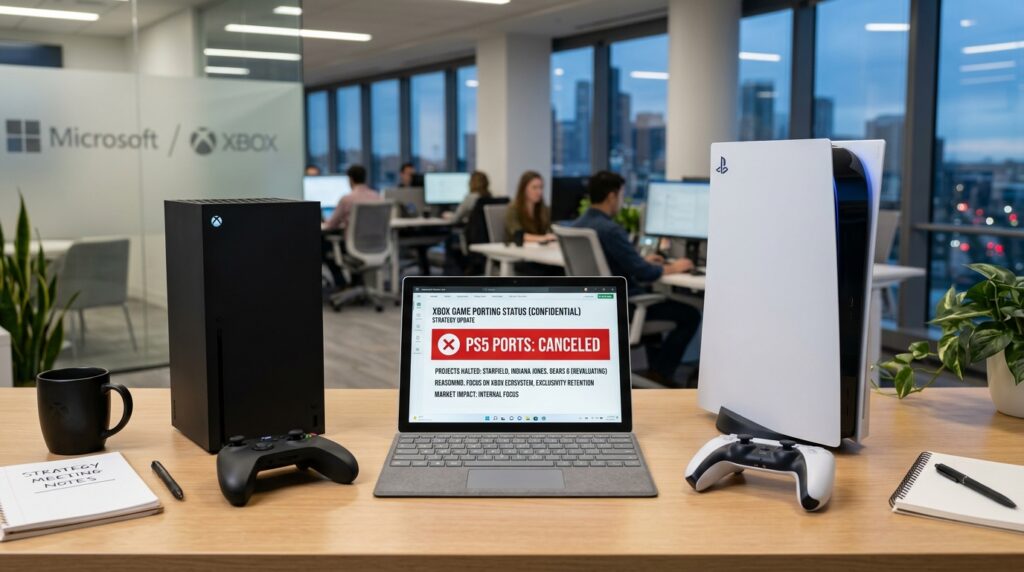
Xbox begins canceling PS5 ports refers to a platform strategy shift in which Microsoft’s gaming division stops funding, greenlighting, or completing PlayStation 5 versions of certain titles. In practical terms, this is not a technical bug or a late-stage accident; it is a publishing decision. A port exists only if the business case, production schedule, and platform strategy all still support it.
This matters now because the console market has moved from “sell on every device” logic to selective distribution. Microsoft, Xbox Game Studios, Bethesda, and Activision Blizzard all operate under a portfolio model, where each release is judged on margin, brand value, subscriber impact, and long-term ecosystem control. For the player, that can mean a title that once looked cross-platform ends up locked to Xbox, PC, or Game Pass instead.
There is also a technical layer that people miss. A PS5 port is not a copy-paste job; it requires separate QA, certification, controller mapping, trophy integration, build stabilization, and release coordination with Sony’s publishing pipeline. When that work is cut, the decision usually reflects a business pivot, not a lack of engineering ability. That distinction is central to understanding what is happening.
Pontos-Chave
- Canceling a PS5 port is usually a portfolio decision, not a technical failure, and it often happens when the expected return no longer justifies certification, QA, and release management costs.
- Microsoft’s gaming strategy increasingly prioritizes ecosystem value across Xbox, PC, and Game Pass, which can reduce the incentive to support every competing platform.
- A port cut late in development creates sunk costs, but publishers still cancel when the projected lifetime revenue is weaker than the cost of completion and support.
- Players should interpret these cancellations as a sign of tighter platform strategy, not as proof that cross-platform publishing is disappearing altogether.
- The real question is not whether PS5 ports can be made, but which titles still make economic and strategic sense to ship there.
Xbox Begins Canceling PS5 Ports: What the Decision Actually Means
The Formal Definition, Then the Plain-English Version
In publishing terms, a PS5 port is a separate build target created from the same game codebase but adapted for Sony’s hardware, operating system, input stack, store rules, and certification requirements. That means its own performance tuning, compliance testing, localization packaging, and release approval. When a publisher cancels that version, it removes an entire commercial SKU from the launch plan.
In plain English: the game may still exist, but it will not ship on PlayStation 5. That can happen before development begins, in the middle of production, or after a playable build already exists. The timing matters because the later the cancellation, the more money gets written off.
Why the Timing Matters More Than the Headline
A late cancellation usually tells you that strategic assumptions changed. Maybe the forecast on PS5 sales weakened. Maybe Game Pass grew as a higher-value channel. Maybe leadership decided that keeping the title exclusive strengthens the Xbox brand more than a multiplatform release would. Those are different motives, and they produce different outcomes for studios.
Who works in publishing knows this pattern well: once a title moves from “possible expansion” to “core platform asset,” every additional platform gets harder to justify. That is especially true when the platform owner wants tighter control over launch windows, subscription value, and first-party identity.
The Practical Effect on Players and Studios
For players, the immediate result is straightforward: fewer access options and a stronger chance of platform fragmentation. For studios, the result is more planning discipline but also more business pressure. Teams must now defend every platform slot with hard numbers, not just a vague “bigger audience” argument.
That is where the friction lives. A PS5 port can expand revenue, but it can also dilute focus, extend QA cycles, and create support obligations that continue long after release. If the economics are weak, the platform gets cut.
Why Microsoft Would Pull Back from PlayStation 5 Versions
Portfolio Logic Beats Sentiment Every Time
Microsoft runs Xbox as a platform business, not just a hardware business. That means each game is judged against a portfolio of outcomes: console sales, PC engagement, cloud usage, subscription growth, and brand reinforcement. If a PS5 release helps revenue but weakens any of those other goals, it becomes a harder sell internally.
This is the core reason cancellations happen. A title can be commercially viable on PlayStation 5 and still be strategically inconvenient for Xbox. Those are not the same question.
Exclusivity Windows, Attach Rates, and Ecosystem Value
An exclusivity window is the period in which a game ships on one ecosystem before reaching another, or never reaches another at all. Publishers use it to concentrate attention, improve launch economics, and strengthen platform loyalty. Xbox can use the same logic to push value into Game Pass, Xbox hardware, or PC storefronts.
The important metric is attach rate: how many players buy hardware, subscribe, or spend more because the game is tied to the ecosystem. A PS5 port can boost total unit sales, but if it weakens the ecosystem pull of an Xbox release, leadership may decide the tradeoff is poor.
Cost Control is Not the Whole Story
Yes, porting costs money. But serious publishers do not cancel ports only to save a few million dollars in engineering and QA. They cancel because the long-term economics do not justify the opportunity cost of finishing, certifying, marketing, and supporting the release.
That distinction matters. In practice, the decision is usually a mix of margin protection and strategic positioning. The port is not “too hard”; it is no longer worth the full life-cycle commitment.
The Technical Pipeline Behind a PS5 Port
What Actually Gets Built and Validated
A console port involves more than asset conversion. The team needs a stable build for the target hardware, a performance profile that holds at acceptable frame times, controller behavior tuned for DualSense, save-system validation, storefront metadata, and a certification pass that matches Sony’s technical requirements. This is a pipeline, not a one-step export.
Studios also need regression testing after every major code change. A feature that works on Xbox Series X can fail on PS5 because of different memory behavior, storage routines, API handling, or platform services integration. That is why porting schedules slip even when the core game is ready.
Where Cancellations Usually Happen in Production
The earliest cancellations are cheap. The latest are painful. If a PS5 version gets cut after the project has entered optimization or compliance, the studio loses months of work, and often the publisher eats external vendor costs too. That is why publishers try to make the decision before content lock whenever possible.
There is a pattern here that experienced producers recognize: when milestone reviews show that launch quality will miss target on one platform, leadership chooses between delay, scope reduction, or cancellation. Cancellation becomes the rational option when the missing platform no longer changes the launch outcome.
Why Certification Can Tilt the Decision
Sony’s certification process is not a formality. It verifies system behavior, suspend/resume handling, network stability, save integrity, and policy compliance. Passing it takes engineering attention, and failing it can create release delays that bleed marketing momentum. For a publisher with a crowded release calendar, that risk alone can kill the port.
This is one reason titles sometimes ship on Xbox and PC first while the PS5 version quietly disappears. The project may still be technically alive, but the operational risk no longer fits the release window.
Decision Factor Why It Matters Typical Outcome Porting cost Engineering, QA, and certification resources are finite Port is delayed or cut Ecosystem value Game Pass, Xbox hardware, and PC may outperform PS5 revenue strategically Xbox-first release is favored Release risk Late bugs and compliance failures can derail launch timing Port is postponed or canceled Brand positioning Exclusivity can strengthen platform identity Competing platform is excluded
How the Move Fits Microsoft, Bethesda, Activision Blizzard, and Game Pass
Xbox is No Longer Just a Box
The modern Xbox strategy is an ecosystem strategy. It includes console, PC, cloud streaming, subscription, and first-party content. That is why Microsoft’s game business cannot be understood through hardware sales alone. A title may be more valuable as a service driver than as a one-time unit sold on PlayStation 5.
Bethesda and Activision Blizzard make this even more important. Their catalogs include franchises with powerful audience pull, which can be used to reinforce Xbox identity, PC engagement, and recurring revenue. That changes the calculus for every future port decision.
Game Pass Changes the Math
Game Pass is not just another sales channel. It changes how a release is monetized, marketed, and measured. A subscription model rewards retention, engagement, and ecosystem breadth. If a title drives sign-ups or reduces churn on Xbox and PC, giving the same content to a competing platform can weaken the subscription advantage.
That does not mean all PS5 versions disappear. It means each one must prove that its outside-platform revenue is worth more than its lost strategic leverage. Many projects will fail that test.
What Experienced Publishers Watch First
People inside publishing usually watch three numbers before they talk about a port: forecasted launch sales, post-launch engagement potential, and support cost over the first 12 months. If any of those look soft, the risk profile changes fast. A port with weak monetization and high support overhead is a prime cancellation candidate.
Na prática, o que acontece é que titles with broad appeal survive cross-platform plans more often than niche games with high engineering complexity. Who works on live service or premium console projects knows that a strong creative pitch is not enough; the release needs a business model that can carry the extra platform burden.
Sources That Clarify the Broader Market Context
Microsoft’s own platform and acquisition disclosures show how central ecosystem value has become to its gaming business. See the company’s gaming updates on Xbox Wire and the broader strategic context in the FTC’s Microsoft-Activision filings at the U.S. Federal Trade Commission. For market-level console behavior, reports from Circana are often used by analysts to measure hardware and software demand shifts.
These sources do not prove every specific port cancellation, and they should not be stretched that far. What they do establish is the environment: platform competition, subscription economics, and publisher control are all tighter than they were a generation ago.
What This Means for the Next Wave of Console Releases
Expect Fewer Automatic Multiplatform Assumptions
The industry has been drifting away from the assumption that every major game must arrive on every major console. That old model still exists for some publishers, but it is no longer the default for platform-holders with strong ecosystem goals. Xbox can afford to be selective, and in some cases, selective is the point.
For consumers, that means release plans will become less predictable. The presence of a prototype or early listing no longer guarantees a finished PS5 version. If the strategic value changes, the port can vanish.
The Likely Pattern Going Forward
Near-term, the most likely outcome is not a total end to PS5 support from Xbox-affiliated projects. The more realistic pattern is segmentation: flagship franchises, service-heavy titles, and ecosystem drivers stay exclusive, while lower-stakes collaborations may still release across platforms when the revenue case is strong enough.
That is why the market needs to stop treating every cancellation as a shock. It is increasingly normal. It reflects a mature platform war, not a temporary stumble.
How to Read Future Announcements Without Getting Misled
Watch for three signals: wording around “platform strategy,” changes to release windows, and whether a title is being positioned around subscription value or hardware sales. If marketing moves from broad availability to ecosystem language, the odds of a PS5 version usually drop. If a game is framed as a long-tail service asset, exclusivity becomes more likely.
There is one limit here, and it matters: not every rumored cancellation is real, and not every real cancellation means a permanent exclusivity stance. Some projects return later with a revised plan. Others do not. The only reliable reading comes from official release roadmaps and publisher statements.
Como Aplicar Esse Conhecimento
The right takeaway is strategic, not emotional. If Microsoft and Xbox continue canceling PS5 ports on a case-by-case basis, the market is signaling that platform control now outranks universal distribution for many high-value releases. For analysts, that means tracking ecosystem impact instead of counting raw platform availability. For studios, it means proving that each extra port produces measurable value, not just wider visibility.
If you are evaluating a future release, focus on the business architecture behind it: Game Pass fit, hardware lift, certification risk, and support burden. Those are the variables that decide whether a PS5 build survives. The headline may sound dramatic, but the real story is simpler and more durable: in modern console publishing, every platform must justify its place.
Perguntas Frequentes
Is Xbox Actually Canceling Every PS5 Port Now?
No. The more accurate reading is that Microsoft can choose to cancel or avoid PS5 versions on a project-by-project basis when the business case no longer supports them. That is very different from a blanket ban. Some titles may still ship cross-platform if revenue, timing, and brand strategy line up. The trend points to tighter selectivity, not universal withdrawal.
Does Canceling a PS5 Port Mean the Game is Unfinished?
Not necessarily. A game can be fully playable on Xbox or PC and still lose its PlayStation 5 version because the publisher decides the extra launch and support cost is not worth it. In many cases, the core production is intact; only one target platform is removed. That is a business decision, not a quality verdict on the game itself.
What is the Difference Between a Port Delay and a Port Cancellation?
A delay means the publisher still expects the PS5 version to ship later, usually after more optimization or a revised release schedule. A cancellation means the publisher has stopped funding or pursuing that version altogether. Delays often preserve option value; cancellations write it off. The distinction matters because delayed ports can still return, while canceled ones usually do not unless leadership changes course.
Why Would Game Pass Make a PS5 Version Less Attractive?
Because Game Pass monetizes engagement inside Xbox and PC instead of relying only on single-unit sales. If a title can drive subscriptions, hardware loyalty, or long-term retention, giving that same game to a competing platform may reduce the strategic payoff. The port may still earn money on PlayStation 5, but it can undercut the ecosystem advantage that Xbox wants to build.
Can a Canceled PS5 Port Come Back Later?
Yes, but only if the economics change. A game can be re-evaluated after launch, after a major market shift, or after a change in corporate strategy. That said, once a port is canceled, it usually stays gone because the original production context, staffing, and timing have already been lost. A comeback is possible, just not the default outcome.
Editorial Notice
This content was structured with the assistance of Artificial Intelligence and subjected to rigorous curation, fact-checking, and final review by Editor-in-Chief Nivailton Santos. TechTool Judge reaffirms its unyielding commitment to journalistic ethics, ensuring that editorial judgment and data validation remain entirely under human responsibility and final editorial oversight.