
ChatGPT-5 Release Date and Features: What Can Be Said with Confidence

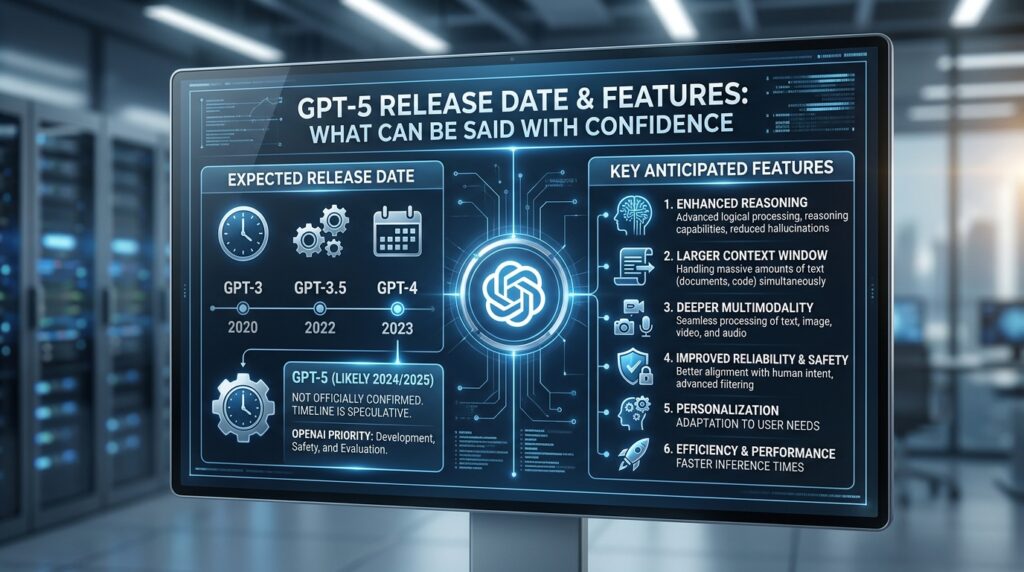
ChatGPT-5 release date and features is best understood as a moving target: a question about when OpenAI will launch its next major model and what capabilities it will prioritize, including reasoning quality, multimodal input, latency, safety controls, and product integration. As of publicly available information, there is no universally confirmed public release date that can be treated as final, so any serious analysis has to separate official announcements from informed inference.
That distinction matters because the market tends to confuse product naming with model readiness. OpenAI has already shifted expectations with GPT-4o, faster voice workflows, image understanding, and tighter API integration. The next step will not be judged only by benchmark gains; it will be judged by whether the model is reliable enough for daily work, safe enough for broad deployment, and economical enough for consumer-scale usage. Those are the real constraints behind any release timeline.
For teams building products, tracking this topic is not idle speculation. A new flagship model can alter cost structure, prompt design, agent workflows, content pipelines, customer support automation, and even procurement decisions around Azure-hosted infrastructure. In practice, the question is not just “when does it launch?” but “what changes once it does?”
Pontos-Chave
- There is no solid public basis for treating any rumored ChatGPT-5 launch date as confirmed unless OpenAI announces it directly.
- The most important feature signals are not cosmetic; they are reasoning quality, multimodal performance, tool use, reliability, and safety behavior.
- Comparing a future model to GPT-4o is more useful than chasing headlines, because GPT-4o set the current product baseline for speed and multimodality.
- For businesses, the practical impact will likely show up first in API behavior, workflow automation, and cost per task rather than in consumer-facing demos.
- Any credible forecast must account for training compute, red-teaming, policy review, and deployment throttles, not just model performance.
ChatGPT-5 Release Date and Features: What Can Be Said with Confidence
There is a Difference Between a Rumor and a Release Signal
A release date becomes meaningful only when it is anchored to an official announcement, a product page update, or a verifiable launch event from OpenAI. Before that point, “release date” is usually a blend of speculation, extrapolation, and wishful thinking. That is why disciplined analysis starts with the public record, not with social media timelines or leak culture.
OpenAI’s own public materials are the safest source for launch timing and product scope. The company’s blog and release notes are where major model changes typically surface first, often alongside product limitations, safety notes, and rollout details. For a baseline on the current generation approach, the GPT-4o announcement is especially useful because it shows what OpenAI considers a major product jump: speed, voice, vision, and tighter user experience.
That baseline matters. If a future ChatGPT-5 arrives, the market will compare it not to an abstract ideal, but to a model already good at low-latency interaction and multimodal input. The bar is high. Launching a new flagship model is not just about “being smarter”; it is about delivering a system that is measurably better on enough dimensions to justify migration.
The Most Plausible Timeline Pattern is Staged Rollout, Not a Single Big Bang
In large-model launches, the public usually sees a phased sequence: internal testing, limited access, broader product integration, API exposure, and then wider consumer rollout. That pattern is common because it reduces risk. It also protects infrastructure from sudden demand spikes and gives safety teams room to observe failure modes in the wild.
Who works in this space knows the pattern well. A model can look impressive in controlled demos and still create trouble under real traffic: higher hallucination rates on edge cases, unstable tool calls, or regressions in instruction following. That is why timing often depends less on raw capability and more on confidence thresholds in red-teaming, policy review, and post-deployment monitoring.
So the right expectation is not “one date, one switch.” The more realistic scenario is a controlled release sequence that may differ by plan tier, region, or platform. Businesses should plan for uneven availability rather than assume universal access on day one.
Why OpenAI Cannot Rush the Launch
Training and deploying a frontier model involves expensive compute, safety evaluation, and product engineering that scale poorly if rushed. A model that performs well in benchmark settings can still fail on adversarial prompts, ambiguous instructions, or high-stakes tasks. That is especially important after the industry-wide scrutiny around model safety, model cards, and deployment responsibility.
For context, the broader governance conversation is not cosmetic. The U.S. NIST AI Risk Management Framework makes it clear that AI systems need structured risk controls, not just better outputs. That framework aligns with how frontier labs now think about launch readiness: capability, safety, monitoring, and accountability are all part of the product.
What Features to Expect If ChatGPT-5 Becomes the Next Flagship Model
Reasoning Will Matter More Than Raw Fluency
The most important feature jump is likely to be better reasoning under ambiguity. That means stronger performance on multi-step tasks, fewer logic breaks in longer conversations, and better resistance to being led astray by poorly framed prompts. In practical terms, the model would need to handle planning, synthesis, and tradeoff evaluation with less user correction.
OpenAI has already moved in that direction with product behavior that rewards more capable instruction following and multimodal interpretation. A future flagship model would likely extend this by reducing “almost right” answers, which are often more dangerous than obvious errors because they look authoritative. That is the core issue enterprises care about.
Benchmarks are useful, but they are not the whole story. A model can improve on academic tasks and still underperform in messy operational settings where instructions are incomplete and context changes quickly. That gap is where real product value is won or lost.
Multimodal Input and Output Are Now Table Stakes
Any serious discussion of future features has to include text, image, and voice. GPT-4o made multimodal interaction feel native rather than bolted on, and that expectation now shapes what users will demand next. If ChatGPT-5 launches, it will likely be judged by how naturally it handles documents, screenshots, spoken instructions, and mixed-format workflows.
For product teams, this is not a novelty layer. It affects onboarding, support automation, accessibility, and field operations. A model that can parse a photo of a whiteboard, summarize a document, and respond in voice can cut friction across many business processes.
The likely differentiator is not whether it supports multimodality, but how well it preserves context across modalities. That is where many systems still struggle. The jump from “can see” to “can reason across formats” is the meaningful leap.
Tool Use, Memory, and Agentic Workflows Could Define the Upgrade
The next flagship release may lean harder into tool orchestration: calling external tools, retrieving information, executing structured tasks, and maintaining session context more effectively. In the ChatGPT product, that means tighter integration with file uploads, browsing-like retrieval, code execution, and workflow shortcuts. In the API, it means better reliability when a model acts as a controller rather than just a responder.
Memory is a separate issue. Persistent memory can improve personalization, but it also raises governance and privacy concerns. If OpenAI expands memory features, the real value will come from precision and user control, not from storing more data indiscriminately. That is one of the places where trust can erode quickly if the defaults are poor.
Agentic behavior is where expectations often outrun reality. A system can appear autonomous while still requiring substantial guardrails. The practical win is not a fully autonomous agent; it is a model that can complete narrow tasks with fewer handoffs and less prompt engineering.
How to Read the Signals Before OpenAI Makes an Official Announcement
Follow Product Artifacts, Not Just Headlines
The strongest launch clues usually come from product artifacts: changelogs, API documentation, model picker updates, help-center articles, and pricing pages. These are more reliable than “insider” claims because they reflect engineering and deployment work already underway. If a new model is close, those surfaces often change before the keynote does.
Another useful signal is ecosystem behavior. When Microsoft Azure expands support for new OpenAI models or adjusts enterprise deployment paths, it often indicates that productization is nearing a more stable stage. OpenAI and Microsoft have a tightly linked commercial relationship, so infrastructure changes can be informative even when marketing remains quiet.
That said, not every infrastructure update means a new flagship model is imminent. Sometimes a change reflects optimization, safety refinement, or regional rollout. The correct reading is probabilistic, not deterministic.
Red-Teaming and Safety Reviews Are Usually the Bottleneck

Frontier-model launches are gated by safety work that the public rarely sees. Red-teaming, abuse testing, bias analysis, and policy review can slow release even when the model is technically ready. This is one reason launch windows often slip relative to expectations.
That reality also explains why feature roadmaps can be misleading. A lab may have multiple candidate capabilities in testing, but only some survive safety thresholds. A model that is strong in internal demos may fail on jailbreak resistance, instruction hierarchy, or refusal consistency.
In practice, the launch date is often decided by the last 10% of risk reduction, not the first 90% of model quality.
This is where public impatience collides with engineering reality. The best teams ship when the system is stable enough to absorb real-world misuse, not when the demo looks polished.
What Users Should Watch for in 2026 And Beyond
If you are tracking adoption or planning procurement, monitor four things: naming changes, latency improvements, API pricing, and enterprise guardrails. Those are the indicators that matter more than rumor cycles. They tell you whether the model is becoming a platform feature or staying a showcase product.
Also pay attention to how OpenAI frames access tiers. If a new model appears first in premium plans or enterprise accounts, that usually signals both limited capacity and deliberate load management. Consumer access often follows later once stability improves.
What a Strong ChatGPT-5 Would Change for Teams, Developers, and Enterprises
For Teams, the Impact Starts with Workflow Compression
The most immediate business effect would be fewer handoffs between people and tools. A better model can reduce the need to rewrite prompts, clean up outputs, or manually verify every step in routine knowledge work. That creates time savings, but more importantly, it lowers friction in the parts of work that are usually ignored in ROI discussions.
In practice, what happens is that teams stop asking the model for isolated outputs and start using it as a layer across processes: drafting, summarizing, classifying, extracting, and routing. That is where value compounds. A marginal improvement in reasoning can produce a much larger gain when it sits inside repetitive workflows.
Still, not every department benefits equally. Legal, medical, and financial functions face tighter review standards, so gains arrive more slowly. Marketing, operations, and support usually see the first measurable uplift.
For Developers, API Reliability Matters More Than Demo Quality
Developers will judge a new model by consistency, not by peak performance. They care about latency, token efficiency, structured output reliability, function calling, and how often the model drifts from task constraints. If ChatGPT-5 exists as an API-accessible model, those details will determine adoption as much as intelligence does.
That is why comparisons to GPT-4o should focus on system behavior. Faster responses are valuable, but only if they remain accurate under load. Better multimodal understanding is valuable, but only if the model can preserve schema, JSON formatting, and tool instructions without breaking.
For product builders, the lesson is straightforward: a frontier model should reduce scaffolding, not add more of it. If you need extensive patchwork to make it dependable, the upgrade is not yet fully operational.
For Enterprises, Safety and Procurement Will Set the Pace
Enterprise adoption hinges on data handling, auditability, and access control. That means contractual terms, retention policies, admin controls, and compliance posture can matter as much as model quality. A new release is useful only if it fits procurement and governance requirements.
Decision Area What Enterprises Need to Verify Why It Matters Data governance Retention, isolation, and logging rules Determines whether sensitive workflows can be deployed safely Reliability Latency, uptime, output stability Affects production SLAs and user trust Compliance Security attestations and audit support Shapes legal approval and risk acceptance Cost API pricing and usage ceilings Determines whether deployment scales economically
That table is the real decision matrix. A powerful model that fails procurement review is not a usable model. Enterprises buy control as much as capability.
How to Evaluate the Next Release Without Getting Misled by Hype
Use a Three-Layer Test: Capability, Reliability, and Governance
The cleanest way to evaluate a new model is to separate how smart it looks from how dependable it is. Capability covers reasoning, multimodality, and tool use. Reliability covers consistency, failure frequency, and latency. Governance covers permissions, logging, retention, and policy fit.
Many teams overvalue the first layer and underweight the other two. That creates disappointment later, because impressive demo performance does not always survive operational use. A model that performs well in a benchmark suite can still be costly to supervise.
The best test set is one built from your own workload. If your prompts, documents, and edge cases are not in the evaluation, your confidence is too high.
Compare Against the Current Baseline, Not an Idealized Future
Any evaluation of a future OpenAI release should compare it to the model you actually use today, not the one you wish existed. For many users, that baseline is GPT-4o or another current frontier model. Measuring against reality keeps the review practical and prevents false expectations.
That also helps with migration decisions. If a new release is only marginally better in your core use case, switching may not justify the disruption. If it meaningfully lowers failure rates or unlocks a new workflow, then the business case becomes obvious.
The right question is not whether the model is “better.” It is whether it is better on the tasks that cost you time, money, or trust.
Keep a Healthy Skepticism About Feature Lists
Feature lists can be accurate and still be incomplete. A model may support voice, image, memory, and tools, yet still underperform in prompt adherence or safety-sensitive use cases. That is why feature checklists should never replace hands-on testing.
There is also divergence among specialists on what counts as progress. Some prioritize benchmark jumps; others value latency and cost; others care most about reliability under ambiguity. All three views are defensible, and all three can be wrong if treated as the only lens.
That is the right way to read the market: not as a race for the loudest claim, but as a disciplined comparison of outcomes.
Próximos Passos Para Implementação
If you are planning around a future OpenAI release, treat the next few months as an evaluation window rather than a waiting period. Build a small benchmark set from your own workflows, define what improvement would actually change your decisions, and map the security or compliance questions that would block adoption. That preparation is more valuable than chasing rumors about a date that may move.
Use official signals first: OpenAI’s blog, product documentation, and the GPT-4o baseline. Then compare any new model against operational metrics you care about: output stability, tool-call accuracy, latency, and cost per completed task. That approach turns speculation into procurement discipline.
The smartest organizations will not ask whether the next model is impressive. They will ask whether it is ready enough to remove friction from real work without introducing new risk. That is the standard that will decide adoption.
Perguntas Frequentes Sobre ChatGPT-5 Release Date and Features
Is There an Official Release Date for ChatGPT-5?
No official public release date should be treated as confirmed unless OpenAI publishes it directly. In frontier AI, timing often changes because of safety review, infrastructure readiness, and staged deployment. The most reliable source is OpenAI’s own announcements, not rumor sites or speculative timelines. Until an official statement appears, the correct stance is that the date remains unconfirmed.
What Features Are Most Likely to Matter in a New Flagship Model?
The features that matter most are stronger reasoning, better multimodal handling, more reliable tool use, and lower latency. Consumer-facing polish matters, but it rarely drives adoption by itself. For serious users, the real test is whether the model reduces correction loops and performs consistently on messy, real-world tasks. That is where upgrade value is proven.
Will ChatGPT-5 Necessarily Be Much Better Than GPT-4o?
Not automatically. A new flagship model should improve on GPT-4o in several dimensions, but “better” can mean different things: deeper reasoning, faster interaction, lower cost, or improved safety. Some users may notice a major jump, while others see only incremental gains in their workflow. The practical impact depends on the task, not just the brand name.
How Can Businesses Prepare Before an Official Launch?
Businesses should create a small evaluation set based on their own prompts, documents, and edge cases. Then they should define success metrics for accuracy, latency, cost, and governance. That preparation lets teams test a new model quickly if access opens. It also prevents rushed adoption based on hype rather than measurable operational value.
What is the Biggest Risk in Relying on Leaked Feature Lists?
The biggest risk is assuming that a feature in testing will survive into release unchanged. Frontier labs often remove, delay, or constrain capabilities after red-teaming or policy review. Leaks also exaggerate launch certainty and can distort procurement planning. A disciplined team treats leaks as weak signals, not decision inputs.
Why Do Safety Reviews Affect Release Timing So Much?
Safety reviews are often the final gate before launch because they expose failure modes that raw benchmarks miss. A model may be strong at reasoning and still fail on harmful prompts, instruction hierarchy, or abuse resistance. That creates real deployment risk. The final delay is usually about reducing those risks to an acceptable level, not about polishing marketing material.
Editorial Notice
This content was structured with the assistance of Artificial Intelligence and subjected to rigorous curation, fact-checking, and final review by Editor-in-Chief Nivailton Santos. TechTool Judge reaffirms its unyielding commitment to journalistic ethics, ensuring that editorial judgment and data validation remain entirely under human responsibility and final editorial oversight.