
DePIN Networks, Decentralized Physical Infrastructure


Decentralized Physical Infrastructure Networks are blockchain-coordinated systems that use distributed owners, operators, and token incentives to deploy real-world infrastructure such as wireless coverage, storage, compute, mapping, and energy services. In practice, the model turns underused physical assets into market-ready capacity, while on-chain rules handle coordination, rewards, and verifiability. The “next-gen” shift is not just decentralization for its own sake; it is the collision between that model and explosive AI demand for compute, bandwidth, sensor data, and low-latency edge infrastructure.
This matters now because AI training and inference are no longer confined to a few hyperscale data centers. They are spreading outward into edge locations, regional facilities, and specialized networks that need fast provisioning, resilient operations, and cost efficiency. DePIN has become relevant precisely where traditional infrastructure is slow, capital-heavy, or geographically uneven. When AI workloads push demand for GPU access, data movement, and real-world sensing, decentralized physical infrastructure stops being a niche Web3 experiment and starts competing on throughput, price, and distribution.
That said, this field has real trade-offs. Token incentives can bootstrap supply faster than conventional capex, but they can also attract speculative behavior if the underlying service is weak. The strongest DePIN systems do not sell decentralization as the product; they sell usable infrastructure with measurable service quality. That distinction separates serious networks from noisy ones.
Key Points
- AI demand is reshaping DePIN by rewarding networks that can deliver low-latency compute, bandwidth, storage, and data collection at the edge.
- The technical value of DePIN is coordination: it aligns many small operators into a service layer that can scale faster than a single vendor in fragmented markets.
- Token incentives are useful for bootstrapping, but unit economics, reliability, and service quality determine whether a network survives after early growth.
- The most defensible DePIN categories today are wireless, GPU compute, storage, mapping, and sensor networks, because AI workloads create direct demand in each.
- DePIN is not a universal replacement for cloud infrastructure; it performs best where distribution, redundancy, and local presence matter more than centralized control.
Decentralized Physical Infrastructure Networks and the AI Demand Shock
What DePIN is, Technically
At a technical level, DePIN is a network design pattern in which physical assets are owned or operated by many independent participants, then coordinated through software and economic incentives. The core stack usually includes device registration, proof-of-service or proof-of-location mechanisms, automated payouts, and some form of reputation or slashing logic. The point is not to “put hardware on-chain” for novelty; it is to create a trust-minimized market for real infrastructure.
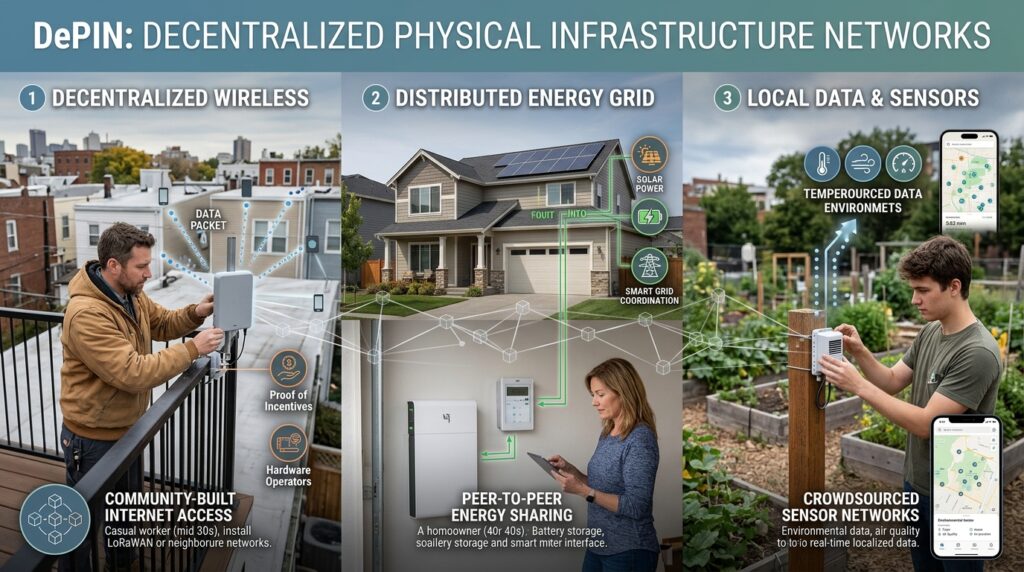
In plain English, DePIN makes it possible for thousands of people or firms to contribute capacity and get paid according to actual usage or verified contribution. That can mean hotspots delivering wireless coverage, GPUs offering inference capacity, disks supplying storage, or vehicles and phones collecting mapping data. The model turns distributed ownership into a supply-side advantage.
Why AI Changed the Economics
AI workloads are hungry for three things that DePIN can help deliver: compute, bandwidth, and data. Model training consumes large GPU clusters, but inference is where the market broadens; once AI services are embedded in apps, assistants, and enterprise workflows, demand becomes continuous and geographically distributed. That creates room for edge-based and regionally distributed infrastructure, not just centralized cloud regions.
Who works with this space knows the pattern: the first bottleneck is not always raw compute. It is often network proximity, data availability, and cost per request. That is why AI has pulled DePIN into relevance. A network that can place resources closer to users, lower the cost of serving smaller workloads, or source specialized data at scale has a real market edge.
Why the Market is Shifting Now
AI demand is disrupting the older assumption that infrastructure must be centrally controlled to be efficient. Cloud providers still dominate high-end training, but the economics around inference, data acquisition, and edge service delivery are more open than many expected. That opens a lane for decentralized systems that can assemble capacity from many operators without waiting for a single company to build every node.
Public policy and platform dynamics reinforce the shift. Governments and regulators are paying closer attention to infrastructure concentration, digital resilience, and data sovereignty. For background on digital infrastructure and AI policy direction, see the NIST AI Risk Management Framework, the OECD AI policy work, and the U.S. National Science Foundation’s computing and information science programs. These sources do not endorse DePIN specifically, but they help explain why distributed, auditable infrastructure is gaining strategic attention.
Where Next-Gen DePIN Wins: Compute, Wireless, Storage, and Edge Data
GPU Networks and Distributed Compute
GPU marketplaces are one of the clearest AI-adjacent opportunities for decentralized infrastructure. Training can remain concentrated in large facilities, but inference, fine-tuning, rendering, and batch jobs can often run across distributed GPU pools if orchestration is good enough. That matters because demand spikes are uneven; a network that can price capacity dynamically and place jobs near the edge has a better chance of filling inventory.
The real challenge is verification. A compute network must prove performance, availability, and isolation. Without that, buyers face a trust problem: they need to know they are receiving the promised hardware, not a spoofed node or an unstable environment. The networks that solve measurement, benchmarking, and reputation well will outlast the ones that only market token rewards.
Wireless and Physical Coverage Networks
Wireless DePIN models remain attractive because coverage is local by nature. Distributed hotspot deployments can extend network reach in places where a centralized rollout would be slow or uneconomical. For AI, the importance is indirect but substantial: low-latency connectivity is foundational for edge inference, sensor uplinks, and high-frequency telemetry.
The opportunity is strongest in dense urban areas, industrial sites, and underconnected regions where demand exists but incumbent investment has been slow. In those settings, the network effect is physical, not just digital. More nodes create better coverage, which creates more usage, which funds more nodes.
Storage, Mapping, and Sensor Data
AI systems need more than compute. They need storage for retrieval-augmented generation, geospatial data for robotics and autonomy, and real-world sensor streams for model training and validation. DePIN fits here because it can aggregate unused storage, crowd-sourced mapping coverage, and geographically distributed sensors into a usable data layer.
In practice, these are the categories where the business case becomes concrete fastest. A model that needs fresh imagery, local road data, environmental readings, or device telemetry can pay for those inputs directly. That makes the infrastructure layer part of the AI supply chain, not a speculative add-on.
DePIN Category AI-Relevant Use Main Technical Requirement Primary Risk Distributed Compute Inference, fine-tuning, batch processing Verification, orchestration, scheduling Unreliable performance Wireless Networks Edge connectivity, telemetry, access expansion Coverage density, uptime, placement quality Weak adoption in low-demand areas Storage Networks RAG, archival, data redundancy Durability, retrieval speed, integrity proofs Price pressure from hyperscalers Mapping and Sensors Training data, geospatial intelligence, robotics Freshness, validation, location accuracy Data quality variance
What Separates Durable Networks from Token-Driven Noise
Unit Economics Must Work Without Hype
A DePIN network lives or dies by unit economics. If the cost to acquire, provision, verify, and maintain one unit of service exceeds what the market will pay, the token cannot save it. Early incentives can mask this problem for a while, but they do not eliminate it. Once rewards decline or usage stalls, weak infrastructure disappears quickly.
The strongest operators build around a clear service margin: revenue per verified workload, minus hardware cost, uptime loss, support overhead, and incentive spend. That is the sober version of the model. It is also the only one that scales.
Verification is the Trust Layer
DePIN depends on proof. Proof of location, proof of coverage, proof of compute, proof of storage, or some composite measure must show that a node actually delivered what it claimed. Without robust verification, marketplaces decay into adversarial systems where bad actors game rewards and buyers lose confidence.
There is divergence among specialists on how much verification should happen on-chain versus off-chain. My view is that the network should keep the settlement and incentive logic auditable, while performance measurement can remain partly off-chain if it is transparent and reproducible. That approach works well in high-throughput systems, but it fails when the measurement layer itself is opaque.
Bootstrapping is Not the Same as Sustainability
Token emissions are a tool for seeding supply, not a substitute for demand. They can accelerate node growth, attract early operators, and create enough critical mass to make a network useful. After that, the service must stand on its own.
Viable networks transition from incentive-led growth to usage-led economics. That transition is where many projects stall. I have seen cases where node counts looked impressive while actual paid utilization lagged badly. The charts were green; the business was not.
How AI Workloads Pressure DePIN Architecture
Latency, Locality, and Edge Placement
AI inference increasingly depends on where the workload runs, not just what hardware it uses. If a model serves users in a specific geography, placing compute closer to that region reduces latency and transport cost. This is where edge nodes and distributed operators can outperform a centralized cluster that sits far from demand.
That advantage is strongest when the service is interactive: assistants, copilots, vision systems, industrial control, or real-time analytics. Training still favors dense clusters, but inference is the mass market. Next-gen decentralized infrastructure needs to optimize for that reality rather than chase only headline GPU counts.
Data Provenance and Model Trust
AI teams care about where data came from, how fresh it is, and whether it can be audited. DePIN can contribute here by making sensor inputs, mapping data, and storage receipts more traceable. That does not solve model bias or hallucination on its own, but it gives builders a firmer chain of custody for the inputs.
This matters in regulated or safety-sensitive environments. If a robotics company, insurer, or logistics platform uses distributed data, provenance is not a luxury. It is a requirement for risk management and compliance.
Bandwidth and Backhaul Become Strategic
AI systems move large payloads. Model updates, embeddings, telemetry, and video streams all place stress on bandwidth and backhaul. DePIN networks that ignore transport economics will struggle, even if their local node density looks strong on paper.
The lesson is direct: infrastructure for AI is not just compute. It is an end-to-end pipeline from device to edge to cloud to storage and back. Networks that coordinate those layers with measurable service levels will have the best chance of surviving beyond the token cycle.
Implementation Priorities for Builders, Operators, and Buyers
For Builders: Start with a Narrow, Painful Use Case
Do not start with “decentralized infrastructure” as the product. Start with a specific market failure: expensive edge inference, missing sensor coverage, fragmented wireless density, or underutilized GPUs in a particular region. That is where buyers will pay first.
The most credible launch path usually has three steps: define the service, prove the measurement method, then open the incentive market. If you reverse that order, you often end up with a speculative community and no real workload.
For Operators: Optimize for Uptime, Not Vanity Metrics
Node operators should care less about total rewards screenshots and more about service quality. High availability, low maintenance, stable power, and predictable connectivity matter more than raw node count. In many networks, operators with modest but reliable infrastructure earn more over time than those chasing aggressive, fragile setups.
That is the practical lesson most newcomers miss. The best-performing nodes tend to be boring: stable hardware, disciplined monitoring, and realistic load expectations. In infrastructure, boring usually means profitable.
For Buyers: Demand Service-level Evidence
If you are procuring decentralized infrastructure, ask for evidence that goes beyond token dashboards. Look for uptime records, throughput benchmarks, geographic distribution, and dispute-resolution rules. If the network cannot explain how it measures service and resolves failures, it is not ready for mission-critical usage.
This approach works well for pilots and production alike, but it fails when buyers want enterprise-grade guarantees and the network only offers community-level assurances. A serious purchase decision should compare DePIN against centralized alternatives on latency, reliability, and total cost of service—not ideology.
Practical checklist for evaluation:
- Measured uptime and failure recovery.
- Transparent incentive schedules.
- Clear proof-of-service or equivalent verification.
- Geographic coverage aligned to actual demand.
- Pricing that remains viable after emissions decline.
Strategic Outlook for the Next Wave of Decentralized Infrastructure
The next phase of DePIN will be defined by operational seriousness. Networks that only celebrate decentralization will fade; networks that become indispensable infrastructure for AI will compound. The winning pattern is already visible: connect a real pain point, verify service with rigor, and make the economics work after the bootstrap phase ends. That is the difference between a narrative and a durable system.
For teams building in this space, the right move is not to ask whether decentralization is philosophically superior. The right question is whether distributed ownership improves access, cost, resilience, or speed for a specific workload. If the answer is yes, the model has room to grow. If not, it is probably a token wrapper around a weak infrastructure thesis.
Decentralized Physical Infrastructure Networks will keep expanding where AI demand creates fragmented, local, and latency-sensitive needs. The networks that thrive will be the ones that treat token design as a coordination tool, not the end product. Build for measurable service, prove the economics, and let the infrastructure speak for itself.
FAQ
What Makes DePIN Different from a Standard Cloud Marketplace?
DePIN coordinates physical infrastructure owned by many independent operators, while a cloud marketplace typically rents capacity from a centralized provider. That difference changes the supply model, the verification problem, and the failure modes. DePIN can expand faster into fragmented geographies, but it also needs stronger trust and measurement systems to match cloud reliability.
Why is AI Demand Such a Strong Catalyst for DePIN?
AI increases demand for compute, bandwidth, storage, and fresh data at the same time. Those needs are often local, latency-sensitive, or too expensive to serve only from centralized facilities. DePIN becomes attractive when it can place resources closer to demand and aggregate underused assets into sellable capacity.
Which DePIN Category is Most Mature Today?
Wireless and distributed compute tend to be among the most commercially legible categories because the service is easier to understand and measure. Storage and mapping are also strong, but they depend heavily on pricing, data quality, and integration into real workflows. Maturity varies by market, not by category alone.
What is the Biggest Technical Risk in DePIN Networks?
The biggest risk is weak verification. If a network cannot reliably prove that a node delivered the promised service, incentives get gamed and buyers lose trust. Security, uptime, and service integrity all depend on that proof layer holding up under adversarial conditions.
Can DePIN Replace Hyperscale Cloud Infrastructure?
Not broadly, and not soon. DePIN is strongest where distribution, locality, redundancy, or specialized data collection create a clear advantage. Hyperscalers still dominate standardized, large-scale training and enterprise workloads that demand deep control and tight operational guarantees.
Editorial Notice
This content was structured with the assistance of Artificial Intelligence and subjected to rigorous curation, fact-checking, and final review by Editor-in-Chief Nivailton Santos. TechTool Judge reaffirms its unyielding commitment to journalistic ethics, ensuring that editorial judgment and data validation remain entirely under human responsibility and final editorial oversight.