Securing the Software Supply Chain: MITRE Frameworks and Vulnerability Management in CI/CD

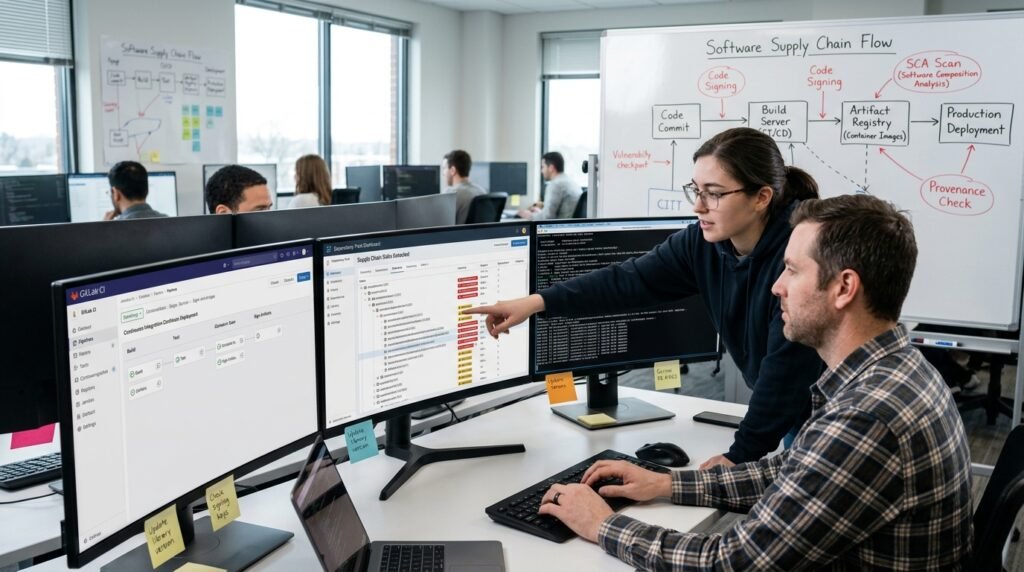
Securing the Software Supply Chain: MITRE Frameworks and Vulnerability Management in CI/CD is the discipline of reducing risk across source code, dependencies, build systems, signing, deployment, and runtime controls by combining MITRE threat models with continuous vulnerability management inside delivery pipelines. In practical terms, it means treating the pipeline itself as a security target, not just the application it produces. The goal is to prevent tampering, detect weak links early, and make every release traceable, attestable, and defensible.
This matters now because software supply-chain attacks no longer rely on exotic techniques. They exploit ordinary weaknesses: stale dependencies, over-privileged CI runners, unsigned artifacts, exposed secrets, weak branch protections, and delayed patching. A single compromised package, token, or build step can cascade into hundreds of downstream systems. That is why organizations increasingly map controls to the CISA supply chain guidance, align threat analysis with MITRE ATT&CK and MITRE CWE, and formalize evidence with SBOMs, signing, and policy gates.
Who works in this space knows the uncomfortable truth: vulnerability management is not effective when it starts after deployment. If the CI/CD system can fetch unpinned dependencies, run untrusted code, or publish artifacts without provenance, the pipeline becomes part of the attack surface. MITRE’s frameworks help teams describe attacker behavior and weakness classes with precision; CI/CD security turns that intelligence into controls that can block, alert, or quarantine a risky release before it reaches production.
Pontos-Chave
- Supply-chain security is a pipeline problem, not only an application problem; the build, signing, and deployment stages need the same level of control as production.
- MITRE ATT&CK helps model attacker behavior, while MITRE CWE helps classify weakness patterns that repeatedly show up in real systems.
- Vulnerability management in CI/CD works best when it is automated, risk-based, and tied to policy gates rather than manual review alone.
- SBOMs, artifact signing, provenance, and secrets hygiene are the minimum baseline for trustworthy delivery in modern software teams.
- Detection without enforcement is weak security; the strongest programs stop unsafe releases before they are promoted.
Securing the Software Supply Chain: MITRE Frameworks and Vulnerability Management in CI/CD
What the Framework Combination Actually Does
The formal definition is straightforward: MITRE ATT&CK provides a catalog of adversary tactics and techniques, MITRE CWE organizes software weakness types, and vulnerability management in CI/CD applies continuous detection, prioritization, and remediation to code and build outputs throughout the delivery lifecycle. Put together, they create a shared language for threat modeling, control selection, and operational response.
In plain English, this combination tells you how attackers get in, what weak patterns they exploit, and where to stop them. ATT&CK is useful for pipeline-focused threat modeling, such as credential theft, supply-chain injection, and persistence in build infrastructure. CWE is useful when you are reviewing recurring failures like insecure deserialization, path traversal, or command injection in tools that the pipeline depends on.
The value is not academic. A CI/CD platform has dependencies, identities, secrets, and trust boundaries just like any production service. If you map attack paths and weakness classes to each stage of delivery, you can decide where to require code review, where to enforce policy-as-code, and where to isolate execution. That is the difference between reactive patching and controlled software release.
Why CI/CD Changes the Security Model
Traditional vulnerability management assumes a relatively stable asset inventory. CI/CD destroys that assumption. Build environments are ephemeral, dependencies change every run, infrastructure is declarative, and release velocity is high. A toolchain that scans once a week will miss the window in which a compromised dependency or secret can do the most damage.
The practical answer is to shift left without becoming naive about runtime risk. Source code scanning, dependency analysis, secret detection, and artifact inspection all belong in the pipeline, but none of them should be treated as a silver bullet. Teams that ship fast and safely usually combine pre-merge checks, build-time controls, and post-deploy monitoring. That layered model is how you keep up with modern release cadence without losing traceability.
For a useful external reference, the NIST Information Technology Laboratory publishes guidance that many security programs use when defining secure development and risk management practices. The specific standards may vary by organization, but the principle stays constant: delivery speed cannot outrun trust controls.
The Control Stack That Makes This Defensible
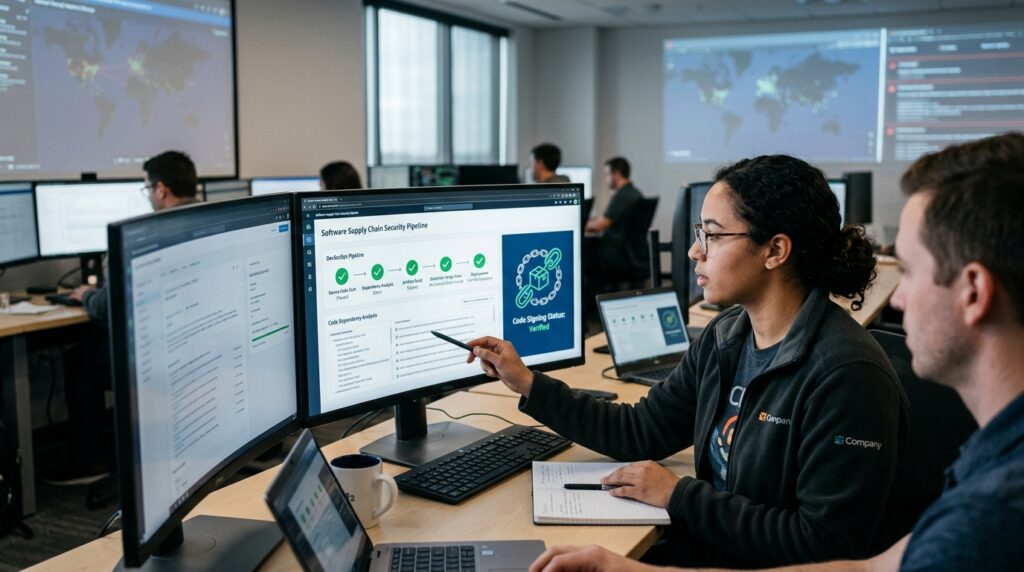
A serious program usually includes at least five control layers. First, source integrity: branch protections, mandatory reviews, commit signing, and protected secrets. Second, build integrity: isolated runners, least-privilege tokens, pinned actions or plugins, and outbound network restrictions. Third, artifact integrity: hashing, signing, attestations, and immutable registries. Fourth, vulnerability control: SCA, SAST, container scanning, and IaC scanning. Fifth, release governance: approval policies, risk thresholds, and exception handling with expiration dates.
These controls should not exist as a loose checklist. They need to be connected to release decisions. If a critical vulnerability lands in a transitive dependency, the pipeline should know whether the package is actually reachable in the deployed code path. If the build runner is untrusted, the artifact should not inherit trust just because it passed a scan. Provenance matters because scans alone cannot prove that a binary came from the source you intended.
Pipeline Stage Primary Risk Best-Match Control Source control Credential theft, malicious commits, unauthorized merges Branch protection, code review, signed commits, secret scanning Build Runner compromise, dependency poisoning, tampered outputs Isolated runners, pinned dependencies, build attestation, least privilege Artifact storage Artifact replacement, unsigned packages, replay attacks Signing, immutable registries, checksum verification Deployment Unsafe promotion, misconfiguration, policy bypass Admission control, policy-as-code, environment approvals Runtime Exploited vulnerabilities, drift, hidden persistence Monitoring, WAF or runtime defense, continuous posture checks
Using MITRE ATT&CK and MITRE CWE to Model Supply-chain Risk
ATT&CK Reveals Attacker Behavior in the Pipeline
MITRE ATT&CK is often associated with enterprise intrusion detection, but its real value in software supply-chain defense is behavioral modeling. The framework helps teams reason about how an adversary would move from initial access to execution, persistence, and exfiltration inside build and release systems. That is useful when the threat is not just malware, but a compromised maintainer account, poisoned dependency, or malicious CI job.
One of the strongest uses of ATT&CK in CI/CD is mapping likely paths through identity and automation. Attackers do not need to “break” the pipeline if they can abuse a token with excess privileges, a workflow that trusts external input, or a build step that executes arbitrary code. By naming those techniques, teams can prioritize controls around token scoping, runner isolation, approval workflows, and network egress.
The U.S. Cybersecurity and Infrastructure Security Agency offers direct guidance on supply-chain risk and security engineering at its supply chain page, and that guidance aligns well with ATT&CK-style thinking: identify adversary pathways, reduce blast radius, and monitor the places where trust is granted.
CWE Turns Repeated Weaknesses Into Actionable Categories
MITRE CWE is the right lens when the issue is not the attacker’s behavior, but the defect class they exploit. If ATT&CK answers “how did they get there?”, CWE answers “what kind of flaw made this possible?” That distinction matters in CI/CD because many release failures repeat the same weaknesses in different tools: insecure credential storage, path traversal in build scripts, command injection in automation, and weak input validation in internal tooling.
Security teams often make the mistake of treating vulnerabilities as isolated events. They patch one package, one plugin, one script, and move on. CWE helps reveal the pattern. If three separate repositories are failing for the same weakness class, the right fix is not another one-off ticket; it is a standard, a guardrail, or a platform-level control.
This is where MITRE frameworks become operational rather than decorative. ATT&CK informs detection and threat hunting. CWE informs secure coding standards and build policy. Together they help you decide whether a failure belongs in developer training, platform engineering, or incident response.
What Experienced Teams Map First
Teams that have done this for a while usually start with the paths that create the highest leverage. They map privileged CI credentials, package registry trust, dependency resolution, workflow triggers, and artifact signing. Those are the points where a small mistake can become a systemic compromise.
- Identity paths: service accounts, OIDC federation, personal access tokens, and ephemeral credentials.
- Execution paths: workflow runners, build containers, shell steps, and external actions or plugins.
- Trust paths: package registries, artifact repositories, container registries, and signing keys.
- Promotion paths: staging approvals, environment variables, deployment manifests, and admission policies.
There is a limit here, and it matters: not every ATT&CK technique maps cleanly to every pipeline. A highly regulated release environment and a small open-source project face different constraints, so the mapping must reflect actual architecture. Good teams adjust the model to fit their delivery path, not the other way around.
Designing Vulnerability Management That Fits CI/CD Reality
Scan Early, but Prioritize by Reachability and Exploitability
The weakest vulnerability programs drown teams in findings. A better model uses layered scanning and then filters by what is reachable, exploitable, and business-critical. If a vulnerable function is never shipped, or a dependency is not on the runtime path, that issue should not consume the same urgency as a flaw directly exposed in production traffic.
This is where software composition analysis, secret scanning, and container analysis need context. A critical CVE in a test-only dependency may matter less than a medium-severity issue in an internet-facing service with a known exploit chain. Context reduces noise and keeps engineers focused on remediations that actually change risk.
Who works with real pipelines knows the problem: a backlog full of “critical” findings becomes operationally meaningless. Good vulnerability management assigns ownership, deadlines, and exception rules, but it also ranks issues by exploitability, asset value, and exposure. Without that discipline, the system becomes a reporting tool rather than a control system.
Make Policy Enforceable, Not Advisory
Security policy in CI/CD should be machine-enforceable whenever possible. If a container image lacks a signature, the deployment gate should reject it. If a secret appears in a pull request, the build should stop. If a dependency violates a known allowlist rule, the merge should fail or require formal override. Advisory warnings alone do not scale.
At the same time, absolute blocking on every vulnerability is counterproductive. Some teams need exception paths for emergency hotfixes, vendor constraints, or legacy systems. The right model is policy with controlled escape hatches: documented exceptions, approval, expiration, and compensating controls. That keeps release velocity intact without normalizing risk.
Experience shows this pattern clearly: teams that automate gates but never tune them end up training engineers to ignore alerts. Teams that tune too loosely create a false sense of security. The mature middle ground is a policy engine that reflects actual risk tolerance and is revisited as the system changes.
Use SBOMs and Provenance as Operational Evidence
SBOMs, or Software Bills of Materials, are not compliance theater when they are used correctly. They give you an inventory of components and a starting point for impact analysis when a new vulnerability is disclosed. Provenance records tell you how an artifact was built, from what source, under what conditions, and with which dependencies. Together they create traceability.
That traceability is essential when supply-chain trust is under scrutiny. If you cannot answer where an artifact came from, you cannot assert that it is safe to deploy. This is why signing and attestation are now central to modern delivery systems, not optional extras. The artifact should prove its own origin.
Building Secure Controls Into the Pipeline Without Slowing Delivery
Harden the Build System First
The build system is a high-value target because it concentrates trust. If the runner is compromised, an attacker can tamper with code, inject malicious dependencies, steal secrets, or publish poisoned artifacts. Hardened builds rely on isolated execution, short-lived credentials, restricted network access, and minimal permissions for every job.
For GitHub Actions, GitLab CI, Jenkins, Tekton, or any other orchestration platform, the design principle is the same: the pipeline should be able to do only what the current job needs, and nothing more. That includes access to package registries, signing keys, cloud APIs, and deployment endpoints. If a job can reach everything, it can be abused to reach everything.
Protect Secrets and Keys as If They Were Production Credentials
Secrets management is often the difference between a secure pipeline and a compromised one. Hard-coded tokens, long-lived keys, and environment variables copied into logs are still common failure modes. A disciplined program moves to secret scanning, short-lived federation, key rotation, and scoped access. Build and deployment credentials should expire quickly and leave an auditable trail.
Artifact signing keys deserve special treatment. They should be isolated, access-controlled, and used through a signing service or hardware-backed mechanism where possible. If an attacker can sign malicious output, downstream verification becomes useless. Trust the signature only if you trust the system that generated it.
Measure Control Effectiveness, Not Just Control Presence
Many organizations can name their controls but cannot prove they work. That gap is dangerous. A scan that runs but is ignored, a signing step that is not enforced, or a policy rule that can be bypassed by one manual approval is a control in name only. Mature teams measure control effectiveness by failure rates, mean time to remediate, exception frequency, and the proportion of releases covered by provenance.
The NIST Cybersecurity Framework is useful here because it pushes organizations toward outcomes, not just tool adoption. In practice, the question is simple: can you prove that risky artifacts are blocked, that vulnerable dependencies are tracked to closure, and that the release path remains trustworthy under pressure?
Operational Governance: People, Process, and Evidence
Who Owns What in a Secure Software Supply Chain
Ownership is one of the most underestimated issues in CI/CD security. Developers own code quality and dependency choices. Platform teams own pipeline hardening and build infrastructure. Security teams define policy, threat models, and response criteria. Release managers own exceptions and promotion decisions. If ownership is unclear, risk becomes everyone’s problem and no one’s responsibility.
A practical governance model assigns each control to a role and gives that role measurable duties. For example, developers resolve reachable vulnerabilities in their services, platform engineers maintain runner isolation and signing workflows, and security sets risk thresholds for blocking releases. This keeps the system moving while preserving accountability.
Evidence is the Difference Between “secure” and “believed Secure”
Security claims should be backed by artifacts: logs, attestations, SBOMs, scan results, policy decisions, and exception records. Those records support audits, incident response, and root-cause analysis. They also reveal whether a process is actually improving or just producing more noise.
Good evidence practices make incident response faster. If an open-source dependency becomes suspect, you need to know which releases included it, which environments ran it, and which signatures or attestations validate the build. Without evidence, remediation becomes guesswork.
There is still debate over how much evidence should be retained and for how long. That depends on regulatory requirements, storage cost, and threat model. A finance or healthcare environment will usually keep stronger records than a small SaaS startup, and that difference is rational rather than a weakness.
Where Teams Should Start If They Are Behind
If the program is immature, start with the highest-risk choke points. Lock down pipeline credentials. Require dependency pinning. Add secret scanning and artifact signing. Introduce SBOM generation for every release. Then map these controls to the most relevant ATT&CK behaviors and CWE classes so the program stops being generic and becomes threat-informed.
- Phase 1: protect identities, secrets, and runner access.
- Phase 2: enforce dependency control, signing, and provenance.
- Phase 3: connect vulnerability findings to release gates.
- Phase 4: measure control effectiveness and exception trends.
This method works well in organizations that can standardize their delivery tooling, but it can fail in environments with extreme tool sprawl or unmanaged legacy pipelines. In those cases, the right answer is governance first, then automation. Otherwise, the controls will not hold under real operational pressure.
Próximos Passos Para Implementação
The strongest programs do not treat supply-chain security as a separate project. They build it into the release system itself so that every merge, build, artifact, and deployment carries its own trust evidence. Start by defining the threat model with MITRE ATT&CK, translating recurrent flaws with MITRE CWE, and then attaching those insights to concrete pipeline gates. That sequence matters: model, classify, enforce.
If the organization needs a pragmatic path, focus first on the points that create irreversible damage: credential abuse, unsigned artifacts, uncontrolled dependencies, and blind promotion to production. Then add reachability-aware vulnerability management, SBOM generation, and attestation requirements. The objective is not to collect more security data. It is to make unsafe delivery paths impossible or, at minimum, visibly exceptional.
Teams that do this well end up with a pipeline that is faster because it is more predictable. They stop arguing over scattered findings and start managing risk as a release property. That is the real shift: security stops being a gate at the end and becomes an engineering discipline embedded in every stage of delivery.
FAQ
How Do MITRE ATT&CK and MITRE CWE Complement Each Other in CI/CD Security?
MITRE ATT&CK describes adversary behavior, while MITRE CWE categorizes weakness types in software and systems. In CI/CD, ATT&CK helps you model how an attacker could abuse credentials, runners, or workflow logic, and CWE helps you identify the flaw class that enabled it. Used together, they make threat modeling more operational because you can connect attacker paths to concrete engineering fixes. That is far more useful than treating vulnerabilities as isolated scan results.
What Should Be Scanned First in a Software Supply Chain Program?
Start with secrets, dependencies, build scripts, and artifact integrity. Secrets create immediate compromise risk, dependencies create transitive exposure, and build scripts often execute with excessive trust. Artifact integrity matters because a clean scan on the source code does not guarantee the binary or container image was not altered later. Once those controls are in place, expand to container images, infrastructure as code, and deployment manifests.
Why Are SBOMs Important If We Already Run Vulnerability Scanners?
Scanners tell you what is known to be vulnerable at a given moment. SBOMs tell you what actually shipped, which is critical for impact analysis, incident response, and compliance. When a new CVE is disclosed, an SBOM lets you determine exposure faster and with less guesswork. Without it, teams spend time manually reconstructing dependency chains and often miss transitive risk.
What is the Biggest Mistake Teams Make When Securing CI/CD Pipelines?
The most common mistake is treating the pipeline as trusted infrastructure by default. In practice, build runners, plugins, tokens, and external actions are all attack surfaces. Teams often add scanners but leave powerful credentials in place or allow unsigned artifacts to deploy. That creates a false sense of safety. Strong security requires enforcement, least privilege, and verified provenance, not just more tooling.
How Should Organizations Decide When to Block a Release for a Vulnerability?
Use reachability, exposure, exploitability, and business impact instead of severity alone. A critical issue in a non-runtime test dependency may be less urgent than a medium issue in an internet-facing service with active exploitation. The best programs define block conditions in policy-as-code and reserve exceptions for time-bound, approved cases. That approach keeps releases moving while preventing teams from normalizing risk.
Editorial Notice
This content was structured with the assistance of Artificial Intelligence and subjected to rigorous curation, fact-checking, and final review by Editor-in-Chief Nivailton Santos. TechTool Judge reaffirms its unyielding commitment to journalistic ethics, ensuring that editorial judgment and data validation remain entirely under human responsibility and final editorial oversight.