
Instagram tests a TV version and flirts with competing with YouTube

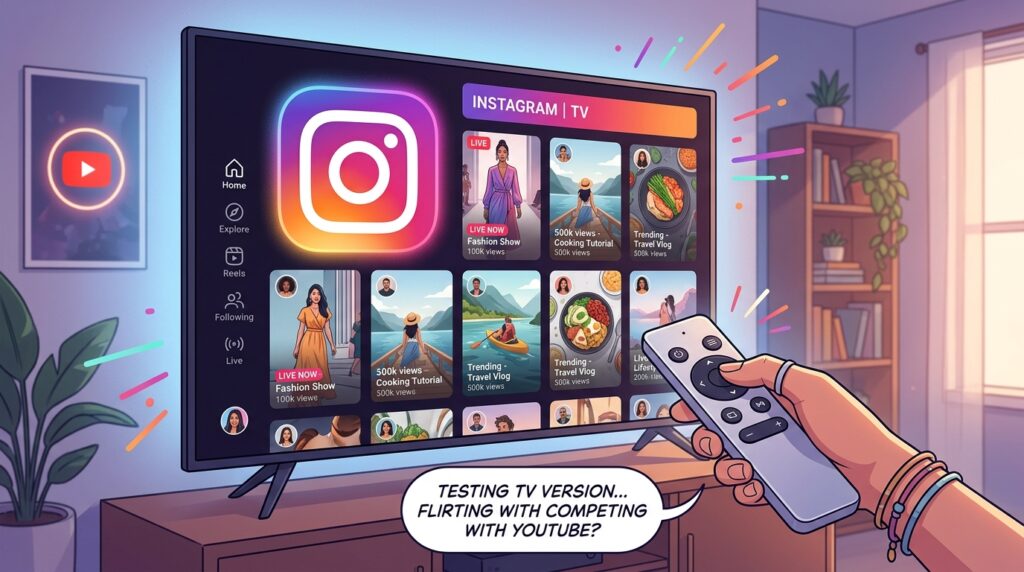
Instagram tests a TV version and flirts with competing with YouTube by exploring a connected-TV experience built around video consumption on the biggest screen in the home. Technically, that means adapting Instagram’s feed logic, vertical video formats, and creator content for a living-room interface where viewing sessions are longer, navigation is leaner, and discovery has to work with a remote instead of a thumb.
This matters because the shift is not cosmetic. It signals that Meta sees Instagram less as a purely mobile social app and more as a multi-surface video platform. That is a direct response to how audience attention has moved: YouTube still dominates on TV, TikTok has pushed short-form video into mainstream viewing habits, and connected-TV advertising keeps growing as brands follow streaming time.
In practice, a TV version only becomes relevant if it solves a real problem: making Instagram video watchable, searchable, and binge-friendly on a large screen without breaking the app’s social identity. That is where the strategic tension lives. Instagram can borrow the viewing model, but it cannot simply copy YouTube’s playbook and expect parity.
Key Takeaways
- A TV-specific Instagram experience would be a strategic move toward lean-back video consumption, not just a new device port.
- The real competitive target is YouTube’s living-room dominance, where recommendation quality, playback continuity, and creator depth matter more than social signals.
- Instagram’s strongest advantage is creator reach and short-form discovery; its biggest weakness is that TV viewers usually want longer sessions and clearer editorial structure.
- Whether this test becomes meaningful depends on product design, content licensing, and how Meta integrates Reels, recommendations, and account state across devices.
- This is not a guaranteed YouTube killer; it is a bid to capture more viewing time and more ad inventory on connected TVs.
Instagram Tests a TV Version and the Logic Behind the Move
What the Product Test Actually Means
From a product standpoint, a “TV version” usually means a redesigned interface for connected televisions and streaming boxes, such as Apple TV, Roku, Fire TV, or smart TV operating systems. The app has to support remote-based navigation, larger typography, simplified content rows, and recommendations that work without the tactile habits of mobile use. That is a different product problem from simply mirroring the phone app on a bigger screen.
The technical definition matters because the TV environment changes the consumption model. On mobile, Instagram is built for rapid swipes, interruptions, and micro-sessions. On TV, users expect continuous playback, predictable queues, and a form of catalog logic that can sustain longer watch times. If Meta is serious, the interface will need to privilege video-first browsing over social graph clutter.
Why Meta Would Push Instagram Beyond the Phone
Meta has a clear incentive: more viewing time, more ad surfaces, and a stronger defense against YouTube’s dominance in video monetization. TV inventory remains attractive because advertisers pay for lean-back attention, and connected-TV budgets keep expanding as media buyers reallocate spending from linear television to digital streaming. A social app that reaches the living room can capture part of that budget shift.
There is also a defensive reason. If creators increasingly publish across Reels, YouTube Shorts, and long-form YouTube uploads, Meta cannot afford to keep Instagram boxed into a small-screen identity. A TV presence gives the platform a narrative: Instagram is not just a place for ephemeral clips, but a broader video destination. That narrative may matter as much as the feature itself.
Why Timing Matters Now
The timing aligns with the continued convergence of short-form and long-form video. Reels normalized snackable viewing, while YouTube proved that audiences will watch creators on TV if the content is organized well and the playback experience is stable. This is the critical lesson: short-form can drive discovery, but TV viewing demands structure, scale, and session depth.
According to Pew Research Center’s internet studies, video platforms continue to play an outsized role in daily media habits, especially among younger audiences who move fluidly between devices. Meta is trying to follow that behavior rather than fight it. The company knows that if it does not expand its video footprint, other platforms will claim the biggest-screen version of attention.
Why YouTube Remains the Benchmark in the Living Room
YouTube’s TV Advantage is Structural, Not Accidental
YouTube has spent years optimizing for the TV environment. Its recommendation engine, watch-history continuity, creator ecosystem, and long-form catalog all align with the way people use televisions. The platform also benefits from an unusually broad content mix: tutorials, commentary, music, sports clips, documentaries, and creator-led shows that keep viewers in-session for long periods. That breadth is hard to match.
Instagram, by contrast, was born as a social feed and later pivoted toward video. That legacy creates friction. A TV viewer does not want to hunt through a socially ordered timeline to find something worth watching. They want a coherent queue. They want relevance with low effort. YouTube has trained users to expect that; Instagram has not.
What Instagram Can Borrow, and What It Cannot
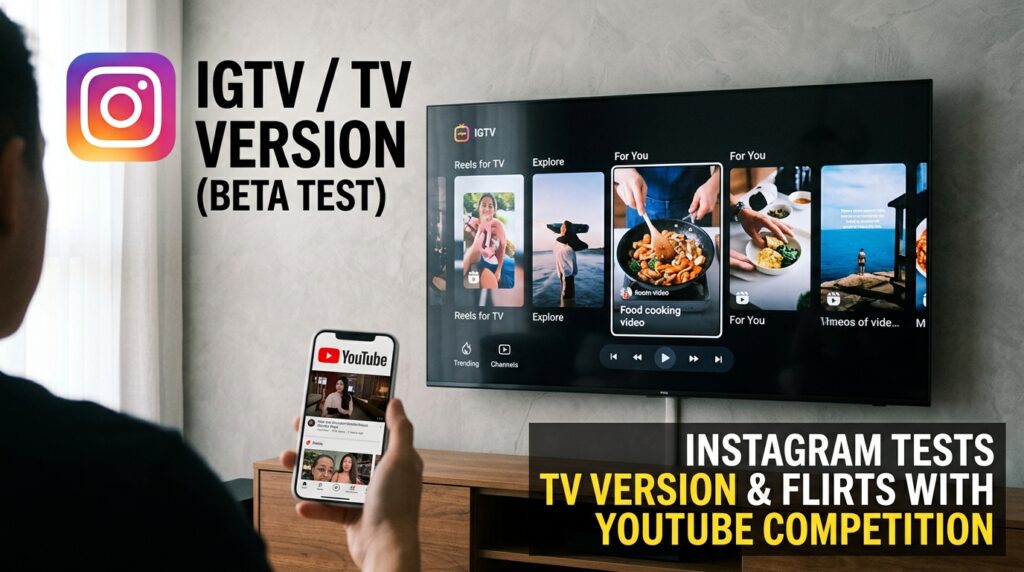
Instagram can borrow the mechanics of recommendation, autoplay, and creator-led video programming. It can also borrow the notion that the homepage should surface a mix of known creators and algorithmic discovery. But it cannot borrow YouTube’s entire value proposition without changing its own identity. If the product becomes too similar, the rationale for using Instagram instead of YouTube weakens fast.
That is the tension Meta has to manage. The platform may succeed if it treats TV as a new viewing surface for creators already inside the Instagram ecosystem. It may fail if it assumes that the same Reels logic will hold in a television context. This method works well for discovery, but it falters when users want depth, series continuity, and editorial clarity.
Comparison of the Two Platforms on TV
Dimension YouTube on TV Instagram TV version Primary behavior Lean-back viewing, search, subscriptions, recommendations Discovery-led video browsing and creator sampling Content depth Strong long-form and mid-form library Likely stronger in short-form and creator highlights Navigation TV-native and mature Would need major adaptation Monetization Established ad stack and creator ecosystem Potentially strong, but still experimental Strategic moat Catalog depth and habit Social discovery and Meta’s distribution power
The Product Challenges Meta Cannot Ignore
TV UX is a Different Discipline
Designing for television is not a matter of enlarging the interface. Remote controls are slower than touch, and the TV view distance changes how users scan content. The interface must reduce decision fatigue, clarify focus states, and support predictable exits and entries. If Meta overbuilds social features into that environment, it will bury the viewing experience under clutter.
Who works in this field knows that TV products fail when they confuse engagement with usability. A mobile app can survive on novelty and fast interaction. A TV app needs calm sequencing, stronger metadata, and fewer dead ends. That is one reason many social products struggle on the big screen: they are engineered for motion, not for continuity.
Content Rights, Creator Incentives, and Moderation
Any move into TV also raises rights-management questions. Music usage, clip licensing, reuploads, and creator ownership become more visible when content reaches a bigger audience and a longer viewing window. Meta would need tighter safeguards around copyrighted material, especially if the product leans into video that resembles broadcast or streaming-TV formats.
Creators matter just as much. If Instagram wants meaningful TV engagement, it must give creators a reason to adapt their output. That could mean longer-form uploads, better distribution analytics, or packaging tools that make vertical video easier to watch horizontally. Without those incentives, the TV version risks becoming a passive sampling layer instead of a real destination.
Where the Effort Could Break Down
There is a limit to how far Instagram can stretch without diluting its core value. The platform already balances DMs, Stories, Reels, creator tools, and shopping signals. Adding TV introduces a new product surface with different content expectations. If that surface cannibalizes mobile behavior without creating durable watch time, the experiment will disappoint investors and creators alike.
Risk assessment: the TV strategy can work for discovery and brand reach, but it may underperform for depth unless Meta solves for serial viewing. In other words, the test may prove demand for Instagram video on TV, but not necessarily prove that Instagram can become a full YouTube alternative.
What This Signals for Creators, Brands, and the Ad Market
Creators Will Be the First Stress Test
Creators are the clearest indicator of whether the product has legs. If they see new reach on TV, they will adapt thumbnails, intros, and pacing. If the audience behaves like a channel audience rather than a feed audience, creators will start thinking in segments, series, and repeatable formats. That is how a platform changes from social network to viewing destination.
In my experience, these shifts happen first in creator behavior, not in corporate announcements. Viable video platforms are built when creators notice that their analytics change in a meaningful way. If watch time, completion rate, and cross-device retention improve, the content strategy changes fast. If those numbers stay flat, the experiment remains a headline, not a market shift.
Brand Budgets Will Follow Attention, Not Branding Claims
Advertising will only move if viewing time on TV becomes measurable and scalable. Brands care less about a platform’s ambition than its ability to deliver incremental reach and stable audience segments. If Instagram can prove that creator videos on TV attract younger viewers who are hard to reach through linear media, it could open a new budget lane.
That lane would compete not only with YouTube but also with streaming-ad ecosystems from Hulu, Roku, and Amazon Fire TV. Meta’s strength is targeting depth and ad tooling; its weakness is that advertisers already trust YouTube’s scale on TV. A new surface has to earn its place with data, not just product vision.
How This Fits the Broader Connected-TV Market
The connected-TV market has become one of the most important battlegrounds in digital media because it blends premium viewing with measurable targeting. Netflix, Amazon, Roku, Disney, and YouTube all want a share of that attention, each with different strengths. Meta’s entry would be unusual because it comes from a social company rather than a traditional video distributor.
That unusual angle is not a guarantee of success, but it does create an opening. Meta has massive identity data, ad infrastructure, and creator relationships. If the company can translate those assets into a coherent TV product, it might win a niche that is too social for YouTube and too video-heavy for the rest of Meta’s apps.
How to Read the Move Strategically and What Comes Next
What to Watch in the Next Product Cycles
The key signals will be interface clues, creator tooling, and whether Meta announces explicit support for living-room platforms. Watch for changes in content packaging, playback behavior, and recommendations that emphasize video sessions rather than post-by-post browsing. Those are the tells that separate an internal test from a real platform strategy.
Also watch the language Meta uses. If the company frames TV as a “video viewing” experience, that suggests a broader ambition. If it frames the test as an incremental experiment, the company may be probing demand before committing engineering and licensing resources. The difference matters because platform bets tend to harden only after the first evidence of retention.
How This Could Reshape the Video Hierarchy
If Instagram succeeds, the likely outcome is not a direct replacement for YouTube. It would be a fragmented video landscape in which Instagram owns creator-led discovery and YouTube retains the strongest long-form living-room position. That is still strategically meaningful, because even a partial shift in viewing time can redraw ad allocation and creator workflows.
If Instagram fails, the reason will probably be conceptual rather than technical: the platform may remain too social and too feed-dependent to feel natural on a TV. That would not be a small miss. It would confirm that the biggest screen rewards depth, not novelty, and that social discovery alone does not build a sustainable television habit.
Practical Reading for Product and Media Teams
The correct takeaway is not “Instagram will beat YouTube.” It is that Meta is testing whether a mobile-native social graph can become a credible TV video surface. That is a much narrower claim, and it is the one worth tracking. Product teams should study how interface constraints alter content behavior; media teams should track whether ad spend begins to follow the new surface.
For operators, the strategic lesson is clear: the future of video is not one screen, one format, or one winner. It is a set of viewing contexts, and the platforms that adapt their UX to each context will capture more of the market. Instagram is trying to prove it belongs in the living room. That alone is a significant move.
Próximos Passos Para Implementação
If Meta continues this test, the next sensible step is to measure the product on three axes: session length, creator retention, and ad yield. Those metrics tell a truer story than download counts or curiosity clicks. A TV version that increases total watch time without harming mobile engagement could justify a broader rollout.
For analysts and media teams, the right response is to separate hype from product-market fit. A TV interface only matters if it creates repeatable viewing behavior. If it does, Instagram may become a meaningful secondary video destination. If it does not, the project will remain a useful signal about Meta’s ambitions, but not a serious challenger to YouTube’s core position.
The most defensible interpretation today is cautious but firm: Instagram is probing a strategic expansion into connected TV, and that move makes sense. Whether it becomes a durable platform category will depend on how well Meta respects the rules of television instead of trying to force a mobile feed into a living room.
FAQ
Is Instagram Really Trying to Become a YouTube Competitor on TV?
Not in the full YouTube sense, at least not yet. The more accurate reading is that Meta is testing whether Instagram video can work on connected TVs as a discovery and viewing surface. That could create partial overlap with YouTube, but replacing YouTube would require deeper content libraries, stronger search behavior, and more mature playback design than Instagram currently has.
Why Would a TV Version Matter for Creators?
A TV version could increase watch time, expand reach, and push creators to package content in more intentional formats. If the interface supports longer sessions, creators may start producing series-style clips, higher-quality intros, and more structured video cuts. The incentive only becomes real if analytics show that TV viewers stay longer and return more often.
What is the Biggest Product Risk for Meta?
The biggest risk is confusing a larger screen with a better viewing experience. TV users expect continuity, low-friction navigation, and a strong recommendation layer. If Instagram imports too much of its mobile feed logic, it could feel noisy and frustrating on TV, which would limit adoption and reduce the value of the experiment.
How is This Different from Instagram Reels on a Phone or Tablet?
Reels on mobile is built around quick interaction, swiping, and interruptions. A TV version would need to support a lean-back environment where users watch for longer periods and expect clearer program flow. The change is not just in screen size; it is in usage behavior, content pacing, and interface expectations.
Could This Shift Ad Budgets Away from YouTube?
It could, but only at the margins at first. Advertisers will move money if Instagram proves it can deliver measurable reach, engaged viewing, and reliable targeting on TV. YouTube still has the advantage in long-form content and viewing habit, so Meta would need strong evidence before budgets shift meaningfully.
What Should Media Teams Monitor Next?
They should watch for changes in creator tools, TV app availability, and any signal that Meta is optimizing for longer sessions rather than short clips. It also helps to track whether content is being repackaged for living-room viewing and whether recommendations become more channel-like. Those are the indicators that the strategy is moving from test phase to platform strategy.
External sources referenced: Pew Research Center on digital media behavior, U.S. Federal Trade Commission on platform and ad-market oversight, and Nielsen on TV and streaming audience measurement.
Editorial Notice
This content was structured with the assistance of Artificial Intelligence and subjected to rigorous curation, fact-checking, and final review by Editor-in-Chief Nivailton Santos. TechTool Judge reaffirms its unyielding commitment to journalistic ethics, ensuring that editorial judgment and data validation remain entirely under human responsibility and final editorial oversight.