
Synthetic Biology, Biocomputing, DNA Data Storage, Organic Hardware

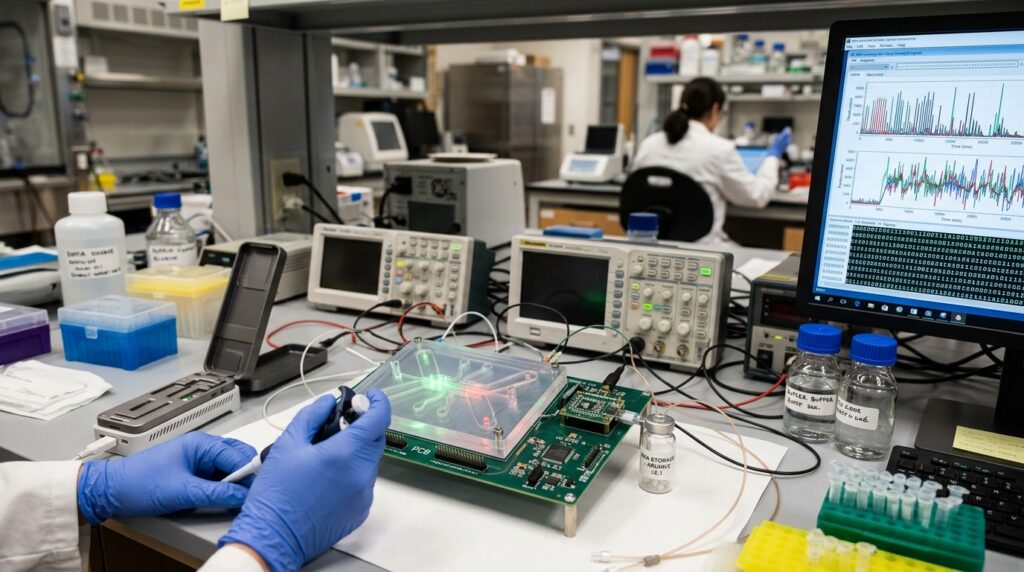
Synthetic Biology and Biocomputing: DNA Data Storage and the Evolution of Organic Hardware describes a converging field in which engineered biological systems are used not only to process information, but also to store it, sense it, and eventually perform hardware-like functions inside living or cell-free environments. In formal terms, it sits at the intersection of synthetic biology, molecular computation, and bioelectronic design: DNA serves as a high-density archival medium, while biological circuits, enzymes, and living cells become computational substrates.
This matters now because conventional silicon systems are colliding with physical limits. Data centers consume enormous energy, long-term digital preservation is fragile, and computing architectures are becoming increasingly specialized. DNA offers a radically different storage paradigm: dense, stable, and biologically legible over long time horizons. At the same time, researchers are learning how to make cells behave more like programmable machines, which opens the door to organic hardware that can sense, compute, and respond in environments where conventional chips struggle.
The real shift is not hype around “bio-computers.” It is the growing recognition that biology can be engineered as infrastructure. That includes archival storage, distributed sensing, wetware logic, and hybrid systems where molecules, proteins, and cells take on roles once reserved for transistors and flash memory. The field is still constrained by synthesis costs, error correction, read/write speed, and regulatory complexity, but the trajectory is clear: biology is moving from being merely a source of inspiration to becoming a computational medium.
Pontos-Chave
- DNA data storage is a physical information medium, not a metaphor: digital bits are encoded into nucleotide sequences, synthesized, preserved, and later sequenced back into binary form.
- Biocomputing is strongest where conventional electronics are weak, especially in highly parallel sensing, biochemical decision-making, and environments that require molecular-level interaction.
- Organic hardware is evolving from speculative language into an engineering category that includes engineered cells, cell-free circuits, and biohybrid devices with functional computational behavior.
- The main barriers are still economic and operational: DNA synthesis, sequencing errors, write latency, and system integration remain the limiting factors.
- The most credible near-term use cases are archival storage, biosensing, and hybrid control systems, not replacing laptops or servers.
Synthetic Biology and Biocomputing: DNA Data Storage and the Evolution of Organic Hardware
What the Field Actually Means
Synthetic biology is the design and construction of biological systems with new functions. Biocomputing applies computation to biological substrates, often using DNA, RNA, proteins, or cells to implement logic, memory, or control. DNA data storage is a specific application in which information is encoded into nucleotide sequences and stored as synthetic DNA molecules. Organic hardware is the broader category for biological or biohybrid components that perform hardware-like roles: sensing, switching, memory retention, signal propagation, and in some cases decision-making.
The phrase sounds broad because the field is broad. But the technical core is precise. DNA is chemically stable relative to many digital storage media, and biological systems can carry out enormous numbers of molecular interactions in parallel. That means biology can function as both a repository and a processor of information. The catch is that biological computation has different design constraints than silicon. It is slower, noisier, and harder to standardize. Those constraints do not negate the field; they define it.
Why DNA is Such a Compelling Storage Substrate
DNA data storage is attractive for one reason above all: density. In principle, DNA can store vastly more information per gram than magnetic, optical, or semiconductor media. It also supports very long retention times when properly preserved. Researchers at Harvard and elsewhere have shown that synthetic DNA can preserve digital information for years under controlled conditions, and that the information can be recovered by sequencing and decoding. For long-term archives, that combination is unusually powerful.
The practical picture is more nuanced. DNA is not suitable for fast random-access workloads, and writing data into DNA remains expensive compared with standard digital storage. For that reason, the most credible use case is cold storage: legal archives, scientific records, cultural heritage, and other data that must survive for decades or centuries rather than milliseconds. A useful reference point is the ongoing research landscape summarized by institutions such as Nature Reviews Genetics and the U.S. National Human Genome Research Institute’s materials on DNA technology, which help frame the biochemical constraints behind sequence design and readout.
Where Organic Hardware Begins
Organic hardware is not one single device category. It spans engineered microbes, cell-free gene circuits, DNA-based logic gates, protein assemblies, and biohybrid interfaces that couple living tissue to electronics. In practice, the most advanced systems are modular: one module senses a chemical signal, another performs a logical transformation, and a third produces an output such as fluorescence, gene expression, or an electrical response.
That modularity matters because it makes biology engineerable. Designers can treat promoters, repressors, riboswitches, CRISPR-based controllers, and enzymatic pathways as composable parts. Anyone who has worked in a wet lab knows the hard part is not the diagram. It is the crosstalk, drift, and context dependence that appear once real biological parts are placed in a living environment. That is where the engineering challenge becomes real.
How DNA Data Storage Encodes, Preserves, and Recovers Information
Encoding Digital Information Into Nucleotides
The encoding workflow starts by translating binary data into a nucleotide alphabet, usually with rules that avoid long repeats and extreme GC content. Those constraints reduce synthesis and sequencing errors. Compression, redundancy, and error-correcting codes are then applied before synthesis. Without that layer, recovery becomes fragile because biological production is imperfect by nature.
In practical systems, data is not written as a single long sequence. It is broken into many oligonucleotides, each carrying an address or index. That indexing is essential for reconstruction. If you lose order, you lose meaning. This is why DNA storage is as much an information-theory problem as a biochemical one.
Preservation, Degradation, and Error Correction
DNA can persist for surprisingly long periods, but only if environmental damage is controlled. Heat, moisture, radiation, oxidation, and enzymatic contamination all degrade integrity. The chemistry is well understood, which is one reason archiving experiments often use encapsulation, dry storage, or protective scaffolds. But no preservation scheme is magical. Every storage design balances density against survivability and retrieval cost.
Error correction is therefore central, not optional. Reed-Solomon style codes, fountain codes, and layered parity schemes are used to recover data from incomplete or corrupted pools. This is where many outsider descriptions oversimplify the field. DNA storage is not “write once, read forever.” It is a managed archival workflow in which redundancy buys reliability.
Reading Data Back from the Molecule
Retrieval uses sequencing, then software decoding. The current bottleneck is not conceptual but operational: synthesis and sequencing remain expensive relative to magnetic storage, and turnaround time is still far slower than electronic access. However, the economics matter less when the target is centuries-long preservation rather than active computation.
Harvard’s early proof-of-concept work and later industry efforts, including organizations such as Twist Bioscience and Catalog, established that molecular storage is feasible at scale, even if not yet economical for mainstream consumer workloads. The conclusion is straightforward: DNA storage is viable where density and durability justify latency and cost.
Biocomputing as Molecular Logic, Not Science Fiction
What Counts as Computation in a Biological System
In biocomputing, computation means transforming inputs into outputs through rule-based molecular behavior. Inputs may be metabolites, light, temperature, RNA species, or disease markers. Outputs may include gene expression, protein production, enzymatic cleavage, or electrical signaling. A DNA strand displacement circuit, for example, can implement logic by allowing strands to displace one another based on sequence complementarity.
That is still computation, even if it does not look like a silicon processor. The key difference is medium. Instead of electrons in transistors, you are manipulating chemical reactions, diffusion, and molecular recognition. The advantage is native compatibility with the biochemical world; the disadvantage is speed, noise, and environmental sensitivity.
DNA Strand Displacement and Synthetic Gene Circuits
DNA strand displacement has become one of the most useful frameworks in the field because it offers predictable, programmable behavior. A strand can be designed to bind, displace, or release another strand based on sequence logic. This enables logic gates, amplifiers, and cascades without requiring a living cell. Cell-free systems then provide a cleaner testbed for building circuits that would be harder to isolate in vivo.
Synthetic gene circuits extend the idea into living systems. Researchers use repressors, activators, CRISPR interference, and transcriptional feedback loops to create logic and memory inside cells. This is where Synthetic Biology and Biocomputing: DNA Data Storage and the Evolution of Organic Hardware becomes more than a storage story. It becomes a design language for living machines that can sense and act within biochemical environments.
Why Biology Excels at Parallelism
Biology is naturally parallel. Millions of molecules can interact simultaneously in a tiny volume, and each interaction can encode state. That gives biological systems an edge in tasks like distributed sensing, pattern recognition in chemical environments, and massively multiplexed assays. Silicon can imitate some of this behavior, but it usually does so with more overhead.
The limitation is determinism. Biological reactions fluctuate. Concentrations vary. Cellular states drift. So biocomputing is not a replacement for digital logic in general-purpose computing. It is a domain-specific advantage where molecular context is the point, not the obstacle.
Organic Hardware: From Living Cells to Biohybrid Devices
Living Cells as Programmable Components
When engineers refer to organic hardware, they usually mean systems that use living cells as active functional units. Bacteria can be engineered to detect inflammation markers, metabolize pollutants, or produce therapeutic molecules. Mammalian cells can be programmed to respond to disease signals and trigger downstream effects. In each case, the cell behaves less like a biological object and more like a configurable component.
This approach works because cells already contain the machinery needed for sensing, signal transduction, amplification, and response. Synthetic biology adds the control layer. The best designs exploit what biology already does well, then reduce the number of unnatural assumptions imposed on the system.
Cell-free Systems and the Move Toward Modularity
Cell-free platforms are a major step toward practical organic hardware. By extracting the transcription-translation machinery from cells, researchers can build circuits without the complexity of maintaining a living organism. That improves reproducibility and makes system behavior easier to measure. It also shortens the path from design to test.
Cell-free systems matter because they bridge chemistry and computation. They are not as robust as fully living systems over the long term, but they are easier to debug. In many labs, that trade-off is worth it. One can prototype a genetic controller in vitro, then decide whether the added complexity of a living chassis is justified.
Bioelectronics and Hybrid Interfaces
Organic hardware increasingly includes interfaces between biology and electronics. Microfluidic chips, biosensors, and conductive polymer interfaces can translate biochemical states into electronic signals. This hybrid layer is where practical deployment is happening fastest, because it allows biology to remain biological while electronics handle readout and coordination.
That boundary is strategic. Pure biological computation is too slow for many applications, but pure silicon cannot natively process chemical context with the same fidelity. Hybrid systems let each medium do what it does best. That is why serious engineers think in terms of interface design, not ideological purity.
Where the Economics and Engineering Still Break Down
Cost, Speed, and Throughput Constraints
The strongest objection to DNA storage is not technical possibility; it is economics. Writing DNA remains orders of magnitude more expensive than writing to conventional storage, and the throughput is not competitive for hot data. Sequencing has become cheaper, but synthesis is still a major bottleneck. For mass adoption, that gap must narrow significantly.
Speed is another hard limit. Silicon reads and writes at electronic time scales. Biology operates at chemical time scales. This mismatch makes DNA storage unsuitable for active databases and most transactional systems. That said, archival workloads do not require constant access, so the mismatch is not fatal in the right use case.
Reliability, Standardization, and Biological Variance
Who works in this field knows that the real difficulty is not only the design on paper. It is the variance across batches, organisms, enzymes, and storage conditions. Biological systems change with context, and that makes standardization harder than in semiconductor manufacturing. There is no single fabrication line that guarantees identical behavior across every chassis.
That variability forces a more conservative engineering style. Designs need validation layers, orthogonal controls, and explicit assumptions about failure modes. Some researchers talk as if biology will eventually become as deterministic as silicon. It will not. The better bet is to build architectures that tolerate variation rather than pretending it can be eliminated.
Regulation, Safety, and Governance
Bioengineered information systems raise safety and governance questions that traditional storage does not. Living systems can evolve, mutate, or interact with ecosystems. Even cell-free platforms can be mishandled if they contain sensitive constructs. Regulatory frameworks for synthetic biology are improving, but they still lag behind the pace of experimentation.
Institutions such as the National Institutes of Health and the National Institute of Standards and Technology are relevant here because standardization and biosafety guidance will shape adoption. A technically brilliant platform that cannot be governed safely will stay confined to the lab.
Where the Field is Already Useful
Archival Storage for High-value Data
The most realistic near-term role for DNA storage is cold archival infrastructure. Think legal records, genomic reference datasets, museum digitization, national archives, or long-term scientific repositories. These are datasets where retrieval latency is acceptable and preservation value is high. If a file must survive fifty years with minimal energy cost, DNA starts to look rational.
This is not hypothetical. Research groups and startups have already demonstrated archive-class prototypes. The point is not that DNA will replace cloud storage. It is that it can absorb a small but important class of information that is expensive to preserve with conventional media.
Biosensing and Medical Decision Support
Organic hardware has immediate value in biosensing. Engineered cells or cell-free circuits can detect biomarkers, toxins, or metabolic changes with high specificity. That makes them attractive for diagnostics, environmental monitoring, and therapeutic feedback systems. In many of these settings, the system does not need general-purpose computation; it needs reliable molecular discrimination.
That is why the field matters clinically. A biological device can operate where a traditional chip has no native visibility: inside a bloodstream, a tissue microenvironment, or a contaminated water sample. The hardware is useful because the medium is the signal source.
Research Tooling and Programmable Assay Platforms
Lab research is another practical domain. Molecular logic, barcoded DNA pools, and programmable reaction networks can make assays more scalable and more information-rich. Instead of treating every measurement as a one-off experiment, researchers can design multiplexed systems that report on many conditions at once.
Those platforms are already changing how some labs think about experimentation. They compress workflow, reduce sample waste, and create richer readouts. The frontier is not flashy consumer technology. It is instrumentation that makes biology itself easier to measure and control.
The Road Ahead for Molecular Computing and Biological Infrastructure
What Progress Would Actually Matter
The next major milestones are not vague. Lower-cost DNA synthesis, higher-fidelity assembly, better random access, and faster molecular read/write cycles would move DNA storage closer to operational utility. On the biocomputing side, the field needs better circuit predictability, lower leakage, and cleaner interfaces with electronic systems. Without those gains, the field remains scientifically impressive but commercially narrow.
The strongest near-term outcome is a hybrid stack: electronics for speed, biology for context, and DNA for durable memory. That combination is more plausible than any claim that cells will replace chips. The engineering logic points toward complementarity, not conquest.
Why Standards Will Matter as Much as Invention
Standards are not a bureaucratic afterthought here. They define how sequences are encoded, how error rates are measured, how storage conditions are validated, and how biological outputs are compared across labs. Without standards, the field fragments into beautiful demos that cannot be reproduced.
That issue is already visible across synthetic biology more broadly. Different chassis, different promoters, different extraction methods, different reporting norms. A mature industry will need standardized metadata, verification pipelines, and quality benchmarks. Technology without measurement discipline does not scale well.
A Grounded Forecast
My view is direct: DNA data storage will not become the default medium for active computing, and it does not need to. Its value lies in archival density and durability. Organic hardware will not displace semiconductor systems, but it will occupy domains where biochemical native intelligence matters more than clock speed. That split is not a weakness; it is the market shape of the field.
The winners will be organizations that design around the true strengths of biology instead of forcing it into silicon metaphors. That means choosing the right workload, the right chassis, and the right interface. The future is not “biological laptops.” It is a layered infrastructure where molecules carry information, cells execute local logic, and electronics coordinate the rest.
Próximos Passos Para Implementação
The strategic move is to treat DNA storage and organic hardware as infrastructure categories with different job descriptions. DNA belongs in long-horizon archives and information preservation pipelines. Biocomputing belongs in molecular sensing, assay automation, and environments where biochemical context is the problem to solve. Hybrid systems will deliver the most value because they assign each layer to the medium that handles it best.
For organizations evaluating the field, the decision should start with workload fit, not novelty. If the use case demands speed, conventional compute wins. If it demands years of preservation, molecular density becomes compelling. If it demands local biochemical response, organic hardware offers capabilities silicon cannot match directly.
The next serious step is controlled deployment with measured targets: synthesis cost per bit, retrieval fidelity, reaction leakage, and environmental stability. Those metrics will separate serious platforms from speculative prototypes. Biology is becoming a computational material, but only disciplined engineering will determine which applications survive outside the lab.
FAQ
What is the Technical Difference Between DNA Data Storage and DNA Computing?
DNA data storage uses DNA as a passive medium for archiving digital information, while DNA computing uses DNA strands or molecular reactions to perform logic operations. In storage, the goal is faithful encoding and retrieval. In computing, the goal is transformation of inputs into outputs through molecular rules. The two often overlap in the same research ecosystem, but they solve different problems and are judged by different performance metrics.
Why is DNA Considered a Strong Archival Medium?
DNA has extremely high theoretical storage density and can remain stable for long periods when protected from heat, moisture, and enzymatic damage. It also does not require constant electrical power to preserve information, which is a major advantage for cold storage. The trade-off is slow access and costly synthesis, so it is best suited to data that matters more over decades than seconds.
What Limits the Practical Deployment of Organic Hardware Today?
The biggest constraints are variability, speed, and integration. Living systems drift, biological reactions are slower than electronic circuits, and interfaces between biology and hardware still require careful engineering. Costs and regulatory concerns also matter. The field is advancing, but it remains strongest in specialized sensing and control tasks rather than general-purpose computing.
Are Cell-free Systems More Practical Than Living Cells for Biocomputing?
Often, yes, for prototyping and controlled workflows. Cell-free systems reduce complexity, improve reproducibility, and make circuit behavior easier to isolate and debug. Living cells offer richer functionality and self-maintenance, but they introduce more context dependence and harder-to-predict dynamics. The best choice depends on whether the application values precision or biological persistence more.
Will DNA Storage Replace Flash, HDDs, or Cloud Storage?
No, not in any broad sense. DNA storage is too slow and too expensive for active data workloads, so it will not displace conventional storage architectures. Its value lies in niche archival roles where density, longevity, and energy efficiency outweigh latency. The more realistic future is a multi-tier storage stack with DNA at the deepest archival layer.
Editorial Notice
This content was structured with the assistance of Artificial Intelligence and subjected to rigorous curation, fact-checking, and final review by Editor-in-Chief Nivailton Santos. TechTool Judge reaffirms its unyielding commitment to journalistic ethics, ensuring that editorial judgment and data validation remain entirely under human responsibility and final editorial oversight.