
Excess Energy Curtailment and Why ONS is Cutting Small Power Plants

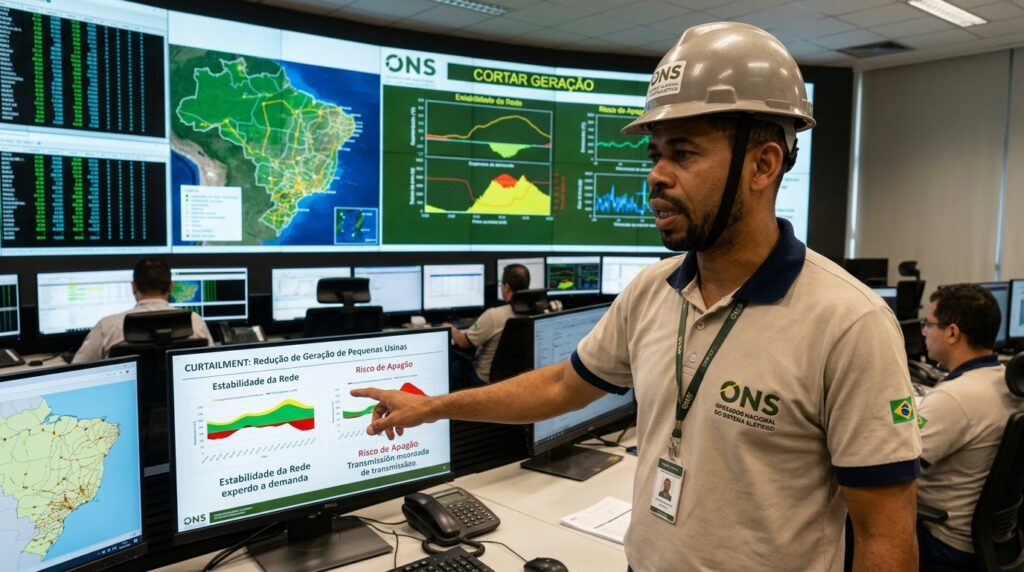
Excess energy curtailment is the forced reduction of electricity generation when the grid cannot absorb all available supply, even though plants are technically capable of producing more. In the Brazilian case, the National System Operator, or ONS, is now requiring cuts for the first time from small power plants as well, not just large projects. That is a material shift in grid operation: it means the constraint is no longer limited to a handful of big assets, but has reached distributed and smaller-scale generation units too.
This matters because curtailment is not a commercial inconvenience. It is a system-level signal that generation, transmission, demand, and dispatch rules are no longer aligned. When the grid is saturated, the operator must preserve frequency, voltage, and security of supply. In practice, that means renewable output, especially from wind and solar assets tied to constrained corridors, can be reduced even when weather conditions are favorable and equipment is available.
The decision also exposes a harder truth about the current power mix: installed capacity is not the same as deliverable capacity. Brazil has added a large volume of intermittent generation faster than the network, storage, and transmission reinforcements needed to absorb it. The result is a more complex operating environment for ONS, ANEEL, generators, and consumers alike.
Key Points
- ONS curtailment for small plants signals a structural grid constraint, not a temporary operational glitch.
- The issue is driven by supply exceeding demand in specific hours and regions, combined with transmission bottlenecks and limited flexibility.
- Wind and solar plants are the most exposed because their output is weather-driven and often concentrated in already congested areas.
- For generators, the financial impact depends on contract structure, dispatch rules, and whether the cut is classified as system, network, or energy constraint.
- The long-term fix is not one measure; it requires transmission expansion, better forecasting, storage, demand flexibility, and regulatory clarity.
Excess Energy Curtailment and Why ONS is Cutting Small Power Plants
Formally, curtailment is an instruction to reduce output from generation units even though they are available to produce electricity. In power-system terms, it is a dispatch constraint imposed by the operator to maintain the balance between supply and demand while respecting transmission limits and security criteria. In plain language, the grid has more electricity than it can safely handle at that moment, so some plants are told to back off.
The fact that ONS is now extending these cuts to smaller power plants is significant because it widens the operational footprint of the problem. Historically, the first restrictions usually affected larger assets or highly concentrated corridors. When smaller plants are included, it usually means the issue has become more dispersed across the system, or the operator needs finer control to preserve stability. That is a different order of problem.
For context, ONS is the entity responsible for coordinating the operation of Brazil’s interconnected grid. Its decisions are guided by system security, not by individual generator economics. The operator’s public technical material and operational reports, available through the ONS official website, show how heavily the Brazilian system depends on real-time balancing and transmission adequacy.
What Changed in Practice
What changed is not that generators suddenly became inefficient. What changed is the relationship between peak generation hours and load absorption. In several periods, especially when wind and solar output is strong and demand is moderate, supply can exceed what the local network can export. If the transmission path out of a region is saturated, the operator has no choice but to reduce generation at the source.
Who works with this knows the hardest part is that curtailment rarely shows up as one clean cause. A plant may be technically healthy, weather conditions may be favorable, and contracts may be in place, yet the grid still rejects output because the limiting factor sits elsewhere. That is why curtailment disputes often involve technical evidence, metering data, dispatch logs, and regulatory interpretation.
Why Small Plants Are Now in Scope
Small plants tend to be treated differently in regulatory and operational design because they are numerous, geographically dispersed, and often part of distributed or semi-distributed expansion. But once excess energy becomes persistent, the operator cannot rely only on large-unit controls. Smaller plants also become part of the balancing toolkit, especially where local congestion or reverse power flow threatens stability.
There is a practical trade-off here. Expanding curtailment to smaller assets gives the system operator more room to maneuver, but it also spreads financial and contractual pain across more market participants. That may be necessary in the short term, yet it is not a substitute for structural investment. This approach works in acute congestion, but it fails as a long-term substitute for grid expansion.
The System Drivers Behind the Surplus: Demand, Transmission, and Intermittency
Three forces usually converge before curtailment becomes unavoidable: weak or uneven demand at certain hours, insufficient transmission capacity, and high intermittent generation. In Brazil, the growth of wind and solar has been fast enough that some regions now produce more power than local load can absorb during favorable conditions. When that happens, the system has to shed generation rather than risk overload.
This is not a sign that renewables are the problem. It is a sign that the system around renewables has not caught up at the same pace. A modern power mix needs more than generation assets; it needs grid reinforcements, reactive power support, digital controls, and enough flexibility to move energy from where it is produced to where it is needed. Without those elements, clean power can still be stranded.
Constraint What It Means Operational Effect Low demand window Consumption drops below available generation Operator reduces output to keep balance Transmission bottleneck Lines or substations cannot carry more power Generation is cut at the source Intermittent oversupply Wind or solar spikes beyond load forecast System needs rapid downward dispatch Limited flexibility Few storage or demand-response resources Curtailment becomes the fastest control tool
How Wind and Solar Concentration Amplify the Problem
Brazil’s renewable buildout has been highly successful, but much of it is geographically clustered. That creates a classic congestion problem: the same corridors that connect strong renewable resource zones to load centers become overloaded at the same time output rises. Wind farms in the Northeast and utility-scale solar projects in specific substations can all be affected if the export path is already near its limit.
Solar adds another twist. Its output peaks around midday, which may not align with the system’s highest demand periods. If the network already has strong daytime generation and moderate consumption, the operator has to choose between overloading assets or curtailing production. That is why curtailment is often more visible in periods of strong sun and wind combined with subdued consumption.
Why Forecasting Alone Cannot Solve This
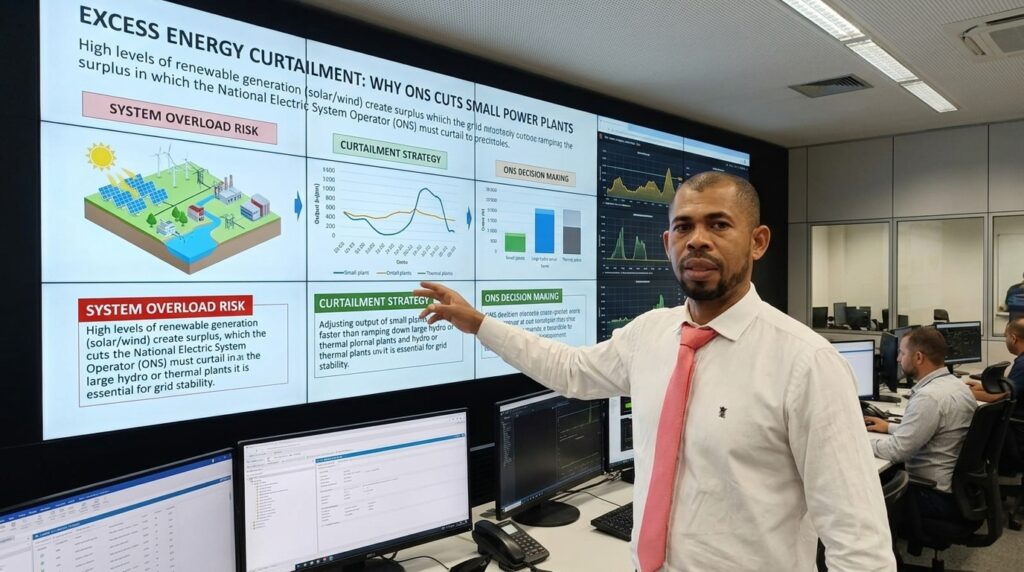
Better forecasting helps, but it does not eliminate physical constraints. An operator can predict surplus with impressive accuracy and still be unable to move the power elsewhere. Forecasts reduce uncertainty; they do not create transmission lines, batteries, or flexible load. That distinction matters because some stakeholders incorrectly treat the problem as if it were a planning error alone.
ONS, EPE, and regulators can refine their models, and they should. Still, model quality is only one layer of the response. The deeper challenge is that Brazil’s system now needs more tools at the operational edge. The Energy Research Office has repeatedly emphasized the importance of planning consistency between generation expansion and network reinforcement, and that coordination is now under pressure.
Regulatory and Financial Implications for Generators and Investors
Curtailment is not just a grid-operation issue; it is a revenue issue. For plants with merchant exposure or contracts sensitive to delivered energy, every megawatt-hour not injected can affect cash flow, debt coverage, and project valuation. The precise impact depends on the cause of the restriction, the market framework, and how the reduction is recorded under regulatory rules.
In Brazil, this is where ANEEL’s role becomes central. The regulator determines how cuts are interpreted, who bears the loss, and whether there is room for compensation in specific circumstances. The ANEEL official site is the relevant reference point for rules and resolutions, including the treatment of generation restrictions, market settlements, and sector compliance.
There is a limit to any blanket analysis, though. Not every plant will experience the same financial damage, and not every cut has the same legal status. A network constraint is not identical to a dispatch decision taken for reliability reasons, and that difference can matter in disputes, audits, and arbitration. The details decide the outcome.
What Developers and Lenders Will Reprice
Investors should assume that curtailment risk is now part of the underwriting conversation, not an edge case. That means rechecking production assumptions, stress-testing capture prices, and revisiting debt sculpting under lower availability scenarios. Lenders will also pay closer attention to congestion maps and local load profiles instead of relying only on resource quality and PPA tenor.
For project developers, the practical lesson is blunt: a great wind regime is not enough if the substation and evacuation line are weak. Viable projects now need stronger evidence of grid access, not just generation potential. In some cases, the commercial value of a project will be determined more by its location in the network than by its capacity factor.
Where Disputes Are Likely to Emerge
Disputes usually emerge around classification. Was the cut unavoidable system protection, or did it result from avoidable planning deficiencies? Was the plant curtailed due to a genuine network constraint, or was it a workaround for broader coordination failures? Those questions drive compensation claims and regulatory filings.
Experienced market participants also know that evidence quality is decisive. Metering records, dispatch notices, substation data, and time-stamped communications form the backbone of any serious challenge. Without that paper trail, a claim can collapse even when the operational facts are favorable.
What Needs to Change in Grid Operations and Energy Planning
The response to excess energy should not be limited to emergency curtailment protocols. Brazil needs a portfolio approach that combines transmission expansion, storage, flexible demand, and better system planning. If one of those pillars is missing, the pressure simply moves elsewhere in the chain.
Transmission is the most obvious bottleneck, but not the only one. Batteries, pumped storage, industrial load shifting, and time-of-use incentives can all help absorb output that would otherwise be curtailed. The point is not to eliminate every surplus hour; that is impossible. The point is to reduce the number of hours when valuable clean energy is stranded.
Short-Term Measures That Actually Help
- Improve intra-day forecasting and operational visibility for congested nodes.
- Prioritize network upgrades in regions with persistent renewable oversupply.
- Expand battery pilots near generation clusters and constrained substations.
- Use demand-response programs to shift flexible loads into surplus windows.
- Clarify curtailment compensation rules so investors can price risk more accurately.
What Will Not Solve It Alone
Subsidies alone will not fix congestion. Neither will more generation approvals without parallel grid reinforcement. And while storage is often presented as a universal remedy, it is not a magic substitute for transmission. Batteries help with timing and local balancing; they do not replace the need to move power across regions at scale.
The more serious strategic error is to treat curtailment as a nuisance rather than a planning signal. Once ONS starts cutting even smaller plants, the system is telling regulators and investors that the current expansion model has reached its limits. That signal deserves a structural response, not a public-relations response.
How the Market Should Interpret the First Small-Plant Cuts
The first small-plant cuts should be read as a marker of maturity in the problem, not as an isolated operational event. When curtailment broadens, the market moves from “this affects a few large assets” to “this is becoming a system design issue.” That changes investment logic, regulatory urgency, and the credibility of future expansion plans.
For policy makers, the message is clear: generation growth without synchronized network development creates stranded output and avoidable friction. For generators, the signal is equally direct: location, flexibility, and contractual protection now matter as much as nameplate capacity. For consumers, the implication is subtler but real. A system that must repeatedly curtail clean energy is a system that is not extracting full value from its asset base.
There is a broader lesson here about power-sector transitions. High shares of renewables do not automatically mean a weaker grid, but they do demand a smarter one. The countries and markets that adapt fastest will be the ones that treat congestion as a planning metric, not an after-the-fact surprise.
Próximos Passos Para Implementação
The most effective response is to align operation, regulation, and investment around the same congestion map. That means ONS needs sharper operational tools, ANEEL needs clearer curtailment rules, and developers need to price network risk honestly before capital is committed. The industry cannot keep assuming that every new megawatt will be fully dispatchable just because it is technically available.
For the market as a whole, the right next step is to build flexibility where the grid is weakest: constrained substations, export corridors, and load centers that can shift consumption. The combination of transmission reinforcement and demand-side flexibility will outperform any single intervention. That is the direction serious systems take when oversupply becomes structural rather than episodic.
In practical terms, the coming phase will reward planning discipline. Projects with stronger evacuation studies, better congestion analysis, and explicit curtailment stress tests will carry more credibility with lenders and off-takers. That is not pessimism. It is the new baseline for operating in a grid where excess energy can no longer be assumed to flow without friction.
FAQ
What Does Curtailment Mean in Power-system Operations?
Curtailment is the deliberate reduction of electricity generation even when a plant is available to produce. System operators use it when supply exceeds what the grid can safely absorb, or when transmission assets reach their limits. In Brazil, ONS applies this measure to preserve reliability, frequency, and voltage stability. It is a technical control action, not a statement that the plant is defective.
Why Would ONS Curtail Small Power Plants Instead of Only Large Ones?
Because the constraint may be local, not just system-wide. When congestion spreads across multiple nodes, smaller plants can also contribute to overload conditions or reverse flows that the network cannot handle. Including them gives the operator more control over the balance of supply and demand. It also indicates that the grid constraint has become more distributed than before.
Are Wind and Solar Plants the Main Targets of These Cuts?
They are usually the most exposed because their output depends on weather and often peaks when demand is not at its highest. That said, the real driver is not technology alone; it is the combination of generation location, transmission capacity, and load shape. A thermal or hydro unit in a congested area can also face restrictions if the system cannot move its output.
Does Curtailment Mean the Energy Transition is Failing?
No. It means the transition is outpacing some parts of the grid. High renewable penetration increases the need for transmission, storage, flexible demand, and better operational coordination. The issue is not that renewables are unworkable; it is that the supporting infrastructure has not scaled fast enough in certain regions.
What is the Biggest Risk for Investors in This Situation?
The biggest risk is overestimating deliverable generation and underpricing congestion. A project can look strong on paper and still lose value if its evacuation route is constrained during high-output hours. Investors should test local grid capacity, curtailment history, and regulatory treatment before finalizing financing assumptions. That discipline reduces surprises later.
Editorial Notice
This content was structured with the assistance of Artificial Intelligence and subjected to rigorous curation, fact-checking, and final review by Editor-in-Chief Nivailton Santos. TechTool Judge reaffirms its unyielding commitment to journalistic ethics, ensuring that editorial judgment and data validation remain entirely under human responsibility and final editorial oversight.