
Court orders Steam, PlayStation, Xbox, and other companies to pay R$298 million for loot boxes

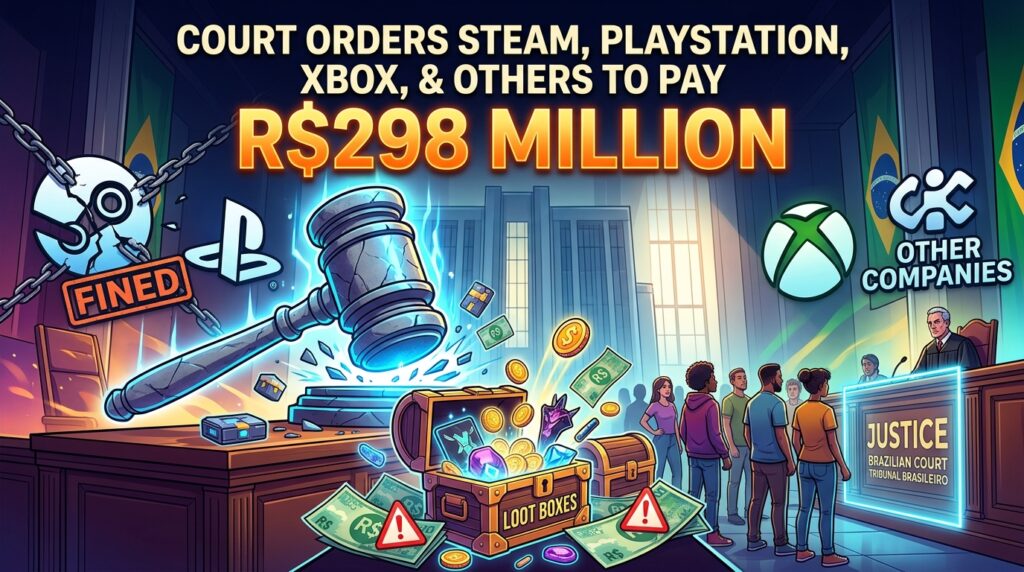
Court orders Steam, PlayStation, Xbox, and other companies to pay R$298 million for loot boxes is a Brazilian judicial ruling that treats randomized in-game reward systems as a serious consumer and child-protection issue, not just a design choice in video games. In formal terms, the case concerns alleged collective moral damages tied to the use of loot boxes in games accessible to minors, with the court in the Federal District holding major platform holders and publishers financially accountable.
This matters now because loot boxes sit at the intersection of game monetization, consumer law, and youth protection. The decision affects companies tied to major ecosystems such as Steam, PlayStation, Xbox, App Store, Google Play, and publishers including Electronic Arts, Riot Games, Ubisoft, Konami, Nintendo, Tencent, Valve, Sony, Microsoft, Apple, and Google. In practice, the ruling reinforces a simple but consequential idea: if a monetization mechanic resembles gambling in structure and reaches children, regulators and courts are increasingly willing to scrutinize it as a public-interest problem.
The larger issue is not one isolated judgment. It is the direction of travel. Courts, lawmakers, and regulators around the world are converging on the same concern: randomized monetization can distort informed consent, especially when minors are involved. That is why this case resonates beyond Brazil. It is a signal to the games industry that the legal standard is moving from “can this mechanic drive revenue?” to “can this mechanic survive scrutiny under child protection, transparency, and fairness rules?”
Key Points
- The ruling targets loot boxes as a consumer and child-protection issue, not as a purely creative game-design feature.
- The amount at stake, R$298 million, reflects collective moral damages rather than a simple commercial fine.
- The case involves major platform and publishing names, which raises the compliance bar across the gaming ecosystem.
- The legal debate centers on transparency, minors’ vulnerability, and whether randomized rewards resemble gambling-like mechanics.
- The decision aligns Brazil with a broader international trend of tougher scrutiny on in-game monetization.
Court Orders Steam, PlayStation, Xbox, and Other Companies to Pay R$298 Million for Loot Boxes: What the Ruling Actually Means
The Legal Concept Behind the Decision
Loot boxes are digital containers that grant randomized virtual items after a payment or in-game purchase. The legal issue is not randomness by itself; it is the combination of payment, uncertainty, and behavioral influence, especially when the user is a child or adolescent. In Brazilian law, that combination can trigger consumer-rights analysis, youth-protection rules, and collective moral damage claims if the practice is viewed as harmful to a broad group.
That distinction matters. A game can use random rewards without crossing a legal line if the mechanic is transparent, age-appropriate, and not exploitative. But once the system is marketed to minors, obscures odds, or uses psychologically sticky reward loops, the argument shifts. The court in the Federal District treated the issue as more than an isolated product dispute; it treated it as a structural problem affecting children’s rights and the market’s duty to inform.
Why the Amount is So High
The R$298 million figure is not a price tag on a single game. It reflects a collective civil judgment meant to compensate diffuse harm, discourage repetition, and recognize that many users may have been affected in small but cumulative ways. That is a different logic from a standard refund case. It is closer to a public-interest sanction designed to change corporate behavior across an industry segment.
In cases like this, the court is not asking whether one player lost too much money on one title. It is asking whether the business model, taken as a whole, creates a predictable risk of harm to a protected group. That is why the ruling has strategic importance for platform operators and publishers alike. A company can outsource development, but it cannot outsource responsibility for what it distributes, promotes, or monetizes.
Why This is Not Just a Gaming Story
The debate reaches beyond entertainment because loot boxes borrow mechanics long studied in behavioral economics: variable rewards, near-miss effects, and intermittent reinforcement. Those mechanisms are powerful. They are also controversial when applied to users who may not fully understand probability, sunk-cost behavior, or the real-world value of repeated microtransactions.
That is why regulators and courts often compare loot boxes to gambling-like systems without calling them identical to gambling. The resemblance is enough to trigger caution. In the Brazilian context, the sensitivity is even higher because child and adolescent protection has constitutional weight. If a monetization system can shape spending behavior in minors, the legal scrutiny will be intense.
Why Loot Boxes Trigger Legal and Regulatory Risk
Random Rewards, Paid Access, and Informed Consent
The core technical issue is informed consent. A user can consent to a transaction only if the conditions are understandable, visible, and not misleading. Loot boxes complicate that standard because the consumer pays for a chance, not a guarantee. In many jurisdictions, that structure is debated under consumer law, unfair commercial practices, and youth-protection frameworks.
Who works in this field knows the problem is not the word “random” on its own. The problem is the combination of opacity and monetization pressure. If the odds are hidden, the purchase flow is frictionless, and the user base includes minors, the system can look less like entertainment and more like a behavioral extraction model. That is where courts begin to intervene.
Minors Are the Decisive Factor
Minors are not simply “smaller adults” under the law. They receive special protection because they are more vulnerable to persuasive design, impulsive spending, and incomplete probability reasoning. This is why the same monetization mechanic can be acceptable in a narrow adult-only context and problematic in a mixed-age or child-facing environment.
That nuance is essential. Not every randomized reward is illegal, and not every game with microtransactions will face liability. But the legal risk rises sharply when the product is accessible to children, the spend loop is aggressive, or the company cannot demonstrate clear disclosures and safeguards. That is the line the court appears to have drawn in this Brazilian case.
What Global Regulators Say About Loot Boxes
Brazil is not acting in a vacuum. The U.S. Federal Trade Commission has long warned about deceptive design and consumer harm in digital markets, while the European Union’s legal framework increasingly emphasizes transparency and platform accountability. On the research side, universities and policy institutes have repeatedly documented the overlap between loot boxes and gambling-like spending patterns.
That body of work matters because it gives judges and lawmakers a factual foundation. The legal system does not need to prove that every loot box causes addiction. It only needs a reasonable basis to conclude that the mechanic can mislead, pressure, or exploit a protected audience. For policymakers, that is enough to justify stronger disclosure, age-gating, or even restrictions.
Who is Covered and Why the Case Reaches So Many Companies
Platforms, Storefronts, and Publishers Are All in the Chain
The ruling’s reach is striking because it spans both platforms and publishers. Steam, PlayStation, Xbox, App Store, and Google Play are distribution ecosystems. Valve, Sony, Microsoft, Apple, and Google control access, visibility, and payment rails. Publishers such as Electronic Arts, Riot Games, Ubisoft, Konami, Nintendo, and Tencent shape the in-game economy itself. In legal terms, that means responsibility can attach at multiple layers.
This is one of the hardest lessons for the industry. Companies often assume the developer bears the risk because it designed the mechanic. In reality, the platform that hosts the game, processes the transaction, or profits from the sale can also face scrutiny if the harm is systemic and foreseeable. That is why platform governance now sits at the center of game-law compliance.
Why Valve, Sony, Microsoft, Apple, and Google Matter Differently
Not all defendants perform the same function. Valve and Sony may be viewed through the lens of storefront curation and ecosystem control. Microsoft, Apple, and Google raise questions about app distribution, account systems, and in-app purchases. Publishers such as Electronic Arts or Riot Games are usually closer to the monetization design itself. The court’s broad list of defendants suggests it looked at the economic chain, not just the final game build.
That matters because modern gaming is platform-mediated. A player does not always buy directly from a studio. The transaction runs through hardware ecosystems, digital wallets, app stores, and online services. Once a company benefits from that chain, it may also inherit legal exposure if the monetization model is judged harmful or insufficiently disclosed.
Which Entities Are Most Exposed Going Forward
The companies most exposed are the ones that combine three factors: large youth audiences, recurring microtransaction systems, and weak disclosure around odds or spend limits. That includes major live-service titles, mobile games, and cross-platform ecosystems. The legal pressure is likely to fall hardest on products that normalize repeated purchases in exchange for uncertain rewards.
Entity type Typical role Legal exposure in loot-box cases Platform holders Distribute games and process payments High if they curate or profit from the system Publishers Design monetization and live-service economies High if loot boxes are central to revenue Storefront operators Host, rank, and sell digital titles Moderate to high depending on oversight Payment intermediaries Enable purchases and billing flows Lower, unless linked to deceptive practices
How the Gaming Industry Should Read This Precedent
Disclose Odds, Limit Exposure, and Redesign Incentives

The practical response is not cosmetic compliance. Posting a vague disclaimer is not enough. Companies need visible probability disclosures, age-appropriate defaults, stronger parental controls, and design changes that reduce compulsive purchase loops. If a product relies on randomness for revenue, the company should be prepared to justify why that choice is proportionate and clearly explained.
In practice, what happens is that the weakest systems fail on two fronts: they hide the real cost of participation and they make spending feel routine. I have seen cases in digital products where revenue collapses only after the company removes frictionless repeat purchases. That is not a bug; it is evidence that the original design depended on impulse, not informed choice.
Age Gating is Useful, but Not Sufficient
Age gates help only if they are real. A checkbox that anyone can click is not a safeguard. Effective controls require account verification, parental approvals where necessary, spend caps, and default protections for younger users. If a company markets to families but does not verify age or enforce spending limits, it should expect regulators to question the seriousness of its safeguards.
There is also a reputational cost. Once a company is seen as profiting from gambling-like mechanics aimed at minors, trust erodes quickly. That trust loss can spread beyond one title and affect the entire brand, including future launches, subscription ecosystems, and premium releases. The legal risk is only one piece of the problem.
Why the “it’s Just Cosmetics” Defense is Weak
Some executives argue that loot boxes are harmless because they deliver virtual items rather than cash. That defense is weaker than it sounds. The legal question is not whether the item is physical; it is whether the consumer is paying for uncertainty in a way that can distort decision-making. A cosmetic item can still be part of an exploitative spending structure.
The industry should also stop assuming that player sophistication solves the issue. Adult gamers may understand odds, but children often do not. Mixed-age communities complicate the defense even further. Once minors can access the content, the company must account for the least-informed user, not the most sophisticated one.
What This Means for Brazil, Players, and Future Litigation
Brazil May Move Toward Tighter Standards
This ruling could influence how Brazilian courts, consumer agencies, and lawmakers think about digital monetization. Even if appeals change the final amount or narrow liability, the underlying legal theory will remain influential. It gives future plaintiffs a framework for challenging opaque in-game rewards and pushes companies to treat youth protection as a design constraint rather than a post-launch legal issue.
Brazil already has a strong consumer-protection culture, and the child-protection angle gives this debate additional force. If future cases show that a game targets adolescents with randomized monetization, the legal argument will be easier to sustain. That creates a strong incentive for preemptive compliance rather than reactive defense.
The Likely Pressure Points Are Transparency and Enforcement
Three pressure points stand out: disclosure of odds, protection for minors, and enforcement against deceptive UX patterns. Regulators may also examine whether stores and platforms provide enough visibility into monetization features before purchase. That is especially relevant for mobile ecosystems, where users often buy inside a game with little practical warning about what they are entering.
The lesson for the market is straightforward. If the product depends on a mechanic that a judge could reasonably view as predatory, the company must be able to defend its architecture, not just its marketing copy. That is a hard standard, but it is becoming the new normal.
The Ruling Does Not End the Debate
There is still room for legal disagreement. Some specialists argue that broad liability could chill legitimate game design and treat all randomness with suspicion. Others believe that courts have been too slow to protect minors from manipulative monetization. Both views have merit, which is why this area will keep evolving. The court’s decision is significant, but it is not the final word.
The important point is that the burden is shifting. Companies can no longer assume that loot boxes will be treated as harmless entertainment by default. They will need to prove fairness, transparency, and restraint. In a market this large, that change will alter product strategy, legal review, and store policy for years.
Próximos Passos Para Implementação
For game companies, the practical response is to audit every randomized monetization system that can reach minors, then map legal exposure by region, store, and age profile. The safest path is to reduce dependence on chance-based purchases, publish clear odds where randomness remains, and build stronger account-level controls. That is not just a compliance exercise; it is a business-risk reduction strategy.
For policymakers and consumer advocates, the next step is to separate three questions that are often blended together: whether loot boxes should be banned, whether they should be disclosed, and whether they should be restricted for minors. Those are different policy tools. The Brazilian ruling shows that courts may not wait for a perfect legislative solution before acting on harmful patterns.
For players and families, the useful takeaway is to treat in-game purchases as a financial decision, not a casual tap. Check whether a title uses randomized rewards, whether odds are disclosed, and whether parental controls actually block spending. In this space, the companies that survive long term will be the ones that design for trust instead of exploiting ambiguity.
FAQ
What Exactly is a Loot Box Under Legal Analysis?
A loot box is a paid or earnable randomized reward container in a game. Legally, the key issue is that the consumer receives uncertainty in exchange for value, which can raise consumer-law and child-protection concerns. Courts focus less on the label and more on the economic structure, disclosure quality, and target audience. If minors can access it, the scrutiny becomes much stricter.
Why Did the Court Treat This as Collective Moral Damage?
Collective moral damage is used when a practice is alleged to harm a broad group, not just one identifiable individual. In this case, the harm theory appears to center on minors and adolescents exposed to gambling-like mechanics through digital games. The idea is that the injury is social and diffuse, so compensation should also operate at a collective level. That is why the amount is so large.
Does This Ruling Mean All Loot Boxes Are Illegal in Brazil?
No. The decision does not automatically outlaw every randomized reward mechanic. Its force comes from the specific facts: the companies involved, the access by minors, and the alleged lack of adequate protection or transparency. A different implementation could face a different outcome. Still, the legal risk is now much higher for any system that targets younger users.
Why Are Platform Holders Like Steam, PlayStation, and Xbox Included?
Because modern gaming liability is not limited to the studio that codes the mechanic. Platform holders control distribution, discovery, payments, and sometimes promotional placement. If a harmful monetization system is hosted and monetized within their ecosystem, a court may view them as part of the causal chain. That is why storefront governance matters as much as game design.
What Compliance Steps Are Most Effective Right Now?
The strongest steps are age verification, transparent odds disclosures, parental spend controls, and redesigning reward systems to reduce compulsive repeat purchases. Companies should also audit regional laws and keep records showing that risk assessments were done before launch. The weak approach is a generic disclaimer buried in a settings menu. That kind of measure rarely persuades regulators or courts.
Editorial Notice
This content was structured with the assistance of Artificial Intelligence and subjected to rigorous curation, fact-checking, and final review by Editor-in-Chief Nivailton Santos. TechTool Judge reaffirms its unyielding commitment to journalistic ethics, ensuring that editorial judgment and data validation remain entirely under human responsibility and final editorial oversight.