
Musk is About to Become a Trillionaire. But How Much is $1 Trillion Worth? In Real Economic Terms

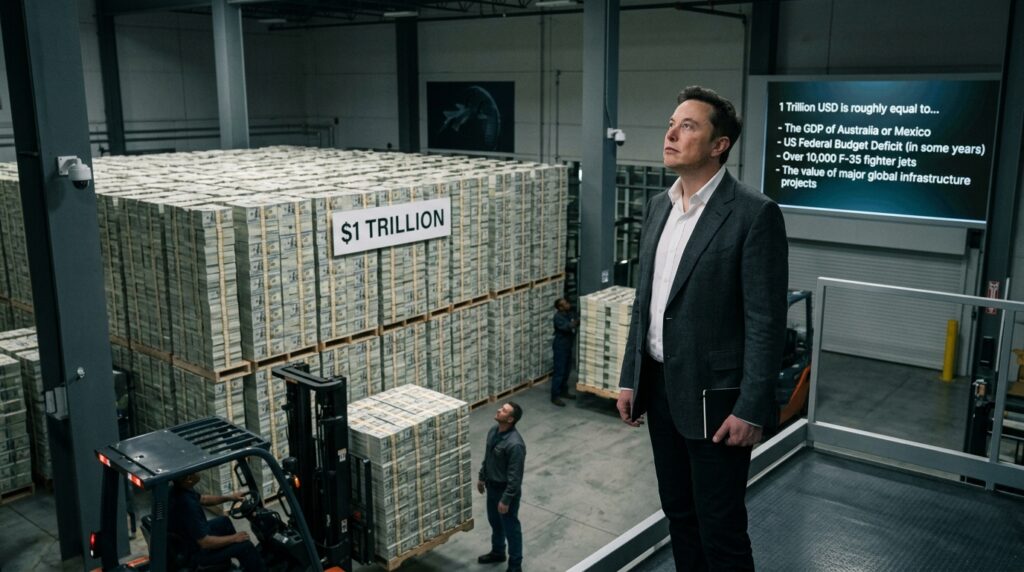
Musk is about to become a trillionaire. But how much is $1 trillion worth? Formally, it is one million millions: 1,000,000,000,000. In practical terms, it is a scale of wealth so large that it changes the conversation from “how rich is this person?” to “what does ownership of capital that size mean for markets, institutions, and society?” That is the real subject here, not celebrity wealth as entertainment.
The timing matters because Elon Musk’s net worth is tied to volatile assets such as Tesla equity, SpaceX valuation, and a set of private and public market assumptions that can move by tens of billions in a single day. The headline is dramatic, but the number itself is more useful as a measuring stick than as a personal fortune in the normal sense. The closest comparison is not a paycheck, a bank balance, or even a billionaire’s portfolio; it is the balance sheet of a midsize economy.
Why Musk is about to become a trillionaire. But how much is $1 trillion worth? matters now is that the number forces a sanity check. Most people can picture a million. Some can picture a billion. Almost nobody can intuit a trillion without converting it into time, institutions, infrastructure, and global-capital scale. That is where the useful analysis begins.
Key Takeaways
- $1 trillion is 1,000 times larger than $1 billion, and the difference is not cosmetic; it is the gap between extreme personal wealth and macroeconomic significance.
- A trillion-dollar net worth is usually not liquid cash; it is a valuation claim on equity, options, and concentrated ownership stakes.
- Elon Musk’s wealth is sensitive to Tesla’s market capitalization, SpaceX valuation, and option structures, which makes the headline both real and conditional.
- The best way to understand $1 trillion is to compare it with government budgets, corporate revenues, and physical infrastructure costs.
- The number is politically and economically meaningful because it concentrates influence, not because anyone can casually spend it.
Musk is About to Become a Trillionaire. But How Much is $1 Trillion Worth? In Real Economic Terms
The Formal Definition of a Trillion
In U.S. numbering, a trillion equals 1012, or one thousand billion. That is the technical definition used in finance, economics, and public budgeting. When analysts discuss net worth, they are usually referring to an estimate of net assets: the market value of owned assets minus liabilities. For Musk, that means equity stakes in publicly traded Tesla, private-company holdings such as SpaceX, and other interests that can be assigned a valuation.
In plain English, a trillion is not “a lot.” It is a different category of magnitude. A billionaire can own multiple homes, aircraft, sports teams, and still remain inside a conventional frame of personal wealth. A trillionaire does not fit that frame. The number starts to resemble sovereign capacity: the ability to shape capital allocation, industrial policy, supply chains, and national labor markets.
Why the Number is Hard to Visualize
Human intuition breaks at scale. We are built to understand hours, days, maybe years. We are not built to intuit what happens when a fortune could fund a city’s operating budget for generations. One useful conversion: if you spent $1 million every day, it would take about 2,740 years to exhaust $1 trillion. Even at $10 million per day, the total lasts nearly 275 years.
That gap explains why headlines about wealth often feel abstract. The number becomes meaningful only when mapped to concrete systems. Who works with this kind of analysis knows that scale is not a rhetorical flourish; it determines what decisions become possible, what risks become systemic, and what institutions must respond.
How Net Worth Differs from Spendable Cash
This is where many takes go wrong. Net worth is not cash on hand. It is an estimate of asset value, often dominated by equity that cannot be liquidated instantly without moving the market. For Musk, the relevant assets are heavily concentrated. Tesla shares can be sold, but large sales can trigger price pressure, taxes, disclosure requirements, and regulatory scrutiny. Private-company stakes are even less liquid.
That distinction matters because a trillion-dollar valuation does not mean a trillion dollars can be deployed like a checking account. This method works well for measuring relative wealth, but it fails if you confuse paper wealth with immediate purchasing power. Markets are not ATMs.
What a Trillion Dollars Can Buy: Governments, Companies, and Physical Scale
Comparing $1 Trillion with Public Budgets
The cleanest comparison is with government spending. A trillion dollars can cover major portions of annual federal outlays in many countries, and it can rival the annual budgets of large states or entire ministries. For context, the U.S. federal budget is measured in trillions, which means a single trillion sits in the same conversation as defense, healthcare, entitlement spending, and debt service. That is not ordinary wealth; it is fiscal magnitude.
According to the Congressional Budget Office, federal baseline projections operate in the trillions each year, which helps explain why even a single trillion-dollar figure matters in policy debates. The number is large enough to fund serious national priorities, but not large enough to solve every structural problem at once. That distinction is often lost in media coverage.
What a Trillion Buys in Corporate Terms
A trillion dollars can buy, in whole or in part, some of the largest public companies in the world. It can also purchase entire sectors if values are depressed. But the interesting point is not acquisition fantasy; it is comparative scale. If a founder’s net worth reaches that level, their influence can dwarf most boards, venture funds, and sovereign-wealth allocations.
Here is the practical implication: ownership at this level affects capital markets. It shapes employee expectations, lender confidence, supplier negotiations, and even how competitors frame long-term strategy. Equity concentration is not just a wealth metric. It is a control metric.
Physical Infrastructure at Trillion-dollar Scale
People often ask what $1 trillion “looks like.” A better question is what it builds. It could fund thousands of miles of high-speed rail, large-scale power generation, extensive broadband deployment, or multiple generations of space infrastructure. Yet there is no universal answer because infrastructure costs vary by geography, permitting, labor, materials, and regulation.
In practice, what happens is that large capital pools can be deployed only through systems that can absorb them. You cannot drop a trillion into a single project and expect efficient execution. Capacity constraints, procurement bottlenecks, and political approvals become the limiting factors long before the money runs out.
Comparison Approximate Scale Why It Matters U.S. federal annual spending Trillions Shows that $1 trillion is macroeconomic, not personal luxury scale Top public companies Hundreds of billions to over $1 trillion market cap Illustrates how much of the world’s equity markets one fortune can track Major infrastructure megaprojects Billions to tens of billions each Reveals that a trillion can finance many large projects, but not without absorption limits
How Elon Musk’s Wealth is Actually Calculated
Tesla Stock, Options, and Concentration Risk
Musk’s wealth is dominated by Tesla equity, with value fluctuating as Tesla’s share price changes. That makes his net worth unusually volatile. A 5% move in the stock can translate into a gain or loss measured in billions, sometimes tens of billions, because his stake is so large. This is not theoretical. It is the direct consequence of concentrated ownership in a high-beta asset.
Options and compensation structures complicate the picture further. A founder’s wealth estimate often depends on vesting schedules, grant terms, exercise prices, and restrictions on sale. Analysts who follow these calculations must separate headline value from realizable value. Those are not the same thing, and conflating them produces misleading stories.
SpaceX and Private-market Valuation
SpaceX is one of the most important components of the story because it is privately held and periodically marked at new valuations through secondary transactions or financing rounds. Private-market valuation is not as transparent as public-market pricing, and that introduces uncertainty. Still, for a founder with a large stake, a rising valuation can add enormous paper wealth.
There is a real caveat here: private valuations are less liquid and less frequently tested than public share prices. That means analysts disagree more than they would on a listed company. The uncertainty does not invalidate the estimate; it just means the confidence interval is wider.
Why Debt, Taxes, and Liquidity Matter
A proper net-worth estimate subtracts liabilities and considers taxes. That matters because a founder with concentrated equity cannot convert all paper value into spendable funds without friction. Selling stock can trigger capital gains taxes and market impact. Borrowing against shares creates leverage and introduces collateral risk. The wealth exists, but access to it is mediated by structure.
That is also why billionaire wealth debates become distorted. Public discussion often treats valuation as if it were cash. It is not. It is a claim on future earnings, market sentiment, and control rights. The difference is material.
Why a Trillionaire Changes Markets, Politics, and Inequality Debates
The Influence Problem is Bigger Than the Money Problem
At this scale, the central issue is influence. A trillionaire can affect capital formation, media narratives, research priorities, and labor markets simply through ownership and signaling. That does not mean one person controls everything. It means their decisions can shift expectations in ways that most investors cannot.
That is why the debate around Musk’s rise is not just about admiration or resentment. It is about governance. When a single individual’s balance sheet is comparable to the output of major institutions, the public has reason to ask how market power, civic power, and regulatory power intersect.
Economic Concentration and Social Perception
The rise of trillion-dollar fortunes also changes what society considers normal. A generation ago, billionaire status was rare enough to signal extraordinary success. Now the distribution curve has stretched so far that a trillion-dollar outcome feels like the next frontier. That reshapes wage debates, tax proposals, antitrust scrutiny, and attitudes toward entrepreneurship.
According to Federal Reserve Financial Accounts data, wealth is highly concentrated in the U.S. already, so a move into trillion-dollar territory amplifies a long-running structural trend rather than creating it from scratch. The public reaction is not irrational. It is a response to concentration reaching a level that many people regard as politically salient.
Where the Line Between Admiration and Risk Sits

There is nothing inherently illegal or inherently immoral about creating enormous value. Innovation can generate extreme concentration. The risk emerges when scale outruns accountability. If one person’s economic footprint is large enough to shape industrial ecosystems, then markets need stronger disclosure, cleaner valuation methods, and better conflict-of-interest discipline.
Some specialists argue that the market should be left alone as long as wealth is created legally. Others believe that concentration at this level justifies policy intervention. There is real divergence here, and the best answer depends on whether you prioritize efficiency, competition, or distributional fairness. Any serious analysis has to admit that tradeoff.
How to Read the Headline Without Getting Tricked by It
Separate Symbol from Substance
The headline is powerful because it compresses a complex story into one number. But the number can mislead if you read it like cash in a vault. The useful move is to separate symbolic wealth from operational wealth. Symbolic wealth drives influence and media attention. Operational wealth drives real spending power, investments, and risk capacity.
That distinction helps explain why markets react so sharply to asset prices. A founder’s paper net worth may rise faster than the company’s actual production capacity. The headline changes first. The real economy moves later, if at all.
Use the Right Comparison Set
If you compare a trillion dollars to a house, a luxury car, or a sports contract, you will misunderstand the scale. Compare it to sovereign budgets, mega-cap valuations, and long-duration infrastructure. Those are the relevant anchors. Once you do that, the number stops feeling like gossip and starts reading like a structural event.
One reliable way to keep perspective is to ask what changes at each order of magnitude. Million: lifestyle. Billion: private power. Trillion: system-level impact. That framework is more useful than almost any sensationalist framing.
What the Next Valuation Cycle May Reveal
Future valuations will likely remain volatile because Tesla, SpaceX, and broader tech markets do not move in straight lines. Regulatory shifts, interest rates, EV competition, launch economics, and macro risk appetite all matter. A headline about crossing the trillion threshold may appear, disappear, and reappear as markets reprice risk.
The point is not to predict the exact date. It is to understand the mechanics. Wealth at this level is a moving target, not a fixed monument. Once you see that, the headline becomes less mystical and more analytical.
Próximos Passos Para Implementação
The best way to use this topic is to convert fascination into analytical discipline. Start by separating net worth from liquidity, then compare the number against public budgets, corporate valuations, and infrastructure costs. That yields a more accurate mental model than celebrity-centered commentary ever will. It also prevents the common mistake of confusing market value with money available to spend.
For investors, policy analysts, and business leaders, the important takeaway is concentration risk. A fortune of this scale signals more than personal success; it signals how capital, governance, and market structure interact. Keep the focus on valuation mechanics, not theatrics. That is where the real insight lives.
If the goal is to judge whether a trillion-dollar fortune is “too much,” the correct approach is to examine transparency, taxation, competition, and liquidity. The number itself is not the argument. The structure behind the number is.
FAQ
Is a Trillionaire’s Wealth Usually in Cash?
No. It is usually dominated by equity, options, and ownership stakes that are valued by the market. That means the number is real, but it is not a giant bank account. Selling enough shares to turn paper wealth into cash can move prices and trigger taxes, which reduces practical liquidity.
How Much is $1 Trillion Compared with $1 Billion?
$1 trillion is 1,000 times larger than $1 billion. The jump is not just arithmetic; it changes the type of influence attached to the wealth. A billion-dollar fortune is extraordinary. A trillion-dollar fortune starts to intersect with macroeconomic and institutional scale.
Why Does Elon Musk’s Net Worth Move So Much?
His wealth is heavily tied to Tesla stock and private valuations like SpaceX. Because those assets are volatile and concentrated, small percentage changes can add or erase enormous amounts of paper wealth. This is typical of founder wealth at the top end of the market, where concentration magnifies every price move.
Can a Trillion Dollars Fund a National Economy?
It can fund major public priorities, but not an entire modern economy for long. The amount is large enough to shape infrastructure, defense, healthcare, and industrial policy, yet economies are too broad and recurring to be “solved” by one lump sum. Capacity, politics, and execution matter as much as capital.
Why Do Experts Treat Trillion-dollar Wealth as a Governance Issue?
Because wealth at that level can influence labor markets, capital allocation, and policy debates. The concern is not just inequality; it is concentration of power. When one person’s assets approach the scale of major institutions, transparency and accountability become more important.
Editorial Notice
This content was structured with the assistance of Artificial Intelligence and subjected to rigorous curation, fact-checking, and final review by Editor-in-Chief Nivailton Santos. TechTool Judge reaffirms its unyielding commitment to journalistic ethics, ensuring that editorial judgment and data validation remain entirely under human responsibility and final editorial oversight.