
The Chip War Behind Your Next Smartphone Price Hike, Explained: What is Actually Getting More Expensive

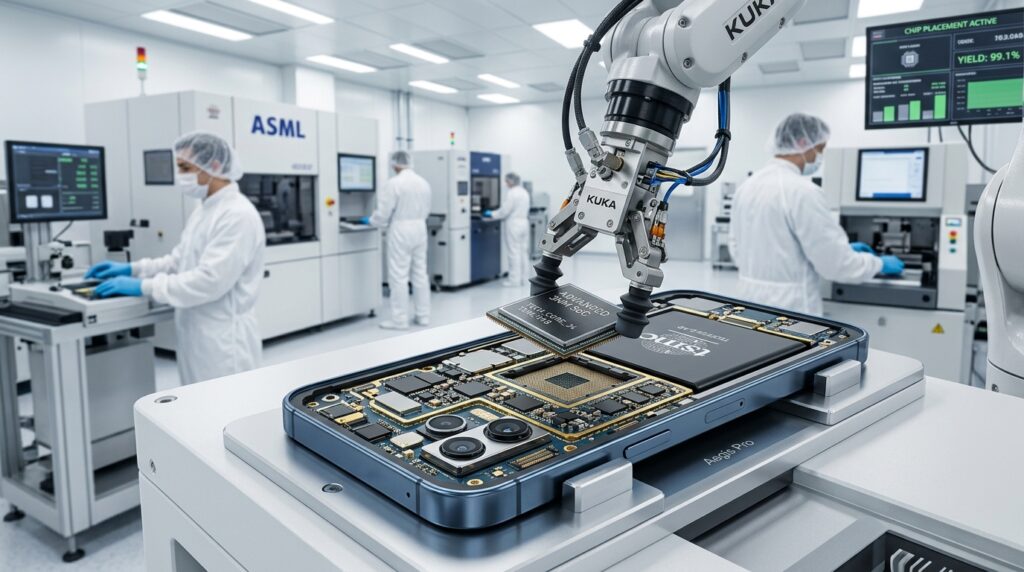
The chip war behind your next smartphone price hike, explained is the overlap of geopolitics, semiconductor capacity, and product design choices that determines how much it costs to build the processor, memory, modem, and power-management stack inside your next phone. In technical terms, it is not one single “chip shortage”; it is a chain of constraints across leading-edge fabrication, advanced packaging, lithography tools, and memory supply that raises bill of materials costs and narrows the options phone makers have.
This matters now because the smartphone market is no longer priced by the phone itself alone. It is priced by access to TSMC’s most advanced nodes, by how much capacity Qualcomm and Apple can reserve, and by whether the supply chain can absorb shocks from export controls, energy costs, and regional concentration. When those pressures tighten at the same time, OEMs have two choices: absorb the margin hit or pass it to consumers.
In practice, what happens is more blunt than most marketing decks suggest. A new generation of chips can cost more even when the silicon die is smaller, because the tools, masks, wafers, packaging, and yield losses all get more expensive at the frontier. I have seen cases where the “chip cost” in a phone increase not because the chip was larger, but because the manufacturer had to buy scarce capacity months earlier than planned just to secure launch volume.
Pontos-Chave
- The biggest price pressure comes from leading-edge manufacturing, where capacity at advanced nodes is limited and expensive to reserve.
- U.S.-China tech restrictions, especially around AI accelerators and semiconductor equipment, ripple through the smartphone supply chain even when phones are not the direct target.
- Memory, modem, and packaging costs can move faster than consumer expectations, so phone pricing often lags the real cost increase by one product cycle.
- Not every handset gets hit equally: flagship models feel the pressure first, while midrange phones often keep prices stable by using older nodes and less aggressive component mixes.
- The price hike is usually a margin decision, not a pure necessity; brands choose where to defend profit and where to protect share.
The Chip War Behind Your Next Smartphone Price Hike, Explained: What is Actually Getting More Expensive
Leading-edge Nodes Are Scarce, Not Magical
The formal definition of the problem starts with semiconductor manufacturing capacity at advanced process nodes such as 3nm, 4nm, and 5nm. These nodes require extreme ultraviolet lithography (EUV), extremely tight process control, and very high capital spending. In plain English: the most efficient smartphone chips are built in a tiny number of fabs, and those fabs cannot expand on demand.
That scarcity changes pricing power. TSMC, which manufactures many of the world’s top smartphone SoCs, does not set prices like a commodity wholesaler. It manages allocation. When Apple, Qualcomm, and other large customers compete for wafers, the buyer with stronger volume commitments and better forecast discipline gets priority. Smaller OEMs then pay more indirectly, because they buy chips through a tighter channel.
Source context matters here. The TSMC investor and technology materials show how much the company concentrates on advanced-node capacity, while the ASML technology pages make clear why EUV tool scarcity is a structural bottleneck rather than a temporary shipping issue. This is not a rumor cycle; it is a capacity architecture problem.
Smartphones Buy More Than Just a Processor
A modern phone bill of materials includes the application processor, modem, RF front end, power-management ICs, DRAM, NAND flash, display driver chips, and an increasing amount of sensor and security silicon. Each category has its own supply dynamics. A Qualcomm Snapdragon platform may be the headline item, but a memory price swing can be just as important to the final retail price.
That is why a flagship can feel expensive even if the SoC cost only rises modestly. The buyer is also paying for LPDDR5X memory, UFS storage, sophisticated thermal materials, and advanced camera control silicon. Apple, Samsung, Xiaomi, and other OEMs do not price these parts separately. They price the finished device, then decide how much of the component inflation to pass through.
The practical takeaway is simple: if one major input jumps 8% and another 10%, the combined impact can move device pricing far more than consumers expect. Smartphone margins are thin enough that a few dollars per unit matter at scale.
The Geopolitical Layer is Part of the Economics
Semiconductors sit inside trade policy now. U.S. export controls on advanced chip equipment and China’s push for domestic substitution have created a world where some manufacturing, packaging, and design decisions are driven by national security policy rather than market efficiency. That tension raises costs because firms duplicate suppliers, hold more inventory, and redesign products around politically safer manufacturing routes.
The Brookings analysis of the CHIPS and Science Act is useful here because it frames the economic tradeoff: resilience is expensive. A supply chain built to avoid one-country dependence will not be as cheap as a supply chain optimized purely for lowest cost. That cost lands somewhere, and phone buyers often absorb part of it.
Why TSMC, Samsung Foundry, and ASML Matter More Than Most Phone Buyers Realize
TSMC Owns the Bottleneck Most Consumers Never See
TSMC sits at the center of the premium smartphone world because it combines yield, scale, and process maturity better than most rivals. A flagship chip is only valuable if it ships on time and performs consistently across tens of millions of units. That is why Apple’s A-series and many Snapdragon flagship variants have historically leaned on TSMC. Reliable output is worth money, and that money gets baked into device pricing.
When TSMC shifts to a new node, the early wafers are expensive. Yield ramps take time, and the first customers often pay for the privilege of being first. That is one reason newer iPhone and Android flagships frequently land at higher introductory prices than last year’s model, even before carrier subsidies are considered.
Samsung Foundry Keeps Pressure on the Market, but Not Enough
Samsung Foundry is the other major advanced-node competitor, and its presence matters because competition can restrain pricing. But competition is not the same as excess capacity. Samsung has its own portfolio constraints, process transitions, and customer concentration challenges. The result is a market with two strong players, not a market with enough slack to make prices harmless.
For phone makers, dual sourcing is attractive in theory and messy in execution. A chip designed for one foundry’s rules and performance characteristics often cannot be ported overnight. Engineering teams know this well. A last-minute node change is not a spreadsheet issue; it can trigger validation delays, power tuning work, and software requalification.
ASML is the Hidden Supplier That Shapes Every Premium Phone Launch
ASML does not make smartphone chips, but its EUV tools make the most advanced chips possible. That makes it a strategic supplier in the same way that a rail switch operator is strategic to a rail network. If lithography tool production, servicing, or export policy changes, the downstream effect is slower node expansion and higher effective cost per wafer.
This is where the “chip war” phrase becomes more than a headline. The competition is not only between device brands. It is between national industrial strategies, toolmakers, and foundries over who gets access to the production layer that defines future electronics. Smartphones sit at the consumer-facing end of that stack, so the price impact arrives there last, but it does arrive.
| Supply-Chain Layer | Representative Entity | Why It Affects Phone Price |
|---|---|---|
| Advanced wafer fabrication | TSMC, Samsung Foundry | Sets the cost and availability of flagship SoCs |
| Lithography equipment | ASML | Limits how quickly advanced capacity can expand |
| Modem and platform design | Qualcomm, Apple, MediaTek | Determines chip complexity, integration, and licensing cost |
| Memory and storage | Micron, Samsung, SK hynix | Moves the device BOM even when the main processor is stable |
How Export Controls and Industrial Policy Push Costs Into Consumer Phones
The Policy Shock Travels Farther Than the Headlines
Trade restrictions usually begin with a narrow target: advanced AI accelerators, chipmaking tools, or sensitive manufacturing know-how. But the ripple effect spreads. Suppliers hedge, governments subsidize domestic capacity, and companies build parallel sourcing strategies. That creates redundancy, and redundancy costs money.
Phones are not usually the direct target of sanctions or export controls. Yet they are built from the same industrial ecosystem. When a country restricts equipment sales or when firms anticipate future restrictions, they alter their investment plans. Those decisions change the cost base for fabs, packaging houses, and component vendors that serve smartphone brands as well as other electronics sectors.
China’s Counterpressure Changes Design Decisions
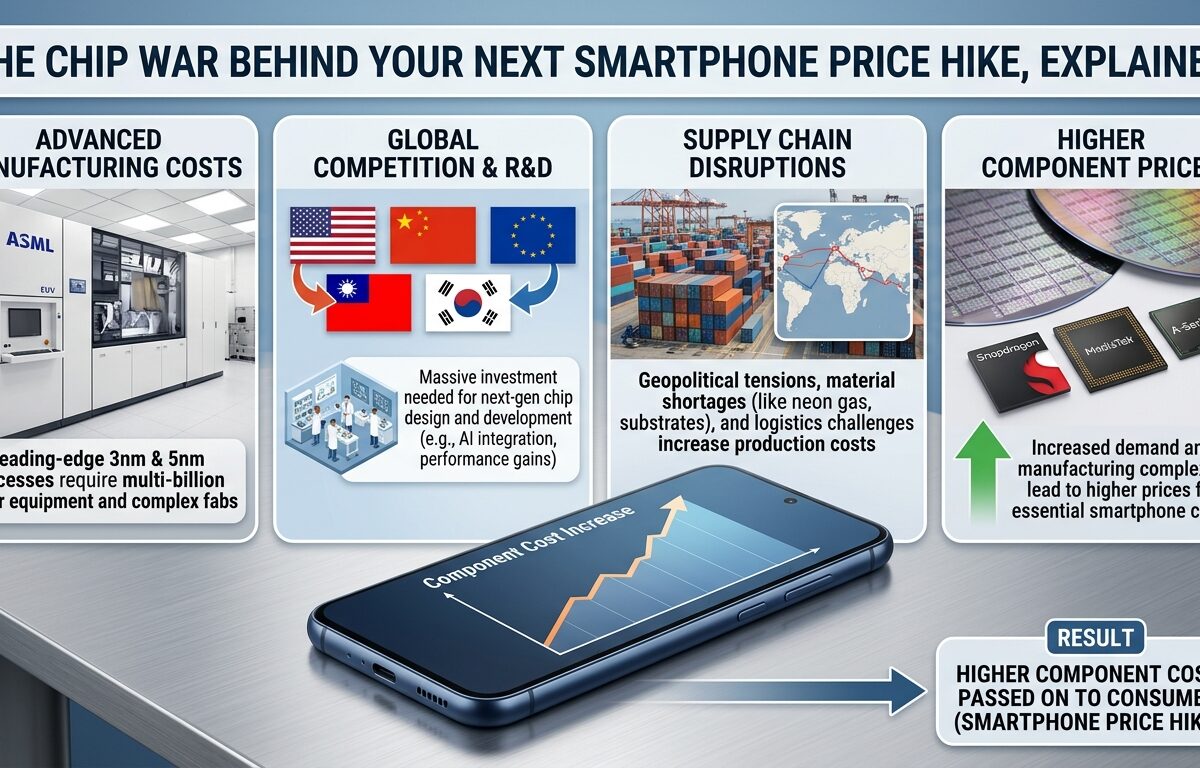
China’s push to localize semiconductors is partly a response to pressure from the U.S. and allied governments. That effort matters because it changes where components are sourced and what design tradeoffs companies accept. If a handset vendor must substitute one RF component, storage supplier, or packaging partner, the phone may still launch on time, but its cost structure shifts.
There is a real nuance here: not every localization move raises prices immediately. Some domestic supply can lower costs over time if it scales well. The problem is the transition period. Transitional duplication, lower yields, and qualification overhead often cost more before they cost less. That is why the near-term effect is often higher prices or thinner margins, not instant savings.
Policy Support in the U.S. And Europe is Not Free Money
The CHIPS and Science Act in the U.S. and parallel European incentives aim to reduce dependence on a single geographic hub. Those policies can improve resilience, but they do not eliminate cost. They redirect some of the bill from the private sector to the public sector. Consumers may not see it in the sticker price immediately, but companies still model those incentives into long-term sourcing and pricing strategies.
In other words, industrial policy does not make chips cheaper by decree. It changes who pays, when they pay, and how much slack exists in the system. If you are a smartphone buyer, the result is usually a slower decline in prices than the market would otherwise produce.
Why Flagships Get Hit First and Midrange Phones Often Hold the Line
Premium Phones Absorb Frontier Costs First
Flagship devices are where the newest chips show up first: the latest Snapdragon 8-series platform, Apple’s newest A-series silicon, top-tier camera processors, and the highest-density memory packages. These are the parts most exposed to advanced-node inflation. Because premium buyers tolerate higher price points, OEMs have room to pass through cost increases without losing the entire product thesis.
That is why a $999 phone can become a $1,099 phone with relatively little public shock, while a $399 phone cannot absorb the same relative increase. The flagship segment has a larger margin buffer. It also serves as a brand signal, so manufacturers protect it even when the bill of materials rises faster than forecast.
Midrange Phones Survive by Design Compromise
Midrange smartphones usually rely on older nodes, less aggressive modem integration, and memory configurations that are easier to source. MediaTek, for example, competes strongly in this tier by offering capable platforms that do not require the same cutting-edge wafer economics as the top end. That makes the segment more resilient to a chip war, but also less exciting from a performance standpoint.
Manufacturers also move features around. A phone may keep the same camera count and battery size while quietly downgrading the panel, storage type, or 5G modem category. Consumers notice the sticker price first, but the actual hedge against cost pressure often lives in the specification sheet.
There is a Ceiling on How Much Brands Can Pass Through
Brands cannot raise prices endlessly. They lose share if they overreach, especially in markets where carrier financing is weak and unlocked phone buyers compare specs aggressively. That is why some of the cost increase is hidden in smaller batteries, slightly slower charging, less premium glass, or fewer years of top-tier software support. Pricing is only one lever.
Who works on device launches knows this pattern well. The discussion is rarely “Can we price it higher?” It is “What can we remove, delay, or simplify so the margin survives?” That is the real business consequence of the chip war for consumer hardware.
What Buyers and Product Teams Should Expect over the Next 12 To 24 Months
Expect Uneven Inflation, Not a Single Clean Jump
Smartphone prices will not rise in a straight line. They will move in bursts tied to launch windows, memory pricing cycles, carrier promotions, and foundry allocation. A brand may hold pricing on one model while increasing another by $50 or $100. That unevenness reflects supply contracts, not consumer preference.
For buyers, the sensible expectation is that premium phones remain exposed to advanced-node cost pressure, while mainstream models feel smaller but more persistent component inflation. For product teams, the lesson is to lock in capacity early and treat chip sourcing as a strategic function, not a procurement detail.
Advanced Packaging is Becoming the Next Constraint
As dies get smaller and more integrated, advanced packaging becomes more important. Technologies like chiplets and high-density interconnect packaging can improve performance, but they also introduce another supply bottleneck. CoWoS-style capacity, substrate availability, and test complexity are no longer edge issues; they are part of the pricing structure.
That matters because the industry often solves one bottleneck by creating another. A phone chip may be manufacturable, but if packaging is constrained, launch volume still suffers. The end user sees that as limited availability or a higher launch price. The supply chain sees it as an allocation problem.
Smartphone Pricing Will Track Industrial Resilience, Not Just Demand
The central mistake is to treat phone prices as a simple function of consumer demand. They are not. They also reflect geopolitical risk, manufacturing geography, energy costs, and the economics of building redundant capacity. When supply chains become more resilient, they also become more expensive. That tradeoff is the real story behind the price hike.
There is no single switch that restores cheap flagship phones. The market can ease pressure if capacity expands, if export policy stabilizes, and if node transitions mature. But as long as the industry depends on a handful of highly specialized nodes and toolmakers, consumers will keep paying for scarcity in one form or another.
How to Read Future Smartphone Price Changes Without Getting Fooled by Marketing
Start by separating launch messaging from supply reality. When a brand says a phone is “more advanced,” that often means it is tied to a costlier node, a denser package, or a pricier memory stack. If you want to predict the retail price, watch the supply chain underneath the feature list. The key indicators are foundry node, memory generation, modem integration, and whether the device uses an especially constrained packaging path.
For practical decision-making, compare the phone not against its predecessor alone, but against the cost environment of the year it ships. A company can justify a price increase if the underlying silicon and packaging stack changed materially. If the hardware only changed cosmetically, then the hike is more about margin strategy than unavoidable cost. That distinction helps buyers decide whether to upgrade now, wait for the next cycle, or move down a tier without losing much real-world performance.
The smartest response is not panic; it is segmentation. Flagships will likely keep paying the premium for access to the best chips, while midrange devices remain the pressure valve for price-sensitive buyers. If you understand that structure, you can read the market with far less noise and a lot more accuracy.
Próximos Passos Para Implementação
If you are evaluating a smartphone purchase, the most useful lens is not “Will this phone be expensive?” but “Which part of the supply chain is pushing this model upward?” Check whether the device uses a leading-edge SoC, the latest LPDDR generation, and premium packaging. Those are the cost markers that usually explain a jump better than brand positioning does. When those markers are absent, a higher price is far more likely to be a margin play than a necessity.
For product and procurement teams, the priority is to treat chip sourcing as a risk-management problem. Lock in forecast volume earlier, diversify where the design allows it, and avoid overcommitting to a node before yield and packaging capacity are stable. The companies that win this cycle will not be the ones that talk most loudly about innovation. They will be the ones that align roadmap timing with real manufacturing economics.
The next price hike in smartphones will not come from one dramatic event. It will come from accumulated pressure across foundries, toolmakers, memory suppliers, and policy regimes. Buyers who recognize that pattern will see the increase coming before the marketing copy does.
FAQ
Why Do Smartphone Prices Rise When Chip Sizes Get Smaller?
Smaller nodes are harder and more expensive to manufacture because they require advanced lithography, tighter process control, and lower tolerance for defects. The cost per wafer can rise even when the transistor density improves. In the real world, that means a phone maker may pay more for the newest chip generation even though the chip is physically smaller and faster. Yield losses and packaging costs often explain the increase better than raw silicon area.
Is TSMC the Main Reason Flagship Phones Get More Expensive?
TSMC is a major reason, but not the only one. It provides the advanced capacity that many flagship chips need, and that capacity is scarce. But the final phone price also reflects memory, modem integration, packaging, software support, and brand margin strategy. The processor matters a lot, yet it is only one part of the total bill of materials.
Do U.S.-China Export Controls Affect Regular Smartphones Directly?
Usually not directly, but the indirect effect is real. Export controls can change how fabs invest, how suppliers allocate equipment, and where companies choose to source components. That raises the cost of redundancy and reshapes the broader semiconductor ecosystem. Smartphones then inherit those costs through higher component prices or tighter availability.
Why Are Midrange Phones Less Exposed to the Chip War?
Midrange models often use older nodes, less constrained memory configurations, and more mature design platforms. That keeps their manufacturing costs lower and more predictable. They are not immune to inflation, but they do not rely on the most expensive frontier capacity. Manufacturers also have more room to trade off some performance for price stability in this segment.
What Should Buyers Watch to Predict the Next Price Increase?
Watch the process node, memory generation, and launch timing. If a new phone moves to a more advanced node, uses faster LPDDR and UFS parts, or launches during a tight supply period, a price increase becomes more likely. Carrier subsidies can hide the rise for a while, but the underlying retail price usually reflects those inputs. The spec sheet tells you more than the ad copy.
Editorial Notice
This content was structured with the assistance of Artificial Intelligence and subjected to rigorous curation, fact-checking, and final review by Editor-in-Chief Nivailton Santos. TechTool Judge reaffirms its unyielding commitment to journalistic ethics, ensuring that editorial judgment and data validation remain entirely under human responsibility and final editorial oversight.