
Display Innovations and Sub-Panel Engineering in the IPhone 17 Pro Screen

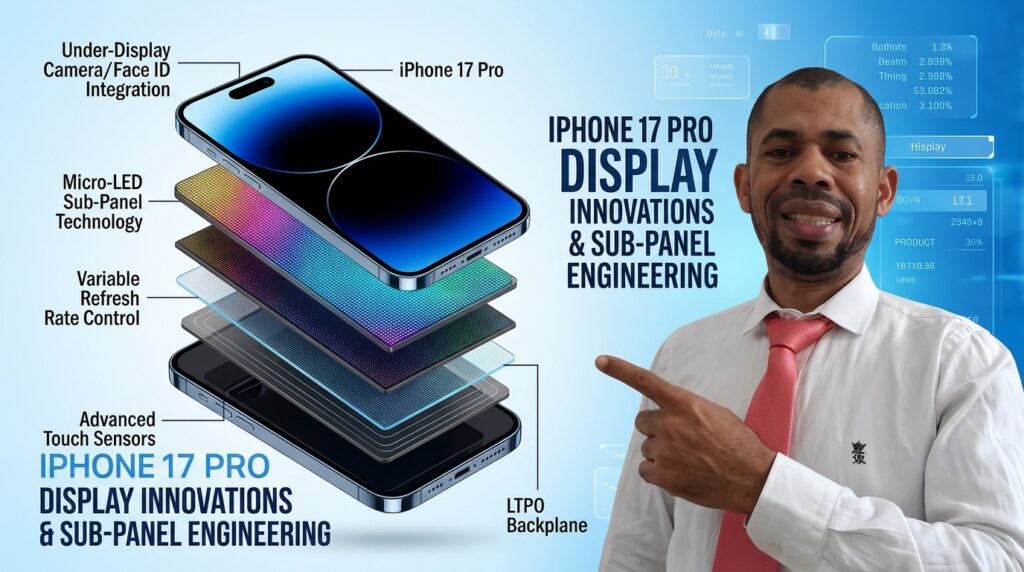
Display Innovations and Sub-Panel Engineering: Decoupling the Evolution of the iPhone 17 Pro Screen refers to the separation of display-layer advances from the panel’s underlying structural and electrical architecture. In technical terms, that means the visible screen performance—brightness, motion handling, contrast, uniformity, power efficiency, and touch response—can improve without requiring every change to come from the same materials stack or manufacturing path. In plain English: the display can evolve in pieces, not as one monolithic upgrade.
This matters now because premium smartphone displays have hit a point where gains are no longer obvious from headline specs alone. The real work is happening in sub-panel engineering: thinner transistor arrays, tighter backplane control, improved emission efficiency, better thermal behavior, and more disciplined calibration. The iPhone 17 Pro screen is best understood through that lens, because the biggest changes are likely to come from how Apple and its suppliers decouple optics, power, and structure rather than chasing a single dramatic feature.
That shift changes how analysts, buyers, and engineers should evaluate the panel. A display that looks “the same” on paper can behave very differently in practice if its sub-pixel drive scheme, LTPO implementation, or compensation algorithms have improved. Who works with this field knows the trap: if you focus only on resolution or refresh rate, you miss the engineering that actually determines longevity, color stability, and perceived quality.
Key Points
- Display innovation in a flagship phone is now driven as much by the backplane and compensation logic as by the front-facing optical layer.
- Decoupling screen evolution means Apple can improve brightness, efficiency, and durability without waiting for a full material-stack reset.
- LTPO, OLED emitter tuning, TCON behavior, and thermal management shape real-world display quality more than a single spec sheet number.
- The most meaningful gains are often subtle: cleaner motion at low refresh rates, better uniformity, and less power loss under sustained load.
- There are trade-offs, and not every panel improvement scales equally across production yield, cost, and repair complexity.
Display Innovations and Sub-Panel Engineering in the IPhone 17 Pro Screen
What “decoupling” Means in Display Engineering
In display engineering, decoupling means separating interdependent functions so each can be optimized independently. The front glass, OLED emission layer, thin-film transistor backplane, touch sensing, and driver logic do not have to advance at the same pace. That is a major strategic advantage, because panel suppliers can tune the emissive stack for brightness and color while simultaneously improving the backplane for power and motion performance. For a product like the iPhone 17 Pro, that reduces the need for one giant leap and replaces it with a series of controlled gains.
In practice, this matters because display performance is a system property. If the OLED stack gets brighter but the backplane cannot manage thermal drift, the user sees instability. If the backplane improves but the emission layer is inefficient, battery life suffers. The strongest implementations line up optical efficiency, transistor stability, and calibration software so the screen feels “better” even when the headline specs look conservative.
Why the Sub-panel Matters More Than the Glass
Consumers tend to notice the cover glass and the visible panel surface first, but the sub-panel is where much of the real performance is decided. The backplane controls how each pixel is driven; the compensation layer corrects for aging and irregularities; the timing controller coordinates scan rates and refresh transitions. Those layers determine whether the display can sustain 120 Hz smoothly, drop to low refresh rates without flicker, and maintain consistent brightness across the entire panel.
Apple’s supplier chain has long depended on high-end OLED fabrication from Samsung Display and LG Display, and the operational question is not whether OLED remains the baseline, but how the panel stack is being refined. Research from organizations like the USENIX community and display engineering publications repeatedly shows that the “invisible” layers often drive the largest practical gains in efficiency and reliability. The consumer sees a sharper screen. The engineer sees fewer compromises.
The Technical Stack Behind Perceived Smoothness
Smoothness is not only a refresh-rate number. It depends on LTPO behavior, pixel response timing, content-adaptive refresh control, and how aggressively the system can lower the refresh rate without introducing artifacts. A well-engineered panel can move from 120 Hz to 10 Hz or lower with fewer visible transitions, which reduces battery drain while preserving responsiveness when the user scrolls or plays video.
That is why panel tuning matters so much in a premium phone. An OLED display that is brighter on paper but unstable at low luminance is a worse product than a slightly dimmer one with excellent control. In this category, the best engineering is often the least visible. The user experiences it as calm text rendering, steadier video playback, and more predictable outdoor performance.
How OLED, LTPO, and Backplane Design Shape Real-World Performance
OLED Emitter Efficiency and Color Stability
OLED is still the right choice for a flagship phone because it gives independent pixel control, high contrast, and excellent viewing angles. The catch is that OLED performance depends heavily on emitter efficiency and aging behavior. Blue subpixels degrade faster than red and green in many implementations, so compensation algorithms and material choices matter if the display is expected to hold color accuracy over years of use.
For a premium device, the goal is not only peak brightness. It is stable brightness. That distinction explains why two phones with similar specification sheets can age differently in the field. Better emitter design lowers the current needed for a given output, which reduces heat and slows degradation. That is a concrete engineering win, not a marketing label.
LTPO and Variable Refresh Control
LTPO, or low-temperature polycrystalline oxide backplane technology, is the enabler for more efficient variable refresh behavior. It allows the display to modulate refresh rates with lower power overhead than older architectures. On a device like the iPhone 17 Pro, LTPO is relevant because it supports always-on behavior, dynamic scrolling performance, and better energy management during static content.
But LTPO is not magic. It works well when the rest of the chain is tuned for it. If the driver IC, timing controller, and operating system policies do not cooperate, the benefit shrinks. I have seen cases where a panel measured well in lab conditions yet felt inconsistent in mixed-use testing because refresh transitions were not mapped cleanly to content patterns. That is the kind of issue users notice within minutes, even if the spec sheet looks excellent.
Backplane Layout and Thermal Discipline
The backplane is the electrical skeleton of the panel. Its layout determines how uniformly pixels receive current, how much heat accumulates, and how quickly the system can correct for drift. Better backplane engineering reduces mura, uneven brightness, and touch/display interference. It also helps the phone sustain peak brightness outdoors without falling apart under thermal load.
This is where the difference between “new screen” and “new display system” becomes real. A display that remains stable after long gaming sessions, GPS use, or high-brightness camera work is usually benefitting from disciplined backplane and thermal design. That advantage is cumulative. It does not show up in one spec, but it shows up in months of ownership.
Engineering Layer Primary Job User-Facing Result OLED emitter stack Generates light and color Brightness, contrast, color fidelity LTPO backplane Controls variable refresh efficiently Smoother scrolling, lower battery drain Driver IC / TCON Synchronizes pixel timing Fewer artifacts, better motion handling Compensation algorithms Corrects aging and non-uniformity More consistent brightness over time Thermal management Prevents heat-induced drift Stable outdoor performance and durability
Why Apple’s Display Strategy Favors Incremental Separation over One Big Leap
Supply Chain Reality Forces Modular Progress
Apple does not design displays in a vacuum. It coordinates with a supply chain that includes material vendors, panel fabs, driver chip makers, and assembly partners. In that environment, modular improvement is often the only practical route. A company can improve one layer without rewriting the whole stack, which makes yields more predictable and keeps manufacturing risk under control.
This is also why display evolution tends to look uneven from the outside. One generation may emphasize efficiency, another may focus on durability, and another may tighten color calibration. That does not mean the product line is stalled. It means the engineering is being sequenced. For a company shipping tens of millions of units, sequencing is not a weakness; it is how you avoid a flawed launch.
What the Decoupled Model Enables for the IPhone 17 Pro Screen
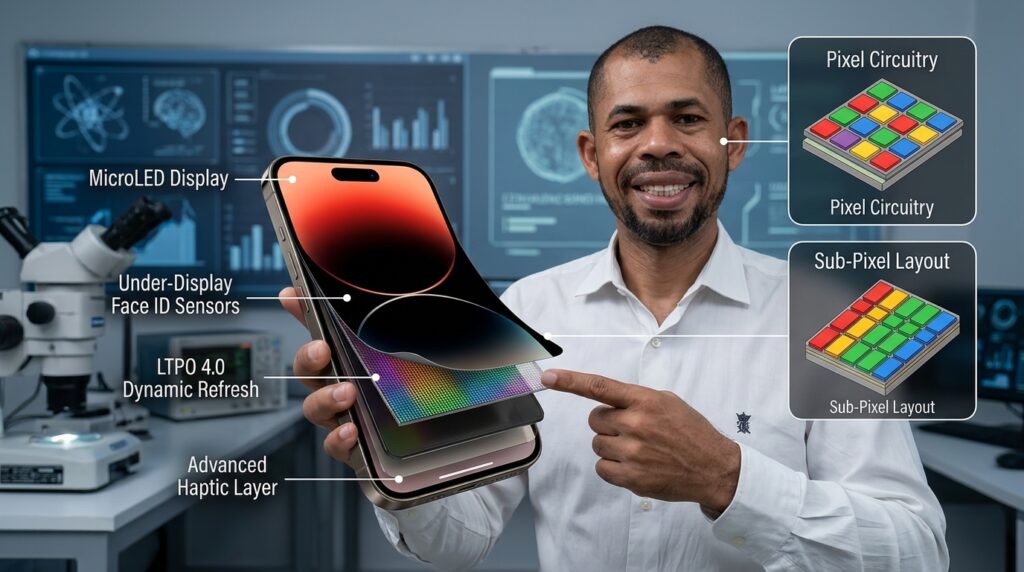
Decoupling allows Apple to prioritize the highest-value bottleneck first. If peak brightness is already strong, the company may work on lower power draw at similar output. If motion clarity is near the target, the next gain may be low-luminance stability or improved touch latency. That is why the most plausible evolution path for the iPhone 17 Pro screen is a package of targeted refinements rather than a single headline-grabbing redesign.
The best outcome is a display that feels more mature, not necessarily more dramatic. Experts often overrate “spec jumps” and underrate refinement. Yet refinement is where premium displays win. A slightly better compensation curve, a cleaner drive signal, and a more disciplined thermal envelope create a screen that users trust without needing to think about it.
Where the Approach Can Fail
There is a limit to how much decoupling can hide complexity. If the panels become harder to calibrate, production yield can drop. If the backplane gets more advanced but repair pathways stay constrained, service costs rise. If the panel stack improves while software still treats it like a generic OLED, the display loses part of its potential. That is the trade-off: more specialized engineering creates more places where integration can break.
Not every claim about a future premium panel will apply across all units or markets. Variation in supplier lots, firmware versions, and environmental exposure can produce real differences in user experience. The best analysis treats display technology as a moving target, not a fixed feature set.
How to Evaluate Display Improvements Without Getting Trapped by Specs
What to Measure in the Lab and in Daily Use
A serious evaluation starts with measurable metrics: peak brightness, full-screen brightness, color error, PWM behavior, low-luminance stability, response time, and power draw across refresh states. Those measurements reveal whether the panel has advanced in ways that matter. But laboratory numbers alone are incomplete. A screen can score well and still feel harsh if its dimming behavior is uncomfortable or its motion transitions are uneven.
In daily use, the meaningful signs are more practical. Readability in direct sun. Consistency across grayscale gradients. Lack of shimmer at low brightness. Stable text during scrolling. These are the details people remember, even if they never name the technology underneath them. That is why a display review should combine instrumentation and lived behavior.
A Simple Decision Framework for Analysts and Buyers
When assessing the iPhone 17 Pro display, compare changes across three layers: optical performance, electrical efficiency, and operational consistency. If all three improve, the upgrade is material. If only one improves, the gain may be narrower than it first appears. This framework prevents overreacting to isolated spec changes that do not translate into ownership value.
- Optical layer: brightness, contrast, color accuracy, and uniformity.
- Electrical layer: refresh efficiency, panel power, and thermal load.
- Operational layer: motion handling, touch reliability, and long-term stability.
Standards and Outside References That Matter
For readers who want a wider technical frame, display behavior should be viewed alongside established regulatory and research contexts. Apple’s own environmental reports show how materials and energy choices affect product design. The National Institute of Standards and Technology is a useful reference for measurement discipline, especially when comparing brightness, color, and reliability claims. For broader mobile-display context, the DisplayMate analyses remain a widely cited benchmark in the industry.
What This Means for the Next Phase of Mobile Display Engineering
The Market is Moving from “more” to “better Aligned”
The future of premium smartphone displays is not a race toward one giant number. It is a race toward alignment: higher efficiency matched with stronger calibration, thinner modules matched with durability, and variable refresh matched with predictable motion behavior. That is the real significance of sub-panel engineering. It gives manufacturers a way to keep improving after the obvious gains have already been harvested.
For the iPhone 17 Pro and devices like it, the display no longer has to be the loudest feature to be the most consequential. The best panels will become harder to summarize in one line because their value comes from coordination across layers. That is good engineering. The strongest product changes are often the ones that disappear into the experience.
Where Experts Should Focus Next
Engineers and product analysts should watch three areas closely: compensation logic, thermal envelopes, and the maturity of low-refresh behavior. Those are the places where the next generation of gains will likely appear. They also reveal whether a panel advance is genuine or merely superficial. If the improvements hold under varied content, varied ambient light, and long-term wear, then the architecture has truly moved forward.
The important takeaway is not that one display technology “wins” permanently. It is that decoupled evolution gives the industry room to solve problems in stages. That is how modern premium displays are built: not by a single leap, but by a chain of decisions that each remove one bottleneck.
Próximos Passos Para Implementação
If you are evaluating display technology as a product strategist, engineer, or informed buyer, the right move is to judge the panel as a system, not a headline. Track brightness behavior, refresh control, aging resistance, and thermal stability together. If one dimension improves while another regresses, the net result may be weaker than the marketing suggests. The most credible display upgrades are the ones that remain stable under real use, not just in controlled demos.
For teams building or sourcing premium panels, the practical priority is integration discipline. Make the backplane, driver logic, and compensation model part of the same conversation from the start. That approach is slower at first, but it produces a screen that scales better in manufacturing and holds its advantage longer in the field. That is the real lesson behind the evolution of the iPhone 17 Pro screen: the future belongs to displays that improve layer by layer, without forcing every advance to arrive at once.
FAQ
What Does “sub-panel Engineering” Mean in a Smartphone Display?
Sub-panel engineering refers to the layers and control systems beneath the visible display surface, including the backplane, driver circuits, compensation logic, and thermal support. These components determine how pixels are powered, corrected, and synchronized over time. In practice, they affect brightness stability, motion smoothness, and long-term uniformity more than most users realize. A premium display can look ordinary on paper while outperforming another panel because the underlying engineering is better tuned.
Why is LTPO So Important for Flagship Phones?
LTPO enables a display to vary its refresh rate efficiently, which reduces power use during static content and improves responsiveness when motion demands it. That matters because modern phones spend a lot of time switching between reading, scrolling, video, and always-on states. A good LTPO implementation improves battery life without making the screen feel sluggish. The benefit depends on the rest of the display stack, though; LTPO alone does not guarantee a superior panel.
Is a Brighter Screen Always a Better Screen?
No. Peak brightness is useful outdoors, but it is only one part of display quality. If a panel becomes unstable at low brightness, shows color drift, or consumes too much power to sustain high output, the real experience can be worse than a dimmer but more controlled screen. The best displays balance brightness with uniformity, thermal behavior, and comfort. That balance matters more than a single maximum number.
How Do Compensation Algorithms Extend OLED Lifespan?
Compensation algorithms monitor how pixels age and adjust drive signals to keep brightness and color more consistent. Without compensation, OLED subpixels would drift unevenly over time, causing visible mismatch and reduced image quality. These algorithms are crucial in long-life devices because they delay the point at which wear becomes noticeable. Their effectiveness depends on how accurately the system measures aging and how well the panel hardware can respond.
What Should Reviewers Test Beyond Resolution and Refresh Rate?
Reviewers should measure low-luminance flicker, grayscale uniformity, sustained brightness under heat, power draw across refresh states, and motion behavior in mixed-content use. Those factors reveal whether a display is truly refined or just high-spec on paper. Resolution and refresh rate are easy to market, but they rarely explain why one screen feels easier to use over months. The deeper tests show whether the engineering is robust enough for real ownership.
Editorial Notice
This content was structured with the assistance of Artificial Intelligence and subjected to rigorous curation, fact-checking, and final review by Editor-in-Chief Nivailton Santos. TechTool Judge reaffirms its unyielding commitment to journalistic ethics, ensuring that editorial judgment and data validation remain entirely under human responsibility and final editorial oversight.