
Deepfakes Are Getting Harder to Spot, Here's How Disinformation Security is Fighting Back

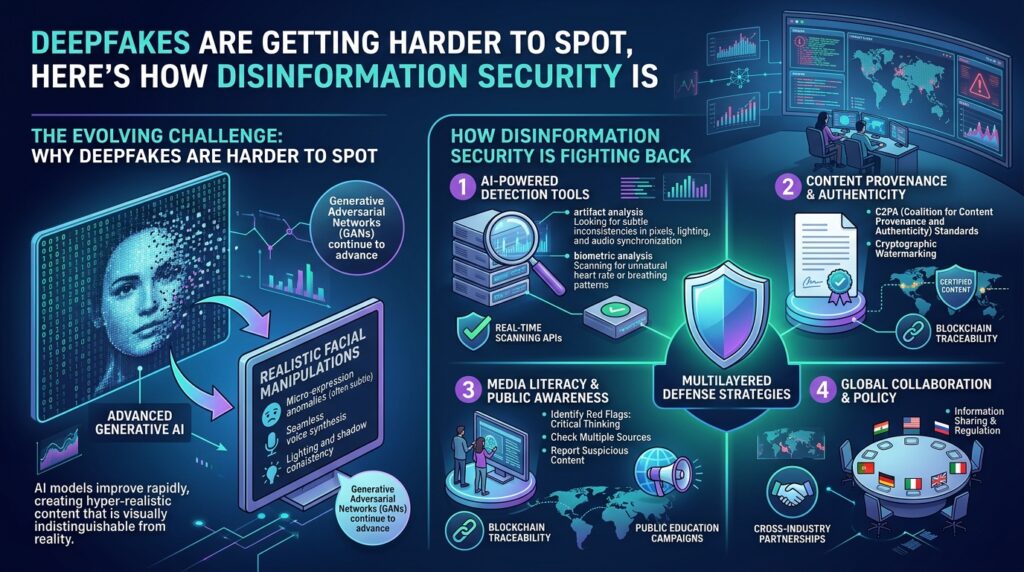
Deepfakes are getting harder to spot, and here’s how disinformation security is fighting back by combining forensic media analysis, provenance standards, adversarial testing, and rapid response workflows to detect synthetic audio, video, and images before they shape public opinion or trigger operational harm. In technical terms, the problem is not just “fake media”; it is the industrialization of deceptive content generation, where machine-learning models can impersonate faces, voices, and gestures with enough fidelity to defeat casual human judgment.
This matters now because the cost curve has collapsed. A convincing fake used to require specialized skills and time. Today, a model can synthesize a voice clone from a short sample, generate a near-photoreal face swap, or alter a video in ways that survive shallow scrutiny. Who works in election security, executive protection, financial fraud, or brand trust knows the pattern: the damage usually happens before verification catches up. The defense problem is no longer “Can we detect manipulation?” It is “Can we prove authenticity fast enough to matter?”
Key Takeaways
- Deepfake defense is shifting from visual suspicion to provenance, cryptographic verification, and workflow-based risk controls.
- Human review still matters, but it is no longer a reliable primary control against high-quality synthetic media.
- Detection models help, yet they degrade as generators improve, which is why layered defenses outperform single-point tools.
- The strongest programs combine content forensics, origin tracking, insider verification, and incident response procedures.
- Organizations that wait for perfect detection usually lose the first hour, which is where disinformation does the most damage.
Deepfakes Are Getting Harder to Spot, Here’s How Disinformation Security is Fighting Back
What a Deepfake is, Technically
A deepfake is synthetic media generated or altered by machine-learning systems to mimic a real person’s appearance, voice, or behavior. The core methods include generative adversarial networks, diffusion models, voice cloning, face reenactment, and lip-sync synthesis. In practice, that means the output can preserve enough temporal continuity, lighting, and acoustic detail to look credible at first glance, even when small artifacts remain under the surface.
The common mistake is to treat deepfakes as one category. They are not. A doctored press photo, a cloned executive voice note, and a full-video impersonation each require different controls. A security team that relies on one detector for all three is already behind. That is why the field now speaks in terms of synthetic media, provenance, and media integrity rather than only “fake videos.”
Why the Threat Escalated So Quickly
The threat expanded because generation became cheap, fast, and accessible. Open-source models, cloud GPUs, and consumer editing tools lowered the barrier to entry. At the same time, distribution channels reward speed over verification, which means a manipulated clip can spread before fact-checking organizations or platform moderators react.
For disinformation operators, this is ideal. They do not need a perfect fake; they need a plausible one that creates confusion, buys time, or reinforces a narrative. In election cycles, that may look like fabricated candidate audio. In finance, it may look like an urgent instruction from a CEO. In geopolitical operations, it may look like a false battlefield clip. The form changes, but the objective is consistent: induce belief faster than verification can respond.
Why Humans Keep Missing Them
People are bad at spotting synthetic media when the signal is emotionally charged, time-sensitive, or repeated by trusted accounts. The brain tends to focus on story coherence, not forensic detail. If the video matches an existing belief, scrutiny drops. If it arrives in a familiar format, such as a clipped interview or a voice memo, suspicion weakens further.
Vi cases where a single suspicious eyebrow glitch used to expose a fake. That era is fading. Modern generation systems have improved temporal consistency, mouth synchronization, and skin-texture realism. The weak point is often not a dramatic visual artifact but the chain of custody, metadata inconsistencies, or the absence of trustworthy origin records.
Detection Alone is Not Enough: The Move Toward Provenance and Content Credentials
What Provenance Means in Media Security
Provenance is the record of where a piece of media came from, how it changed, and which system created or altered it. In digital media security, provenance matters because authenticity is stronger when it can be verified from origin rather than inferred from appearance. The technical goal is to preserve trust signals through capture, editing, publishing, and re-sharing.
This is where standards such as the Coalition for Content Provenance and Authenticity (C2PA) matter. C2PA embeds signed metadata and content credentials so downstream viewers can see whether a file was captured by a trusted device, edited, or exported from a generative system. It does not solve every case, but it changes the burden of proof. Instead of asking, “Does this look real?” defenders can ask, “Can we verify its history?”
Why Provenance Beats Pure Detection in Many Cases
Detection tools look for traces of manipulation. Provenance systems try to prevent ambiguity from the start. That distinction matters because detectors can fail when models improve or when attackers post-process outputs to remove fingerprints. Provenance, by contrast, creates a verifiable identity layer for the media asset itself.
The limit is obvious: provenance only works when participants adopt it. A fake generated outside the trusted ecosystem, then stripped of metadata or re-recorded by a screen capture, will not carry trustworthy credentials. So the best programs use provenance as one layer, not the whole stack. That is the correct position, and it is the one many vendors gloss over.
Where Adobe, Major Platforms, and Newsrooms Fit
Adobe’s Content Authenticity Initiative, newsroom verification workflows, and platform-level media labels are converging on the same idea: trust must be machine-readable. Major publishers increasingly preserve capture metadata, sign assets, and document edit history. That helps when a newsroom needs to defend a breaking image or reject a manipulated submission.
The operational takeaway is simple. If you publish or consume high-risk media, you need a policy for credentials, not just a detector. That includes camera signing where possible, strict export rules, and user education about when credentials are missing. Missing provenance should not prove fraud, but it should trigger scrutiny.
How Disinformation Teams Detect Synthetic Media in Practice
Forensic Signals Analysts Actually Use
Professional detection goes far beyond “zoom in and squint.” Analysts examine frame-level inconsistencies, frequency-domain artifacts, inconsistent lighting, compression anomalies, and audio-visual mismatch. For audio, they may inspect spectral patterns, prosody, breath cadence, and speaker embedding drift. For video, they may check blink frequency, head pose, edge blending, and temporal stability across adjacent frames.
None of these signals is perfect on its own. That is why mature teams use ensemble analysis. One model looks for GAN fingerprints, another examines camera metadata, and a human analyst checks context. If the media was captured in a chaotic setting, the false-positive rate rises. If it came through multiple recompressions, some artifacts disappear. This method works well in controlled workflows, but it falters when the input chain is noisy or intentionally degraded.
The Role of OSINT and Cross-checking
Open-source intelligence remains one of the most reliable defenses. Analysts compare the content against weather records, map data, known timelines, social posts, and satellite imagery. If a clip claims to show a fire at 9 p.m. in a region with no corresponding smoke plume, the claim weakens fast. The video may still be synthetic, but even if it is not, the narrative around it may be false.
This cross-checking is why disinformation security is multidisciplinary. It is not only a media problem; it is a context problem. The U.S. Cybersecurity and Infrastructure Security Agency treats information integrity as part of broader resilience because the same response playbooks that support cyber incidents often apply to deceptive content incidents: triage, verification, containment, and communications discipline.
Why Rapid Triage Matters More Than Perfect Certainty
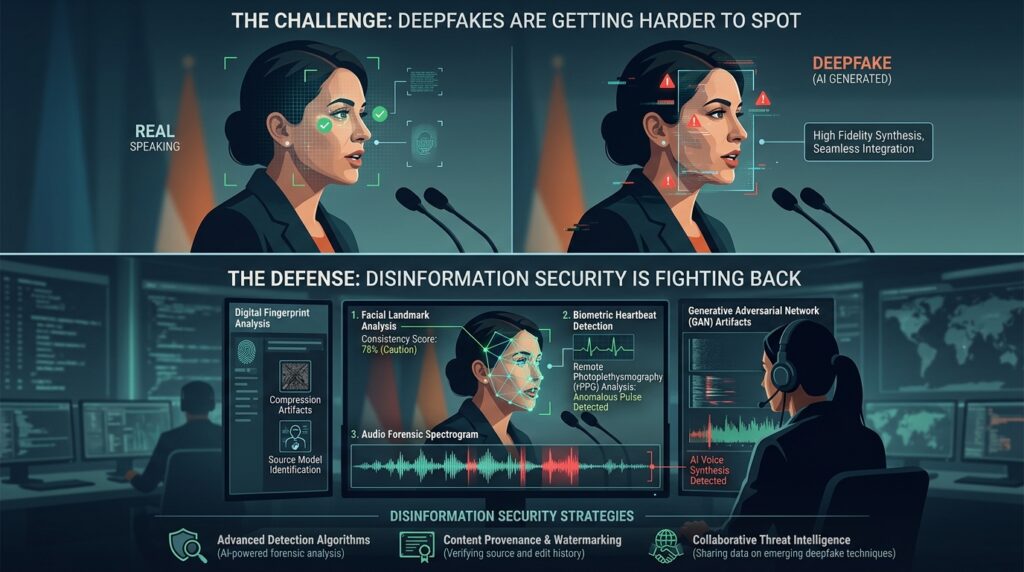
In the first hour, teams rarely need courtroom-grade proof. They need a defensible confidence level that informs action. Should the executive team pause a public statement? Should a bank block a voice-authenticated transfer? Should an election office alert platforms and journalists? Those are operational decisions, not philosophical ones.
The practical rule is to grade risk by impact and reversibility. If the content can trigger financial loss, physical disruption, or mass misbelief, act on partial evidence and keep verifying. Waiting for total certainty is often a losing strategy. By the time the fake is fully proven, the harm has already propagated through reposts, screen captures, and reaction videos.
The Defensive Stack: People, Process, and Machine-Learned Signals
Why No Single Detector is Enough
Every deepfake detector has a shelf life. Once attackers understand what a model flags, they adapt through compression, re-encoding, noise injection, or prompt tuning. The cat-and-mouse dynamic is real. That is why resilient programs avoid betting the farm on a single score or vendor claim.
A better stack combines model-based detection, provenance checks, anomaly monitoring, and human review. Think of it as layered friction. Each layer catches a different class of deception. When one layer misses, another still has a chance to stop the spread. This is the same logic behind mature cybersecurity architecture, and it applies cleanly to synthetic media.
Layer What It Detects Strength Limit AI detector Manipulation artifacts, generator fingerprints Fast screening Adversarially evadable Provenance metadata Origin and edit history Strong trust signal Requires adoption OSINT verification Timeline and location mismatches High contextual accuracy Slower than automation Human escalation Operational judgment Handles ambiguity Subject to fatigue and bias
The People Side: Training That Changes Behavior
Most organizations underinvest in the human layer. They train employees to “be careful,” which is not a control. Effective training teaches staff to verify voice changes, callback using known numbers, and reject urgent requests that bypass normal approvals. In finance, that means no transfer is authorized solely by voice. In communications, it means no sensitive statement goes live without source validation.
Who works in this space knows that procedure beats intuition. If employees must improvise in a crisis, they usually get it wrong. If they follow a short verification script, they are far more likely to stop a fake before it causes damage. That is why incident playbooks matter as much as detection tools.
Use Cases Where This Stack Matters Most
Executive fraud is the clearest example. A cloned voice can pressure a subordinate into moving funds or disclosing credentials. Election integrity is another. A fake candidate statement can trigger confusion, depress turnout, or provoke a false correction cycle. Brand abuse is a third. A synthetic testimonial or fabricated apology can damage trust long after the post disappears.
In all three cases, the response needs to be fast and documented. The security team should log the claim, preserve the media, validate origin, notify stakeholders, and publish a correction only after confirming the facts. Speed matters, but so does precision. Overcorrecting with an unverified denial can amplify the falsehood.
Building an Enterprise Response That Holds Up Under Pressure
What Mature Governance Looks Like
Mature governance starts before an incident. The organization defines who can validate media, who can authorize public statements, and which channels are trusted for urgent internal requests. It also sets rules for watermarking, signing, retention, and evidence preservation. Without those controls, the response becomes improvisation dressed up as policy.
The best programs treat synthetic media as a cross-functional risk. Security leads the technical side. Legal handles exposure and evidence. Communications manages narrative containment. HR and finance handle impersonation risk. If those groups work in silos, attackers exploit the seams. Disinformation rarely stays inside one department’s lane.
What to Do in the First 30 Minutes
When a suspicious clip or voice note appears, the first objective is containment, not debate. Preserve the original file, screenshots, URLs, timestamps, and source accounts. Check whether the content has provenance credentials. Compare the claim with internal records and external context. If it involves a person, use a callback number or secondary authentication path rather than the compromised channel.
This is where the National Institute of Standards and Technology is useful. Its guidance on digital identity and related controls reinforces the idea that strong verification depends on layered assurance, not a single proof point. See NIST’s digital identity resources for standards-oriented thinking that maps well to high-risk authentication scenarios. The lesson is blunt: if a channel can be spoofed, it should never be the only channel.
Metrics That Reveal Whether the Program Works
Good disinformation security teams do not measure only detection accuracy. They measure time to triage, time to escalation, false-positive burden, incident containment time, and percentage of high-risk media with verifiable provenance. Those numbers show whether the organization can respond under realistic conditions.
A program can look excellent in a demo and fail in production. That gap is common. The right way to test is with red-team exercises, synthetic media drills, and communication simulations that involve executives and frontline staff. If the drill does not produce confusion, the drill was too easy.
What Comes Next for Synthetic Media Defense
Expect a Shift from Detection to Trust Infrastructure
The next phase is not about building one magical detector. It is about creating trust infrastructure that spans devices, platforms, and workflows. Secure capture at the source, signed edits, provenance-aware publishing, and platform-level verification will matter more each year. Detection will remain necessary, but it will become the backstop rather than the center of gravity.
That shift is already visible in newsrooms, government agencies, and high-assurance enterprise environments. The organizations moving fastest are the ones that understand a hard truth: if authenticity cannot be established quickly, the false narrative wins by default. That is why deepfakes are getting harder to spot, and why the defense stack has to become more structural, not just smarter.
Where the Market is Still Weak
There is still no universal standard adoption, and that gap creates friction. Some devices can sign content; others cannot. Some platforms preserve metadata; others strip it. Some users understand credentials; most do not. The ecosystem remains fragmented, and attackers benefit from that fragmentation.
There is also disagreement among specialists about how much faith to place in automated detectors. Some argue that future models will identify enough subtle cues to keep pace. Others think the scale of generative improvement will always out-run pure detection. The practical answer is to assume both are partly right. Build for imperfect tools. Do not bet on perfection.
Próximos Passos Para Implementação
Organizations should start by inventorying high-risk media workflows: executive communications, customer support, finance approvals, public relations, and election-adjacent operations. Then they should add provenance checks, callback verification, retention rules, and red-team testing. If the environment cannot prove where media came from, it must treat the content as untrusted until validated. That is a difficult posture culturally, but it is the only one that scales against sophisticated deception.
Next, teams should define the threshold for action. Not every suspicious clip needs a public response, but every high-impact clip needs a documented decision path. The winning organizations will not be those that detect the most fakes. They will be the ones that reduce the time between suspicion and verified response. That is the real competitive advantage in synthetic media defense.
FAQ
How Do Deepfake Detection Systems Actually Work?
They analyze statistical and temporal patterns that often differ from genuine media, such as facial blending artifacts, inconsistent motion, spectral anomalies in audio, and metadata irregularities. Modern systems usually combine multiple detectors rather than relying on one signal. The strongest setups also compare the media against provenance records and contextual evidence. That combination is far more resilient than human inspection alone, especially when the fake is high quality.
Why Are Provenance Standards So Important for Media Security?
Provenance gives defenders a verifiable chain of custody, which is more reliable than trying to infer authenticity from appearance. Standards like C2PA allow content to carry signed information about capture, edits, and export history. That matters because detection can fail when attackers improve their models or remove visible artifacts. Provenance does not stop every fake, but it raises confidence when the media is legitimate and forces scrutiny when it is not.
Can AI Detectors Keep Up with New Generative Models?
Sometimes, but not consistently. Detectors can work well against known artifact patterns, yet attackers adapt quickly through compression, post-processing, and model changes. That is why a detector-only strategy becomes weaker over time. The more durable approach is layered defense: detectors, provenance, OSINT validation, and human escalation all working together.
What is the Biggest Operational Risk from Deepfakes?
The biggest risk is not always public embarrassment; it is decision error under time pressure. A cloned voice can trigger fraudulent transfers, a synthetic video can force a false statement, and a fake announcement can destabilize a market or election process. The harm usually occurs before the content is proven false. That is why verification workflows must be faster than the attack’s distribution cycle.
What Should an Organization Test First in a Deepfake Defense Program?
Start with the highest-impact communication paths: finance approvals, executive messaging, customer-facing announcements, and crisis response channels. Then test whether those paths require callback verification, secondary authentication, and evidence preservation. A good test measures time to triage and time to containment, not just detection accuracy. If a team cannot act quickly with confidence, the control is not ready for production.
Editorial Notice
This content was structured with the assistance of Artificial Intelligence and subjected to rigorous curation, fact-checking, and final review by Editor-in-Chief Nivailton Santos. TechTool Judge reaffirms its unyielding commitment to journalistic ethics, ensuring that editorial judgment and data validation remain entirely under human responsibility and final editorial oversight.