
Amazon Begins Testing New Alexa with Generative AI in Brazil

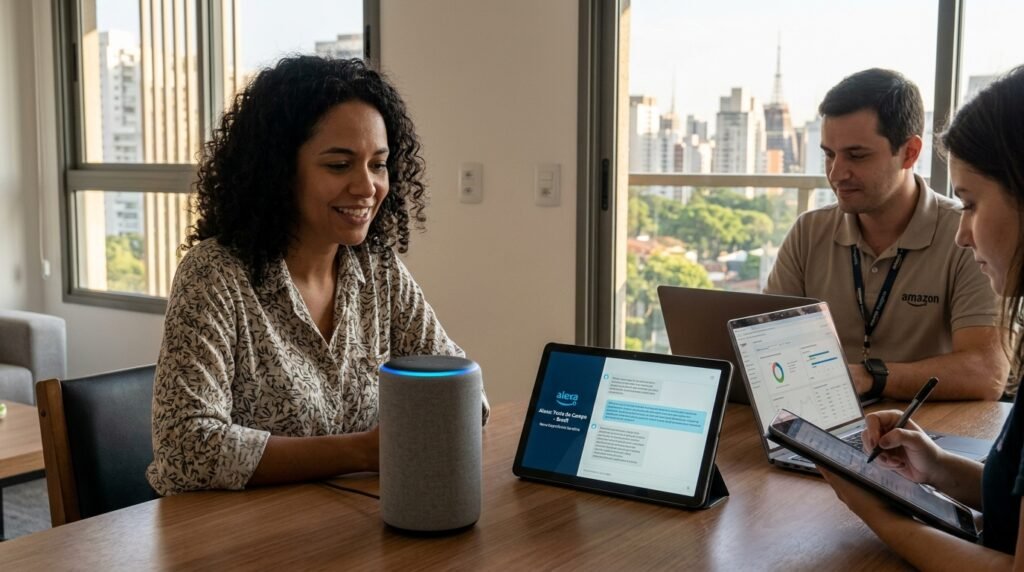
Alexa is about to sound less like a device and more like a person who can actually think on the fly.
Amazon starts testing the new Alexa with generative AI in Brazil at the exact moment voice assistants stop being cute gadgets and start becoming real interfaces. That shift changes everything: how you ask, how it answers, and how much you trust it.
And the interesting part is not the demo. It’s what happens when a helper that used to follow scripts begins to improvise.
Why This Test Matters More Than Another “Smart Speaker” Update
Amazon starts testing the new Alexa with generative AI in Brazil because the old promise of voice assistants was always bigger than the product they shipped. Traditional Alexa worked like a polished switchboard: trigger, route, respond. Generative AI changes the mechanism. It allows the system to synthesize answers, hold context longer, and handle requests that don’t fit a rigid command list.
In plain English, that means you may stop talking like you’re issuing orders. Instead of memorizing the “right” phrase, you can speak more naturally. That sounds minor until you notice how much friction disappears when the machine stops punishing imperfect language.
On paper, it looks like a feature upgrade. In practice, it is a philosophical reset. A device that once waited for instructions now tries to understand intent. That’s a very different relationship — and Amazon knows it.
The move also places Brazil inside a global race where voice assistants are being reimagined as AI companions, not just home controls. And once that happens, the next question is no longer whether Alexa can answer you. It’s whether you can still predict how it will answer.
The Mechanism Behind Generative Alexa, Without the Hype Fog
Generative AI, at its core, is a model that produces new language by predicting the most likely next word or token based on patterns learned from large datasets. It does not “know” things the way a person does. It generates responses by combining context, probability, and learned structure. That distinction matters, because Amazon starts testing the new Alexa with generative AI in Brazil using technology that can sound confident even when it is wrong.
That is the hidden trade-off. Better conversation. More flexibility. More room for error.
Think of the old Alexa as a librarian with index cards. Think of the new one as a fast-talking research assistant who can connect ideas, summarize options, and answer in a more fluid way — but sometimes needs a second check. That’s the comparison most marketing slides avoid, because it sounds less magical and more useful.
Generative AI makes Alexa feel smarter, but it also makes verification your job again. You get convenience and ambiguity in the same package.
According to the U.S. National Institute of Standards and Technology, AI systems need careful testing for reliability, bias, and security before wide deployment; their guidance on trustworthy AI is a good reminder that fluency is not the same as correctness: NIST’s AI guidance.
What Brazilian Users Are Likely to Notice First

Amazon starts testing the new Alexa with generative AI in Brazil, and the first thing people will notice probably won’t be a flashy feature. It will be tone. Replies should feel less robotic, more conversational, and better at handling follow-up questions without making you repeat yourself.
That sounds small until you live with a voice assistant every day. Repetition is where most of them lose you. Ask for a playlist, then change the mood, then ask for volume, then ask a follow-up question — and suddenly you are trapped inside a verbal maze. If generative AI smooths that out, the product feels more human before you even think about “AI.”
- More natural wording instead of canned phrases.
- Better context retention across short back-and-forth exchanges.
- Less command memorization for everyday tasks.
- Higher risk of confident mistakes if the model fills gaps badly.
Here’s the catch: not every user wants a chatty assistant. Some people want speed, not personality. And in a noisy kitchen, a slightly smarter answer can still lose to a faster one. That tension explains why early tests matter more than polished launch videos.
Vi cases where people loved a “smarter” assistant for one week, then got annoyed because it answered in paragraphs when they just wanted the lights off. That is the real-world friction Amazon has to solve.
Brazil is a Smart Place to Test This Shift
Brazil is not just another market on a rollout map. It is a place where voice, accent, household routines, and multi-person homes can expose weak spots quickly. Amazon starts testing the new Alexa with generative AI in Brazil because real usage here can reveal whether the assistant actually understands local speech patterns or just performs well in controlled demos.
This matters for two reasons. First, a language model that sounds impressive in English can stumble in everyday Portuguese if it lacks enough cultural and linguistic nuance. Second, homes are busy, loud, and messy. The assistant has to work while someone is cooking, another person is watching TV, and a kid is asking a second question before the first one ends.
The best AI is not the one that sounds brilliant in a keynote. It’s the one that still works when your house is loud, imperfect, and impatient.
According to Brazil’s consumer protection framework, product claims and digital services still need to meet transparency standards. The official Federal Government portal on consumer rights is a useful reference point when AI-driven services begin changing what a device can and cannot do: Brazilian consumer service information.
And that leads to a practical question many people skip: what can go wrong when a system that sounds more capable starts behaving more freely?
The Three Risks That Matter Before You Trust It
Amazon starts testing the new Alexa with generative AI in Brazil at a time when users are finally more aware of AI’s limits. That awareness is healthy. A more fluid assistant can be more useful, but it can also blur the line between “helpful” and “invented.”
Here are the mistakes users will make first:
- Assuming confidence equals accuracy. A polished answer can still be wrong.
- Using it for high-stakes decisions. Shopping, music, and timers are one thing; medical, legal, or financial advice is another.
- Ignoring privacy settings. A more capable assistant often feels more personal, which makes people share more than they should.
There’s also an emotional risk. When a voice assistant becomes better at conversation, people tend to lower their guard. That’s not a theory. It happens fast. A smoother interface creates a sense of companionship, and companionship makes you more forgiving than you should be.
That is where trust gets expensive. Once a system is inside your home, the bar is not “impressive.” The bar is “reliable when tired, distracted, or wrong.” Amazon starts testing the new Alexa with generative AI in Brazil will be judged on that standard, not on stage demos.
And that is the part worth watching next: whether this update makes Alexa feel like a better assistant, or just a better talker.
What This Move Really Says About the Next Phase of Alexa
Amazon starts testing the new Alexa with generative AI in Brazil because the category itself is changing. The old battle was about commands. The new battle is about context, memory, and usefulness over time.
If Amazon gets this right, Alexa stops being a device you “use” and becomes a layer in the room — something closer to an ambient interface. That is a much bigger ambition than selling speakers. It’s an attempt to make the assistant invisible until you need it, and memorable when you do.
But there is no free lunch here. More intelligence means more complexity behind the scenes, more testing, more moderation, and more ways to disappoint people if the assistant gets overconfident. In other words, the product gets better by becoming harder to perfect.
The real test is not whether Alexa can answer more questions. It’s whether it can do so without making you feel like you need to double-check a machine that sounded sure of itself a second ago.
We are entering the age of assistants that can speak beautifully and still be wrong. That is progress, but it is not the same thing as wisdom.
When Amazon starts testing the new Alexa with generative AI in Brazil, the story is not just about a smarter device. It’s about whether people are ready for technology that talks less like a tool and more like a collaborator.
FAQ
What is the New Alexa with Generative AI?
It is a version of Alexa that uses generative AI to create more natural, flexible answers instead of relying mainly on fixed command-and-response scripts. In practice, that means it should handle follow-up questions better, sound more conversational, and adapt more easily to messy, real-world phrasing. The downside is that more fluid answers can also mean more room for mistakes, so users should still verify anything important.
Why is Amazon Testing It in Brazil?
Brazil is a strong test market because it can reveal whether the assistant handles Portuguese, accents, and everyday household noise in a realistic way. A system that works in a controlled demo can fail in a busy home, so local testing is useful for exposing weak spots early. Amazon also gets feedback from a large, active consumer base that can stress-test the product fast.
Will the New Alexa Be More Accurate?
Not automatically. Generative AI can make Alexa feel smarter and more adaptable, but it does not guarantee perfect accuracy. The assistant may be better at context and conversation, yet still produce confident but incorrect answers. That’s why the most useful approach is to treat it like a helpful layer, not an authority on everything.
What Should Users Watch Out For?
The biggest risks are overtrust, privacy, and using the assistant for decisions that need verified information. A voice assistant that sounds natural can tempt you to share too much or assume it knows more than it does. It is fine for daily tasks, reminders, and home control, but high-stakes topics should always be checked against trusted sources.
Does This Mean Alexa Will Replace Other AI Assistants?
Not necessarily. The market is moving toward multiple assistants with different strengths, and users may prefer one for home control, another for search, and another for productivity. Amazon’s move matters because it shows where the category is heading, not because it guarantees dominance. The winner will likely be the assistant that feels useful, trustworthy, and fast in everyday life.
Editorial Notice
This content was structured with the assistance of Artificial Intelligence and subjected to rigorous curation, fact-checking, and final review by Editor-in-Chief Nivailton Santos. TechTool Judge reaffirms its unyielding commitment to journalistic ethics, ensuring that editorial judgment and data validation remain entirely under human responsibility and final editorial oversight.