
React, Next.js, and the Frameworks Dominating Developer Job Listings Right Now: What Employers Are Actually Hiring For

React, Next.js, and the frameworks dominating developer job listings right now are not just popular tools; they are the frontend stack most employers use to ship production web apps quickly, hire from a deep talent pool, and reduce architectural risk. In technical terms, this is the ecosystem built around React’s component model, Next.js’s server-rendered and hybrid rendering layer, and adjacent frameworks such as Nuxt, SvelteKit, Angular, and Remix that compete for modern web application work.
That matters because job listings are not a vanity metric. They reflect what teams are actually paying to maintain, scale, and extend. When companies keep posting for React and Next.js, they are signaling three things: they want hiring velocity, they want a framework with broad ecosystem support, and they want engineers who can operate across client rendering, server components, routing, data fetching, and deployment constraints without fighting the stack every day.
In practice, what happens is that candidates who understand React syntax but not the runtime model get filtered out fast. I have seen teams hire aggressively for “React developers” only to discover they really needed someone comfortable with Next.js app routing, SSR/SSG tradeoffs, caching behavior, and basic production performance work. The market rewards people who can reason about the whole delivery path, not just JSX.
Key Takeaways
- React remains the baseline hiring signal because it has the deepest talent pool, the broadest ecosystem, and the lowest onboarding risk for employers.
- Next.js has become the default production framework for many React teams because it solves routing, rendering, and deployment concerns in one opinionated layer.
- Framework popularity in job ads is driven less by technical elegance and more by maintainability, staffing availability, and compatibility with existing product teams.
- Learning the React/Next.js stack is valuable, but candidates who also understand SSR, RSC, caching, and performance budgets stand out faster.
- Not every company needs the same framework; teams building highly interactive dashboards, content sites, and SaaS products choose differently based on architecture constraints.
React, Next.js, and the Frameworks Dominating Developer Job Listings Right Now: What Employers Are Actually Hiring For
React is the Hiring Baseline, Not the Finish Line
React is a UI library for building component-based interfaces with declarative state management and a virtual DOM abstraction. In plain English: it gives teams a predictable way to build interactive screens without hand-rolling every DOM update. That predictability is why React shows up in so many listings. Employers know they can hire for it, onboard faster, and draw on a mature ecosystem that includes Redux, TanStack Query, React Hook Form, and testing tools like React Testing Library.
The mistake many candidates make is treating “React” as if it were the full job requirement. It rarely is. Employers usually mean React plus the surrounding production discipline: TypeScript, API integration, component architecture, accessibility, and enough performance awareness to avoid rendering waste. If a listing mentions design systems, state management, or test coverage, the company is signaling that it wants an engineer who can work in a shared codebase, not just build isolated UI widgets.
Next.js Has Become the Default for Production React Work
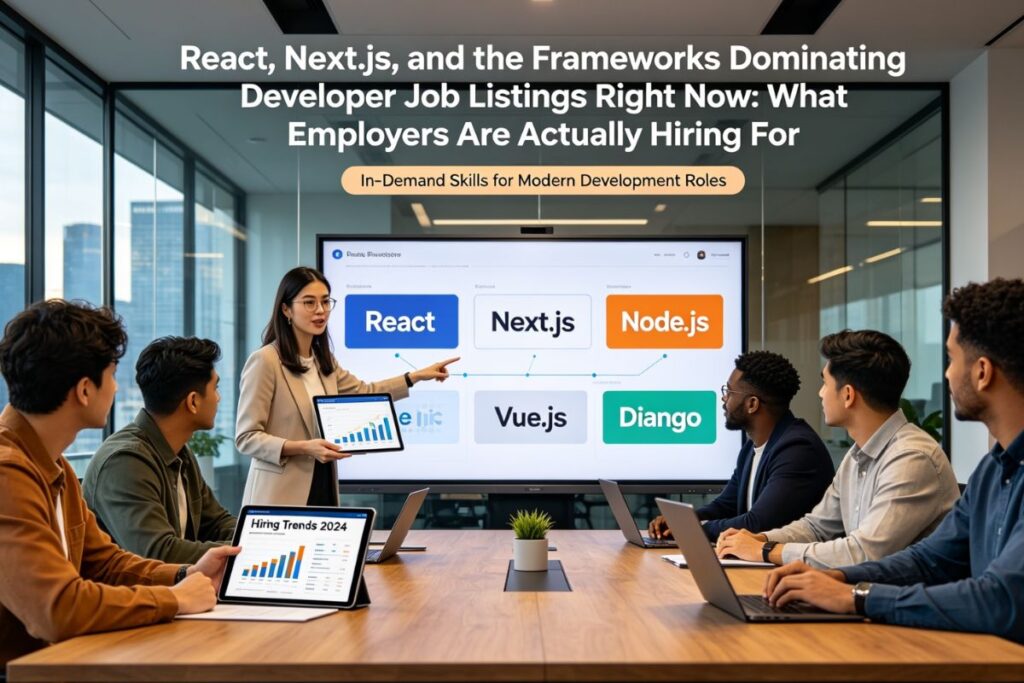
Next.js is a full-stack React framework that adds file-based routing, server-side rendering, static generation, server actions, and deployment conventions. That is the formal definition. In practical terms, it removes a huge amount of setup work and gives teams a coherent path from prototype to production. For recruiters, that matters because Next.js reduces ambiguity: if the company says “Next.js,” it usually wants someone who can ship pages, manage data loading, and think about performance in a real deployment environment.
This is where job listings have shifted. A few years ago, “React developer” could mean almost anything. Now the stronger postings ask for Next.js because companies want hybrid rendering, better SEO for public-facing pages, and fewer framework decisions to manage internally. This is also where the official Next.js documentation matters: it makes the framework’s capabilities and constraints visible enough that hiring teams can align on architecture before a candidate ever joins the stack.
The REST of the Market: Nuxt, SvelteKit, Angular, and Remix
Outside the React world, the other frameworks that show up consistently in job listings tend to map to specific company preferences. Nuxt occupies the Vue ecosystem and is attractive to teams that already standardized on Vue. SvelteKit appeals to smaller, performance-sensitive teams that value compiler-driven simplicity. Angular remains strong in enterprise environments where structure, conventions, and long-term maintainability matter more than cutting-edge developer experience. Remix still appears where teams want a web-standards-first model and tighter control over nested routing and data loading.
None of these frameworks is “best” in the abstract. That is the wrong question. The right question is which stack matches the product’s life cycle, hiring constraints, and operational risk. A startup hiring fast for consumer web experiences will usually pick React plus Next.js. A large enterprise with an existing Angular codebase will not migrate because a trend article said so. That gap between market hype and operational reality explains a lot of the persistence you see in developer job ads.
Why Job Listings Keep Favoring React and Next.js over Flashier Alternatives
Hiring Pools Matter More Than Benchmark Wins
Companies do not hire frameworks; they hire people who can keep shipping. React dominates listings because the available talent pool is massive, interview loops are simpler to standardize, and teams can transfer engineers between products without rewriting the frontend architecture every quarter. That is a strategic advantage, not a trend. If a framework has a large ecosystem and a long runway, enterprise recruiters and startup founders both notice.
This is also why “best technology” and “most hired technology” diverge. A newer framework may offer cleaner abstractions, but if only a small slice of the market knows it well, the company absorbs more risk in recruiting, onboarding, and maintenance. The market for workforces is just as real as the market for software. Job listings reflect that constraint with brutal honesty.
Next.js Solves Three Employer Problems at Once
Next.js is attractive because it reduces the number of separate decisions a team must make. Routing comes built in. Rendering strategies are part of the framework. Deployment on platforms like Vercel is straightforward, and the ecosystem has become familiar enough that even non-specialists can reason about it. That consolidation matters in hiring because managers want engineers who can move from feature work to platform concerns without needing to learn six additional abstractions.
There is a tradeoff, of course. Next.js can hide complexity until you hit caching, hydration, or server/client boundaries. Teams that do not understand those edges can create subtle bugs or performance regressions. The framework is excellent, but it is not magic. It works best when the team understands the difference between server rendering, static generation, and client-side interactivity, and when the app’s architecture fits that model.
Search Demand is Reinforced by Documentation and Community Signals

Framework popularity in listings also tracks educational and ecosystem signals. Strong docs, active issue tracking, and visible adoption from respected companies lower the perceived risk of hiring into that stack. That is one reason official sources matter. React’s official documentation has been a major contributor to standardizing modern React concepts like hooks and server components, while broader labor and technology reporting helps contextualize how software jobs are shifting overall.
For labor-market context, the U.S. Bureau of Labor Statistics keeps tracking software developer demand and employment trends, which is useful when you want to separate anecdote from macro signal. See the BLS software developer outlook for a grounded view of the occupation itself. The broader point: hiring choices are shaped by skill availability, not just technical purity.
How to Read a Frontend Job Posting Like a Hiring Manager
Surface Keywords Vs. Real Requirements
A listing that says “React” may actually require React, TypeScript, testing, GraphQL or REST integration, and a component library like MUI or Chakra UI. A listing that says “Next.js” may require SSR troubleshooting, App Router familiarity, caching strategy, and comfort with deployment platforms. The strongest candidates learn to decode the stack behind the words. That skill separates people who only match keywords from people who can take ownership of delivery.
Who works with this knows the pattern: the job description often under-specifies the real environment. A team might mention Next.js but omit whether they use server actions, edge runtimes, or traditional API routes. Another might mention React but expect deep experience with state orchestration, performance profiling, and accessibility reviews. The interview process usually reveals the gap. Reading between the lines saves time and prevents mismatched expectations.
Common Signals in Strong Frontend Roles
High-quality listings tend to include the same structural clues because they reflect real engineering maturity. You should expect to see at least some combination of the following: TypeScript, testing strategy, accessibility, performance budgets, component reuse, and product collaboration. When those are present, the company usually has enough process discipline to support serious frontend work. When they are absent, the role may be mostly feature chasing with little technical ownership.
- TypeScript: usually indicates a typed codebase, shared contracts, and stronger tooling expectations.
- SSR/SSG: signals awareness of rendering strategy and search visibility requirements.
- Design systems: suggests component reuse, consistency, and cross-team coordination.
- Testing libraries: indicates that quality is part of the workflow, not an afterthought.
- Performance metrics: points to serious attention to Core Web Vitals, bundle size, and runtime cost.
When a Posting is Inflating the Stack
Some listings overstate the number of frameworks they use because recruiters want to widen the funnel. That creates noise. A company may ask for React, Next.js, Redux, Tailwind CSS, GraphQL, Apollo, Node.js, and AWS, when in reality the role is mostly a component-builder on one product team. That does not mean the ad is dishonest; it means the company has conflated adjacent skills into one wish list.
The limit here is real: not every listing can express architecture cleanly in 200 words. Still, candidates should distinguish between required depth and aspirational breadth. If a stack description looks like a laundry list, the interview should focus on the actual day-to-day work. Otherwise you risk optimizing for the posting rather than the job.
What Developers Should Learn Beyond the Framework Itself
Rendering Strategy Matters More Than Syntax
Modern frontend work is no longer about knowing JSX alone. Engineers who understand how React renders, how hydration works, when server components make sense, and what changes between client and server boundaries can diagnose problems faster and make better design choices. That is where production value lives. The people who stand out in interviews can explain why a page should be server-rendered, when client interactivity should be isolated, and how to avoid shipping unnecessary JavaScript.
That knowledge also translates directly into better portfolio work. A polished Next.js app with good loading states, accessible navigation, and sensible data-fetching patterns says far more than a toy CRUD app with a popular framework logo in the footer. Employers see the difference immediately. So do senior engineers.
The Practical Skill Stack That Gets Noticed
If the goal is employability, the highest-return skills are often the ones that sit adjacent to React and Next.js. TypeScript remains a major signal because it improves maintainability and reduces runtime errors. Testing, particularly component and integration testing, proves you can ship with confidence. Accessibility is another differentiator because many teams still underinvest there. Add performance profiling and you have the kind of frontend profile that translates across companies.
Skill Area Why Employers Care Interview Signal TypeScript Safer refactors and shared contracts Can you model data cleanly? Testing Lower regression risk Do you know what to test at component level? Accessibility Compliance and product quality Do you use semantic HTML and keyboard support? Performance Better UX and conversion Can you reason about bundle size and hydration cost?
Where the Market Still Leaves Room for Specialization
There is a tendency to treat frontend as one big interchangeable skill set. That is wrong. E-commerce, content platforms, internal dashboards, and developer tools each impose different constraints. A developer who understands design systems may thrive in enterprise UI work. Another who understands streaming and caching may be stronger in content-heavy products. A third who knows animation and interaction design may be ideal for consumer-facing experiences.
That nuance is why the best frontend engineers avoid shallow generalism. The market rewards breadth, but depth still wins interviews. If you can connect framework knowledge to product outcomes, you will look stronger than someone who merely lists technologies on a resume.
How to Position Yourself for the Roles That Are Actually Open
Build for the Stack Employers Keep Posting
If the target is employability, build projects that mirror the patterns companies are hiring for. A strong portfolio today usually includes a React/Next.js app with TypeScript, authentication, data fetching, server-side rendering or static generation, form handling, tests, and deployed previews. That combination maps closely to real work. It also gives interviewers concrete material to evaluate beyond abstract familiarity.
One useful approach is to choose a project with real tradeoffs, not a tutorial clone. For example, build a dashboard with role-based access, a content site with dynamic routes, or a SaaS-style interface with search, filters, and optimistic updates. Those features force you to deal with edge cases that show up in job listings. They also reveal whether you understand how the framework behaves under production constraints.
Read the Market as a System, Not a Headline
The strongest career decisions come from reading signals together. Job listings, framework docs, labor data, and your own project experience all point to the same conclusion: React remains the entry point, Next.js is the production default for many teams, and adjacent frameworks fill narrower but still meaningful niches. That pattern is unlikely to disappear quickly because it is anchored in hiring economics, not hype cycles.
There is no universal winner, and that is the useful truth. Some teams will keep choosing Angular for structure, others will favor Vue or SvelteKit for specific product goals, and many will stay with React and Next.js because the staffing math works. If you want the broadest set of opportunities, align your skill set with the dominant hiring pattern, then add enough depth to solve real production problems.
Próximos Passos Para Implementação
The most practical move is to treat React and Next.js as a delivery stack, not a certification badge. Build one project that uses the App Router, TypeScript, and realistic data flows. Then add tests, performance checks, and accessibility fixes until the app feels like something a product team could actually ship. That exercise will teach more than memorizing API names, because it forces you to deal with the same decisions hiring managers care about: rendering strategy, component boundaries, and maintainability.
From there, compare postings side by side and map each requirement to a real skill. Separate must-haves from noise. If a company asks for Next.js, make sure you can explain SSR, SSG, hydration, and when to keep logic on the server. If a listing is broader, decide whether the role matches your strengths in UI architecture, data-heavy interfaces, or platform work. That is how you turn market signal into a deliberate career move.
The near-term direction is clear: the market will keep rewarding engineers who can combine React fundamentals with production judgment. React gets you in the door. Next.js gets you closer to shipping. The rest of the stack determines whether you can stay useful after the first release.
Perguntas Frequentes
Is React Still Worth Learning If Next.js Dominates Many Listings?
Yes. Next.js is built on top of React, so React remains the core skill. If you skip React fundamentals, you will struggle with component composition, state management, hooks, and rendering behavior. Companies may hire for Next.js, but they still expect you to understand the React model underneath it.
Should Developers Learn Next.js Before Other Frontend Frameworks?
For broad job-market value, yes, if you already want to work in the React ecosystem. Next.js appears in a large share of production roles and gives you practical exposure to routing, SSR, and deployment patterns. If your target companies use Vue, Angular, or Svelte, then you should align with their stack instead of forcing a React-first path.
Why Do So Many Listings Ask for TypeScript with React?
Because typed frontend code is easier to maintain at scale. TypeScript improves refactoring safety, reduces runtime mistakes, and helps teams share interfaces across frontend and backend code. In larger codebases, it also improves onboarding because the types act as documentation.
What Separates a Junior React Developer from a Hireable Production Engineer?
The difference is usually judgment, not syntax. A hireable engineer understands state boundaries, component reuse, data fetching patterns, and how to avoid unnecessary re-renders or brittle abstractions. They can also explain tradeoffs clearly and show evidence of testing, accessibility, and performance awareness.
Are Frameworks Like SvelteKit or Remix Good Career Bets?
They are good tools, but narrower career bets than React and Next.js in most labor markets. SvelteKit and Remix can be excellent in the right team, yet the number of open roles is typically smaller. If your goal is maximum job flexibility, prioritize the frameworks with the deepest hiring demand first, then branch out once you have leverage.
Editorial Notice
This content was structured with the assistance of Artificial Intelligence and subjected to rigorous curation, fact-checking, and final review by Editor-in-Chief Nivailton Santos. TechTool Judge reaffirms its unyielding commitment to journalistic ethics, ensuring that editorial judgment and data validation remain entirely under human responsibility and final editorial oversight.