
Beyond SEO and Generative Engine Optimization (GEO): What Changed in Content Discovery

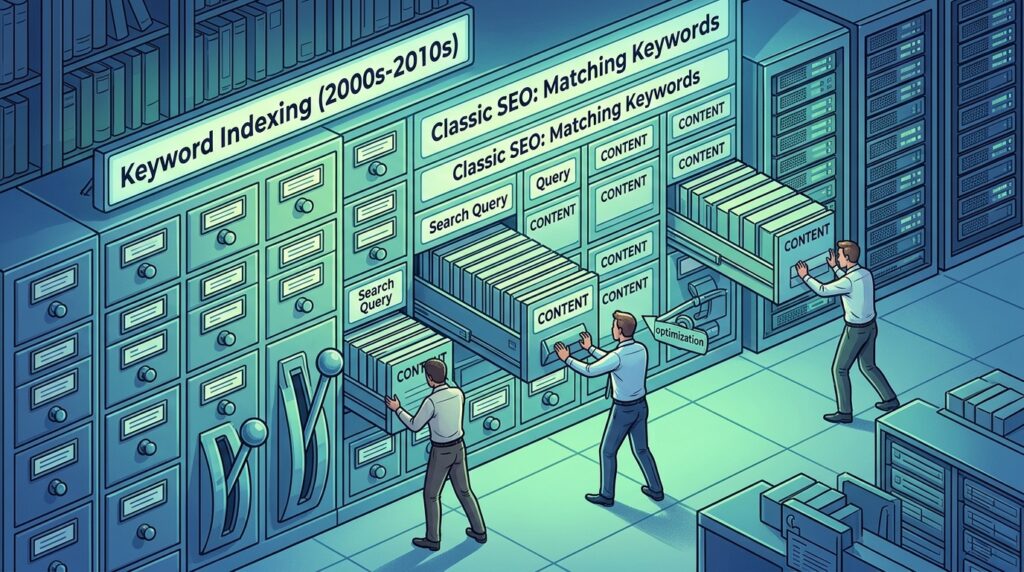
Beyond SEO and Generative Engine Optimization (GEO) describe the shift from ranking only in traditional search engines to being discovered, summarized, and cited inside AI-generated answers. Formally, GEO is the practice of structuring and validating content so large language models and answer engines can identify it as relevant, trustworthy, and easy to quote. In plain terms: SEO helps you appear in search results; GEO helps your ideas survive the trip into the answer itself.
This matters because discovery is changing faster than most publishing teams expected. Google is rolling out AI Overviews, Microsoft continues to embed Copilot across search surfaces, and users are increasingly asking assistants for synthesized answers instead of clicking through ten blue links. The result is not the death of search, but a redistribution of visibility: the brands, publishers, and experts that AI systems can parse confidently will gain disproportionate presence.
That shift changes the economics of content. A page that once competed for a click now competes for inclusion, citation, and attribution. In practice, that means cleaner entity coverage, stronger sourcing, tighter topical focus, and content that answers questions in a way a model can extract without losing meaning. The winners will not be the loudest publishers. They will be the most usable sources.
Key Points
- Generative Engine Optimization is not a replacement for SEO; it is a new layer that optimizes for inclusion in AI-generated answers, citations, and summaries.
- Content that performs well in GEO tends to be precise, well-structured, source-backed, and rich in named entities that models can reliably identify.
- Brand authority now depends not only on backlinks and rankings, but also on whether generative systems can extract and attribute your expertise.
- Pages built around one clear intent, one primary topic, and supporting evidence are easier for answer engines to trust than broad, keyword-heavy articles.
- The content teams that adapt fastest will measure visibility across search results, AI Overviews, citations, and assisted discovery surfaces, not rankings alone.
Beyond SEO and Generative Engine Optimization (GEO): What Changed in Content Discovery
From Ranking Documents to Feeding Answer Systems
Traditional SEO was built around retrieval: match a query, rank a document, earn a click. GEO operates in a different layer. It is about making content legible to systems that synthesize multiple sources into a single response. That includes search engines with generative features, standalone AI assistants, and enterprise copilots that retrieve passages before they generate text.
The technical difference matters. Retrieval systems care about relevance signals, entity clarity, semantic consistency, and source reliability. Generative systems then compress that material into prose. If your page is vague, overloaded, or poorly organized, the model may still understand the topic at a high level but fail to select your content as a quotable source. The page gets indexed, yet disappears from the answer layer.
Who works in this field knows the pattern: the best-performing pages often are not the most verbose. They are the most extractable. Clear definitions, labeled sections, explicit claims, and cited evidence make content easier for both search crawlers and answer engines to process.
Why AI Overviews and Copilot Changed the Visibility Model
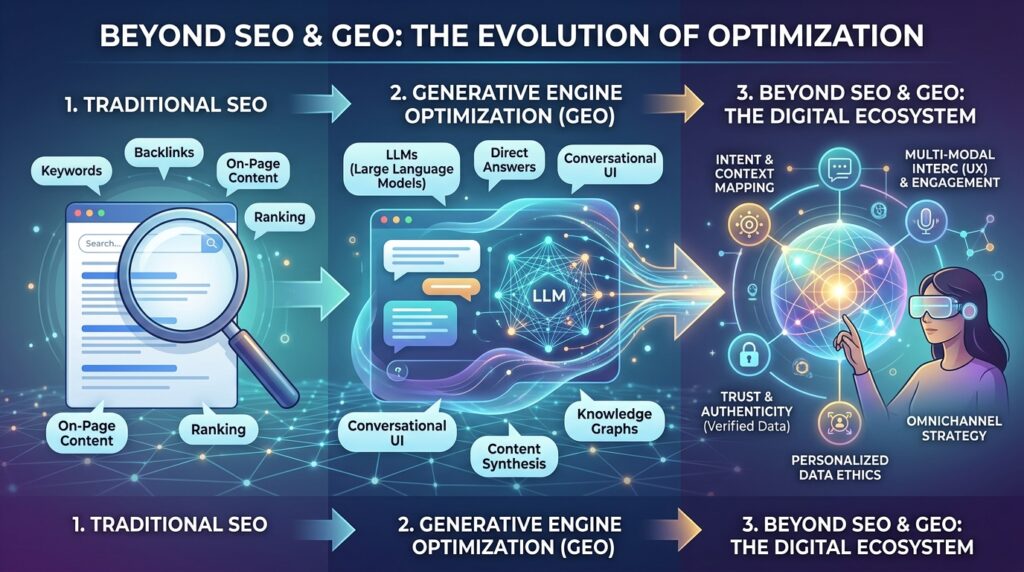
Google’s AI Overviews have normalized a new behavior: the search system can answer many informational queries before the user clicks a result. Microsoft Copilot does something similar inside its own ecosystem, using retrieval and synthesis to reduce the need for manual comparison. That creates a winner-takes-more dynamic for sources that are consistently selected as evidence.
This does not eliminate traffic, but it changes its distribution. Some pages will lose top-of-funnel clicks because the answer is already visible. Others will gain trust because their language, structure, and evidence are repeatedly surfaced by the model. The key metric is no longer just position. It is presence inside the answer architecture.
Organizations that still optimize only for the SERP are preparing for yesterday’s interface. The practical response is to publish content that can be quoted in fragments, not just consumed as a whole.
What GEO is Not
GEO is not a trick to “game” AI systems, and it is not a separate discipline that makes SEO obsolete. Search engines still rely on crawlability, relevance, links, and technical hygiene. If your site is slow, inaccessible, or poorly indexed, generative systems will usually inherit those weaknesses.
There is also an important limit: GEO is strongest for informational and evaluative queries, weaker for highly transactional or highly local tasks where direct navigation still dominates. A user looking for a phone number, a store near them, or a product price often wants a direct result, not a synthesized explanation. That boundary will keep moving, but it has not disappeared.
For a useful reference point on search behavior and indexing fundamentals, Google’s SEO Starter Guide remains relevant because GEO still depends on basic discoverability. The format changes; the substrate does not.
The Technical Mechanics Behind GEO Signals
Entity Recognition, Topical Authority, and Passage Extraction
At the core of GEO is entity recognition: the system needs to know who, what, and which concepts your content is about. Entities are named things such as Google Search Central, Bing, ChatGPT, Google AI Overviews, schema markup, E-E-A-T, and Knowledge Graph. If those entities are clearly connected in the text, the model can build a more reliable map of your expertise.
Topical authority then emerges from consistency. When a site repeatedly covers a subject in depth, with aligned terminology and supporting evidence, it becomes easier for algorithms to classify it as a credible source. Passage extraction matters too. Models often quote or rely on the most answer-ready section of a page, not the entire document. The strongest passages are specific, self-contained, and supported by context.
In the field, this is why a crisp definition often outperforms a clever metaphor. A model can extract a definition. It struggles with ambiguity.
Structured Data, Clear Headings, and Machine-readable Context
Schema markup does not guarantee inclusion in a generative answer, but it improves machine-readable context. Article, Organization, Person, FAQPage, and HowTo markup can clarify the page’s purpose, authorship, and relationships. The same logic applies to clean heading hierarchy and descriptive subheads. When content is organized predictably, systems can navigate it faster and with fewer errors.
That aligns with broader guidance from NIST on information quality, traceability, and risk-aware systems. While NIST is not publishing GEO playbooks, its work on trustworthy AI and evaluation principles is highly relevant. Generative systems reward content that can be traced, validated, and interpreted with low ambiguity.
Structured data is not a magic signal. It is a translation layer. Use it to reduce uncertainty, not to replace editorial quality.
Why Source Trust Now Matters More Than Content Volume
Generative systems prefer content that is easy to validate. That makes citations, publication reputation, author credentials, and factual consistency far more important than scale alone. A site that publishes 200 thin pages can still lose to a smaller publisher that documents one subject with precision and evidence.
That is one reason E-E-A-T remains useful as a practical lens. Experience, expertise, authoritativeness, and trust are not abstract branding words. They shape whether a piece of content looks dependable enough to support an answer. If a source is vague about its authorship or unsupported in its claims, it becomes less likely to be quoted.
For a public policy and research perspective on synthetic media and information quality, the Brookings Institution has published relevant analysis on AI-driven information environments. The specific conclusions vary by context, but the broader direction is clear: provenance matters.
How to Build Content That AI Systems Can Cite
Write for Extraction, Not Just Readability
Content that performs well in GEO is built in layers. The first layer states the claim. The second supports it. The third adds nuance. This structure helps both humans and machines. If a model only needs one sentence to answer a question, that sentence should be complete on its own and not depend on a paragraph of setup.
That means avoiding decorative intros and burying the conclusion under context. State the point, then explain it. Use terminology carefully. When you introduce a technical term such as retrieval-augmented generation, passage ranking, or grounding, define it once before moving on. This makes your page easier to cite and harder to misread.
Na prática, o que acontece é que teams that rewrite content for clarity often see improvements in both search performance and AI citation frequency. The same discipline serves two systems.
Use Evidence That a Model Can Trust
Evidence should be visible, current, and specific. Include primary sources when possible, date-stamp claims, and distinguish observation from interpretation. A sentence like “Google’s AI Overviews are changing click behavior” is weak without a source or a date. A sentence like “Google began expanding AI Overviews across more query classes in 2024” is much easier to verify and reuse.
High-quality external references help here. Industry benchmarks from Pew Research Center or academic work from universities provide grounding that AI systems can cross-check against broader consensus. That does not mean every page needs heavy citation density. It means the most important claims should not float unsupported.
Use quotes sparingly and precisely. Quote when wording matters. Paraphrase when the point matters more than the phrasing. Both can work, but the page must remain factually coherent.
Design Pages for Topic Completeness
Completeness is not the same as length. A complete page covers the main question, the adjacent questions, the exceptions, and the practical next step. For GEO, that often means including related entities such as AI Overviews, Copilot, Perplexity, schema markup, E-E-A-T, the Knowledge Graph, retrieval-augmented generation, and passage ranking. These terms help place the page inside the right semantic field.
But completeness has a limit. If the page tries to cover every angle at once, it becomes harder to extract. The best structure is layered depth: one core topic, several supporting subtopics, and clear boundaries around what the page does not attempt to prove.
Content Element Why It Helps GEO Common Mistake Clear definitions Makes the page easier to quote accurately Using vague marketing language first Named entities Improves semantic mapping and context Hiding brands, tools, or institutions behind generic terms Source citations Supports trust and verification Making unsupported claims sound authoritative Structured headings Helps extraction of specific passages Long, undifferentiated blocks of text
How GEO Changes SEO Strategy, Measurement, and Workflow
SEO Teams Need New Success Metrics
Rankings still matter, but they no longer tell the full story. A page can rank well and still lose visibility to an AI answer box. It can also rank modestly and be quoted inside a generative response more often than competitors. That is why teams need to measure assisted discovery, not just organic traffic.
Useful metrics now include citation frequency, inclusion in AI Overviews where observable, branded search lift, direct traffic changes after AI exposure, and query classes where the content is surfaced as a source. None of these metrics are perfect. Some platforms do not disclose enough detail. But ignoring them leaves a blind spot where the most important visibility shift is happening.
There is also a measurement problem that experts disagree on: attribution. If a user sees your source in an answer engine and later visits directly, should that count as GEO impact? Many teams treat it as assisted conversion or assisted discovery, but standards are still forming. That uncertainty is real.
Workflow Changes Inside Content Teams
GEO works best when research, writing, SEO, editorial review, and subject-matter review are aligned. The old workflow often optimized for publication speed. The newer workflow has to optimize for precision. That means editors checking entity accuracy, writers preserving answerable structure, and SEO specialists validating that the page can be crawled and interpreted cleanly.
In practice, teams that succeed with GEO often adopt a “source-first” editorial process. They identify the claims that should be citeable, gather evidence before drafting, and shape the article around the questions generative systems are likely to ask internally. That is harder than publishing generic thought leadership, but the output is far more durable.
Publication governance matters too. If multiple authors touch a page, preserve ownership, version history, and update dates. These signals do not just help users. They help models infer that the content is maintained rather than abandoned.
Where Traditional SEO Still Leads
Traditional SEO still outperforms GEO in many commercial and navigational cases. People who want a login page, a local provider, a pricing page, or a comparison chart often still click. Backlinks, technical health, and strong internal linking remain fundamental. GEO does not replace any of that.
The smart approach is layered. Build for crawlability first, content quality second, and answer-engine extraction third. That hierarchy keeps the work grounded. A page that is technically weak cannot be rescued by clever wording. A page that is technically sound but unsupported will struggle to become a trusted citation source. Both layers are necessary.
This is where content discovery is headed: not toward one channel, but toward a system of overlapping surfaces where search, synthesis, and direct brand memory all interact.
Próximos Passos Para Implementação
The most effective GEO strategy starts with an audit, not a campaign slogan. Identify which pages already answer common questions, which ones contain weak sourcing, and which ones depend on keyword repetition instead of real explanation. Then rebuild the highest-value pages around extractable claims, verified evidence, and clearer entity coverage. If a page cannot be summarized without losing the point, it is not ready for generative discovery.
Teams should treat this as an operating model shift. Measure how often your content is surfaced, cited, or paraphrased by answer engines. Review how competitors frame the same topic. Update pages that are accurate but structurally hard to quote. Over time, the goal is not to chase every AI interface. It is to become the kind of source those interfaces trust by default.
The publishers that adapt earliest will keep their advantage as the interface evolves. The ones that wait for a perfect standard will discover that the market already moved on.
FAQ
What is Generative Engine Optimization in Practical Terms?
Generative Engine Optimization is the practice of making content easy for AI systems to retrieve, understand, and cite in generated answers. In practical terms, it means clear definitions, strong sourcing, organized structure, and unambiguous topical focus. It is related to SEO, but the success target is broader than ranking: the goal is to be selected as a reliable source inside the answer itself. That distinction matters because visibility now happens across multiple layers of discovery.
Is GEO Replacing SEO?
No. GEO depends on SEO fundamentals such as crawlability, indexation, internal linking, and topical relevance. If search engines cannot access or interpret your content, generative systems are unlikely to trust it either. The real shift is that SEO alone is no longer enough for full visibility. Publishers now need to optimize for both retrieval and synthesis.
Which Content Types Benefit Most from GEO?
Informational, explanatory, and evaluative content usually benefits the most, especially pages that answer definitions, comparisons, how-to questions, and research-backed topics. Editorial analysis can also perform well if it is clearly structured and evidence-based. Purely transactional pages are less dependent on GEO, though they still benefit from clarity. Local and navigational queries tend to rely more on direct results than generated summaries.
How Do I Know If My Content is Being Cited by AI Systems?
Direct measurement is still uneven because many platforms do not expose complete citation data. You can, however, monitor branded search growth, referral shifts, query-level visibility, and manual checks across AI Overviews, Copilot, and other answer engines. Some teams also track prompt-based sampling for priority topics. The limitation is that attribution remains imperfect, so the best approach is directional measurement plus ongoing content audits.
What is the Biggest Mistake Teams Make When Adopting GEO?
The most common mistake is writing for the model instead of writing for the reader and then expecting the model to rescue weak content. GEO is not about stuffing more entities into a page or making copy robotic. It is about producing content that is factually solid, clearly organized, and easy to extract without distortion. If the page is shallow, no amount of technical tuning will turn it into a trustworthy source.
Editorial Notice
This content was structured with the assistance of Artificial Intelligence and subjected to rigorous curation, fact-checking, and final review by Editor-in-Chief Nivailton Santos. TechTool Judge reaffirms its unyielding commitment to journalistic ethics, ensuring that editorial judgment and data validation remain entirely under human responsibility and final editorial oversight.