
Quantum Computing Breakthrough Could Change Technology Forever: What It Actually Means

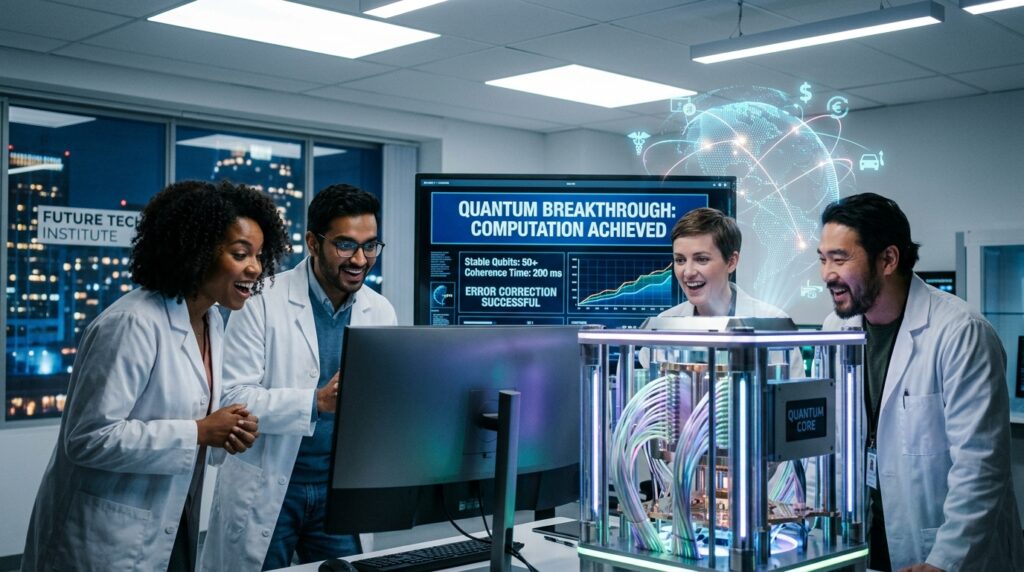
Quantum computing breakthrough could change technology forever is a shorthand way of describing a technical milestone that raises the practical ceiling of quantum advantage: the point where a quantum processor can solve a well-defined class of problems faster, more accurately, or at lower energy cost than the best classical systems. In formal terms, the breakthrough may involve improved qubit fidelity, lower error rates, longer coherence times, better error correction, or a scalable architecture that can run useful circuits reliably.
That matters now because quantum computing has moved from theory-heavy lab work into a stage where engineering details decide whether the field stays a scientific curiosity or becomes an industrial platform. The difference is not a bigger marketing claim. It is whether a machine can preserve quantum states long enough to execute algorithms that stress classical computation, such as cryptography-related factoring, materials simulation, or optimization under constraints.
In practice, the market is watching three things at once: hardware stability, software stack maturity, and whether error-corrected logical qubits can be produced at scale. The recent pace of progress from IBM Quantum, Google Quantum AI, IonQ, Rigetti, and academic groups at institutions such as MIT and Caltech suggests the field is still early, but no longer speculative. The hard part is that quantum systems do not fail gently; one bad control pulse, temperature drift, or decoherence event can collapse an entire computation. That is why a true breakthrough would be more than a headline. It would be a structural shift in what computers can do.
Pontos-Chave
- A real quantum breakthrough is not defined by qubit count alone; it is defined by usable, repeatable computation with lower logical error rates and better scaling.
- The most important technical bottleneck is error correction, because raw qubits are noisy and fragile in ways that classical bits are not.
- Near-term value is more likely in simulation, chemistry, sensing, and specialized optimization than in replacing general-purpose computers.
- Security teams should take quantum progress seriously now, because harvest-now-decrypt-later strategies already create risk for long-lived encrypted data.
- The field still has limits: progress in one architecture does not guarantee commercial readiness, and not every algorithm benefits from quantum speedup.
Quantum Computing Breakthrough Could Change Technology Forever: What It Actually Means
The Technical Definition of a Breakthrough
A genuine quantum computing breakthrough is not a press release about “more qubits.” It is a measurable improvement in the performance envelope of a quantum system: higher gate fidelity, longer coherence time, better connectivity, lower crosstalk, or a demonstrable reduction in logical error after error correction. Those variables determine whether a quantum processor can do useful work before noise destroys the computation.
In plain English, the machine has to keep its quantum state intact long enough to solve a problem that matters. That is harder than it sounds. A quantum bit, or qubit, can exist in superposition and entanglement, but those same properties make it extraordinarily sensitive to heat, vibration, electromagnetic interference, and imperfect control pulses. The breakthrough threshold is crossed when the system becomes reliable enough that engineering no longer cancels out the algorithmic gains.
Why “more Qubits” is the Wrong Headline
Raw qubit counts can be misleading. A system with 1,000 noisy qubits may be less useful than a system with 100 cleaner qubits if the latter supports deeper circuits and more stable measurements. That is why researchers care so much about fidelity, error-corrected logical qubits, and circuit depth. The number that matters is not what the marketing slide says; it is what the machine can execute before the output becomes garbage.
Who works in this field knows the difference immediately. A device can look impressive in a benchmark and still fail at a useful task once calibration drift, noise accumulation, and qubit connectivity limits are included. That is why serious researchers track the full stack: hardware, control electronics, cryogenics, compilers, and measurement protocols. The breakthrough is systemic, not cosmetic.
The Entities Shaping the Field
The discussion is anchored by organizations such as IBM Quantum, Google Quantum AI, Microsoft Azure Quantum, IonQ, and Rigetti Computing, plus academic leaders including MIT, Caltech, and the University of Oxford. On the standards and policy side, the National Institute of Standards and Technology (NIST) is central because post-quantum security and benchmarking practices will influence adoption. The U.S. Department of Energy also tracks the computing and materials angle through research programs and national labs.
These institutions matter because they define the practical frontier. IBM and Google push superconducting qubits; IonQ focuses on trapped-ion systems; academic teams test fault-tolerance and algorithmic feasibility. The architecture differences are not academic trivia. They shape how quickly each platform can scale, how error correction behaves, and where the first commercially relevant use cases are likely to appear.
Why Error Correction is the Real Bottleneck
Physical Qubits Versus Logical Qubits
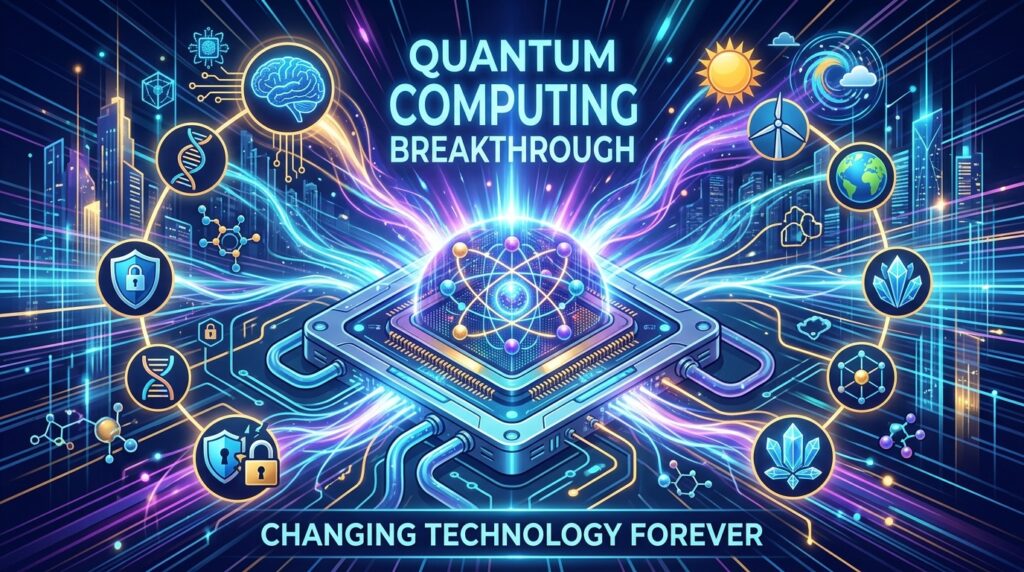
The core distinction in quantum computing is between physical qubits and logical qubits. Physical qubits are the actual hardware elements that encode quantum information. Logical qubits are error-corrected constructs built from many physical qubits, designed to preserve information long enough for meaningful computation. That distinction is the difference between a fragile laboratory device and a machine that can run a real workload.
Without error correction, qubits decohere too quickly for large-scale applications. With it, the system can detect and correct some of the mistakes that noise introduces. But the cost is steep: one logical qubit can require dozens, hundreds, or even thousands of physical qubits depending on hardware quality and error thresholds. This is why scaling is so difficult. The machine does not just need to grow; it needs to grow while becoming cleaner.
Why This Challenge is Harder Than Classical Fault Tolerance
Classical computers also use error correction, but they operate in a world where bits can be copied and checked without destroying the original state. Quantum states cannot be cloned in that way because of the no-cloning theorem. That single law changes everything. Error detection in quantum systems has to preserve the computation while extracting enough information to identify the fault, which is a far more delicate process.
In real systems, even a well-designed error-correction protocol can struggle if qubit connectivity is poor or if the readout chain adds too much overhead. The result is a tradeoff: more protection often means more complexity and more failure modes. That is why experts do not treat error correction as a checkbox. It is the engineering problem that determines whether the field scales or stalls.
What Current Benchmarks Really Tell Us
Benchmark results from groups at Google Quantum AI and IBM Quantum often highlight improvements in circuit fidelity, quantum volume, or randomized benchmarking. These metrics are useful, but they are not the same as proving a commercially disruptive capability. They show progress toward stability and scale, not the end state.
That nuance matters. A benchmark can indicate that the control stack is improving while still leaving practical deployment years away. The smartest reading is cautious optimism: the field is moving in the right direction, but the gap between a controlled demonstration and a fault-tolerant application remains substantial.
Where the First Real-World Gains Are Likely to Appear
Chemistry and Materials Simulation
The strongest near-term use case is quantum simulation, especially in chemistry and materials science. Molecules and electron interactions are quantum-mechanical by nature, so simulating them on classical hardware becomes expensive very quickly. Quantum processors should, in principle, model those systems more naturally. That does not mean they already outperform classical methods at scale, but it does mean the destination is scientifically coherent.
Drug discovery, catalyst design, superconducting materials, and battery chemistry are the kinds of problems where better simulation can translate into real economic value. If a quantum system can shorten the path from hypothesis to validated material properties, the impact reaches manufacturing, energy storage, and pharmaceuticals at once. This is the segment where the field has the clearest reason to exist.
Optimization and Logistics
Optimization is where many vendors pitch quantum advantage, but the reality is mixed. Routing, scheduling, portfolio balancing, and supply-chain design are all hard combinatorial problems, yet not all of them benefit from quantum methods. Some instances may show promising speedups or better exploration of solution spaces, while others remain easier to solve with improved classical heuristics, GPUs, or hybrid methods.
That does not make the category irrelevant. It means companies should test quantum approaches selectively, not adopt them on faith. Hybrid workflows that combine classical preprocessing with quantum subroutines are likely to dominate early enterprise trials because they reduce risk while preserving the possibility of measurable gains.
Cybersecurity and Post-quantum Migration
Security is the most immediate strategic concern for governments and large enterprises. A sufficiently powerful fault-tolerant quantum computer could threaten widely used public-key schemes such as RSA and elliptic-curve cryptography through Shor’s algorithm. That risk is not hypothetical in the abstract; it is the reason organizations are already planning transitions to post-quantum cryptography.
The NIST post-quantum cryptography project is the key policy anchor here. NIST has been standardizing algorithms intended to resist quantum attacks, because long-lived data can be stolen today and decrypted later. In other words, the threat begins before the first large-scale quantum machine exists.
Use Case Why Quantum Helps Current Reality Chemistry simulation Quantum systems model quantum systems more naturally Most promising near-term technical fit Optimization Can explore complex solution landscapes differently Mixed results; hybrid methods are common Cryptanalysis Shor’s algorithm can factor efficiently on fault-tolerant machines Not yet practical, but migration is urgent Machine learning Potential speedups in niche kernels and feature spaces Still experimental and often overstated
What Hardware Architectures Are Competing to Win
Superconducting Qubits
Superconducting qubits, used heavily by IBM and Google, are among the most mature platforms. They benefit from compatibility with microfabrication techniques and fast gate times. Their weakness is noise sensitivity, which forces heavy investment in cryogenics, calibration, and error mitigation. The engineering burden is real, but the ecosystem is strong and deeply resourced.
This architecture has a clear advantage in iteration speed. Researchers can tune, test, and compare designs rapidly. That makes it attractive for scaling experiments, but it also means the platform is unforgiving: slight imperfections in materials or control can degrade performance across the whole processor.
Trapped Ions, Neutral Atoms, and Photonics
IonQ’s trapped-ion systems store qubits in charged atoms confined by electromagnetic fields. They often deliver high-fidelity gates and longer coherence times, but gate speed and scaling architecture differ from superconducting systems. Neutral-atom and photonic approaches are also advancing, each with tradeoffs in connectivity, manufacturability, and control complexity.
No architecture has won yet. That is the honest answer. The market likes to talk as if one design will dominate, but the likely outcome is more fragmented: different platforms for different workloads, at least until error-corrected machines become widely available. The best architecture is the one that can scale reliably without losing control of the physics.
Why the Winner May Be Hybrid
A hybrid future is plausible because the final stack may not depend on one “perfect” qubit type. Classical processors will still handle orchestration, error decoding, compilers, and most business logic. Quantum hardware will likely run tightly scoped subroutines where quantum state gives an edge. That means the practical product may look less like a standalone quantum laptop and more like a cloud service integrated into a broader compute pipeline.
That’s also why cloud access through platforms like Microsoft Azure Quantum matters. Enterprises need a way to experiment without buying cryogenic infrastructure. The likely adoption path is experimentation first, production later, and only then deeper architectural change.
How to Evaluate the Signal Without Falling for Hype
Ask the Right Technical Questions
When a new claim appears, the first question should not be “How many qubits?” It should be: what is the qubit fidelity, what is the logical error rate, what circuit depth was achieved, and what did the system do that a high-end classical stack could not? Those questions cut through exaggerated claims fast. They also force vendors to talk about operational reality instead of abstract possibility.
In procurement or research settings, it helps to define success in advance. If the goal is chemistry, benchmark against molecular accuracy. If the goal is optimization, compare against state-of-the-art classical heuristics, not naive baselines. If the goal is security planning, focus on migration timelines and asset exposure rather than speculative doomsday scenarios.
Where Experts Disagree
There is genuine disagreement about timing. Some researchers believe fault-tolerant quantum computing is still many years away; others see a faster path if materials, fabrication, and control software improve together. The divergence is not about whether quantum mechanics works. It is about how quickly engineering can tame scale, noise, and cost.
That uncertainty should not be confused with weakness. It is the normal state of a field moving from laboratory proof to industrial system design. The responsible position is to invest in the enabling stack now while resisting any claim that quantum computers will replace classical systems wholesale. That claim is too broad and technically careless.
Quantum computing is most likely to reshape technology first through narrow, high-value domains, not through a sudden replacement of classical computing. The breakthrough that matters is not one headline machine; it is a repeatable path from noisy qubits to fault-tolerant logical computation.
For readers tracking the broader policy and research context, the Nature quantum computing research archive is useful for reviewing peer-reviewed advances, while the National Quantum Initiative outlines the U.S. federal strategy around quantum information science. Those sources help separate measurable progress from narrative inflation.
Próximos Passos Para Implementação
The practical response is to treat quantum computing as a strategic option, not a magical upgrade. Organizations with exposure in cryptography, chemistry, materials, or high-complexity optimization should identify where a quantum advantage might matter, then map the required data, algorithms, and success criteria. That creates a usable test plan instead of a vague innovation roadmap. The companies that gain first will be the ones that define the problem tightly and benchmark honestly.
For security leaders, the immediate action is migration planning for post-quantum cryptography, especially for data that must remain confidential for years. For technical teams, the right next step is to run proof-of-concept projects on cloud-accessible platforms and measure them against serious classical baselines. Quantum computing could change technology forever, but only if the industry keeps separating real capability from hype and invests where physics, software, and economics actually meet.
FAQ
What is the Most Important Sign That Quantum Computing Has Reached a True Breakthrough?
The strongest sign is not a qubit-count milestone; it is a reproducible reduction in logical error while executing deeper circuits that solve a relevant problem. A real breakthrough shows that the system can preserve quantum information long enough to outperform classical methods on a defined task. That could be simulation, cryptography-related research, or a narrow optimization class. Without repeatability, the result is interesting science, not technological transformation.
Why Do Experts Focus So Much on Error Correction?
Because physical qubits are noisy, and noise compounds quickly as circuits grow. Error correction is the only path to large-scale, fault-tolerant quantum computation. It lets engineers build logical qubits from many physical qubits, which makes long computations possible. The tradeoff is overhead: the number of physical qubits required can be very large, so error correction is both the solution and the main scaling challenge.
Will Quantum Computers Replace Classical Computers?
No. Classical systems will remain dominant for most workloads because they are faster, cheaper, and easier to scale for ordinary computation. Quantum machines are likely to serve as specialized accelerators for tasks where quantum effects matter, such as certain simulations and cryptographic attacks. The industry’s future is hybrid, with quantum hardware handling narrow subroutines and classical systems doing the rest.
Which Industries Should Care Most Right Now?
Pharmaceuticals, materials science, cybersecurity, energy storage, and advanced logistics should care now, because each has a plausible use case or a direct exposure to quantum risk. Drug discovery and catalyst design may benefit from simulation, while security teams must prepare for post-quantum cryptography. Even if commercial advantage is not immediate, the planning horizon is already relevant for any organization with long-lived data or complex computational pipelines.
Is the Hype Around Quantum Machine Learning Justified?
Only partially. There are promising research directions, but many claims outpace the evidence. Some quantum kernels and feature-space methods may eventually help, yet most practical machine learning workloads still run better on classical GPUs and optimized software stacks. The field deserves attention, but not blind optimism. Any serious evaluation should compare against strong classical baselines and include realistic hardware noise.
Editorial Notice
This content was structured with the assistance of Artificial Intelligence and subjected to rigorous curation, fact-checking, and final review by Editor-in-Chief Nivailton Santos. TechTool Judge reaffirms its unyielding commitment to journalistic ethics, ensuring that editorial judgment and data validation remain entirely under human responsibility and final editorial oversight.