Modern Platform Engineering Vs Traditional DevOps: Optimizing the Internal Developer Experience

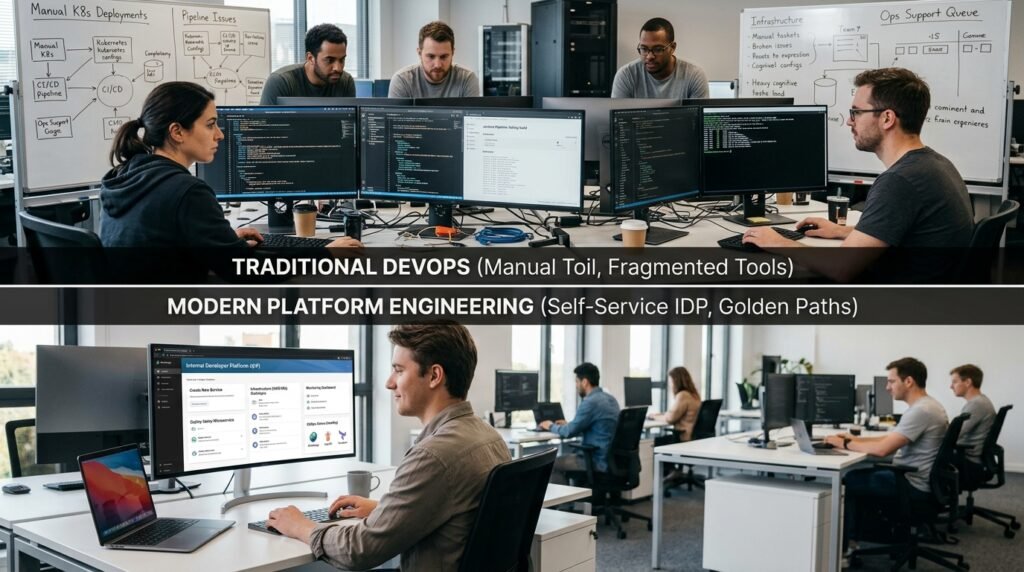
Modern Platform Engineering vs Traditional DevOps: Optimizing the Internal Developer Experience is a comparison between two operating models for software delivery: one centered on shared platform products and developer self-service, the other centered on collaboration and process discipline between development and operations. In practical terms, platform engineering turns infrastructure, CI/CD, security guardrails, and deployment workflows into a reliable internal product; traditional DevOps distributes those responsibilities across teams and asks them to coordinate closely. The distinction matters because the internal developer experience now has a direct effect on delivery speed, cognitive load, reliability, and engineering morale.
This debate is not theoretical. As organizations scale, the bottleneck usually shifts from writing code to navigating environments, approvals, pipeline failures, access requests, and inconsistent tooling. That is where platform engineering earns its place: it reduces friction by standardizing the path to production without forcing every team to become its own infrastructure specialist. DevOps still matters, but its strongest value is cultural and operational alignment. Platform engineering addresses a different problem: how to make the right path the easiest path for every developer, every time.
That is why the topic has accelerated in enterprises, regulated industries, and platform-heavy product organizations. Teams no longer compete only on feature velocity; they compete on the quality of the internal developer platform, the reliability of golden paths, and the speed with which engineers can move from idea to deployed service. In environments with Kubernetes, microservices, service meshes, and IaC, the cost of fragmentation rises fast. A good internal developer experience is no longer a nice-to-have. It is a throughput multiplier.
Key Takeaways
- Platform engineering is a product discipline for internal developers, while traditional DevOps is an operating model focused on shared responsibility and collaboration.
- The best internal developer experience comes from reducing cognitive load, not from adding more tools or dashboards.
- Self-service infrastructure, paved roads, and opinionated templates outperform ad hoc freedom when teams need scale, consistency, and governance.
- DevOps does not disappear; it becomes the cultural baseline that platform teams operationalize through abstractions and automation.
- The right model depends on team size, compliance requirements, platform maturity, and how much inconsistency the organization can tolerate.
Modern Platform Engineering Vs Traditional DevOps: Optimizing the Internal Developer Experience
The Technical Distinction That Matters
Traditional DevOps is an approach that aligns software development and IT operations through shared ownership, automation, and continuous feedback. It emerged to break down handoffs, reduce release friction, and improve reliability. Platform engineering is a newer specialization that packages the most common operational needs into a consumable internal product: environments, deployment workflows, observability, secrets, policy enforcement, and developer tooling.
Put plainly, DevOps asks teams to collaborate better. Platform engineering asks, “What should developers never have to think about in the first place?” That difference is not semantic. It changes team structure, funding, KPIs, and the shape of the engineering organization. A platform team has a product backlog, user research, adoption metrics, and service-level objectives. A DevOps-oriented team often focuses on automation, operating practices, and cultural cohesion across the delivery chain.
Why the Internal Developer Experience Became a Board-level Concern
Internal developer experience now affects the economics of engineering. If a developer spends 30 minutes on every environment issue, access request, or pipeline failure, that overhead compounds across dozens or hundreds of engineers. The result is hidden tax: slower feature delivery, more context switching, more support tickets, and lower morale. Who works with platform teams every day knows this problem is rarely dramatic. It is death by a thousand paper cuts.
Research from DORA’s research on software delivery performance consistently connects strong delivery capability with organizational performance, while Google Cloud’s DevOps and SRE publications have long emphasized automation, reliability, and fast feedback loops. The implication is clear: the faster teams can get safe, repeatable access to production-like capability, the more energy they can put into product work instead of platform friction.
Experience is the Product Now
In mature organizations, the platform is not judged by its architecture diagram. It is judged by the time it takes to create a service, provision an environment, ship a change, roll back a bad release, or get logs for an incident. Those are user journeys, and the users are developers. If the internal platform feels clunky, every team builds workarounds, and workarounds are where standardization dies.
The strongest platform organizations treat developer experience like a product surface: they observe behavior, measure adoption, and design around real usage patterns. That is why Backstage from Spotify became influential; it made the software catalog, ownership metadata, and paved workflows visible to developers in one place. The lesson is broader than any one tool: the platform must reduce choices at the right layer and preserve flexibility only where it creates value.
Dimension Traditional DevOps Modern Platform Engineering Primary goal Shared responsibility and delivery alignment Internal productization of developer workflows Operating unit Cross-functional team practices Dedicated platform team Developer experience Improved through collaboration and automation Designed as a first-class product outcome Control model Loose standards, team autonomy Opinionated paved roads, self-service guardrails Success metric Deployment frequency, MTTR, culture Adoption, lead time, platform satisfaction, support load
How Platform Teams Reduce Friction Without Rebuilding Every Workflow by Hand
Golden Paths, Not Endless Choices

A mature internal developer platform offers golden paths: curated, supported ways to build, test, deploy, observe, and recover services. These are not rigid mandates. They are the default routes that meet most needs with the least effort and the lowest risk. Good golden paths compress decision-making. They also reduce the number of bespoke setups that become unmaintainable after the third team copies them.
The practical effect is powerful. Instead of every squad inventing its own CI pipeline, container base image, deployment manifest, and alerting pattern, the platform provides standard templates and protected escape hatches. That balance matters. Total standardization frustrates teams with legitimate exceptions; total freedom creates entropy. The best systems choose an opinionated middle ground.
Self-service Beats Ticket Queues
Self-service infrastructure provisioning is one of the clearest differentiators between platform engineering and traditional operations-heavy delivery. Developers should be able to create an environment, request credentials, deploy a service, inspect logs, and perform a rollback without opening a ticket and waiting for another team to interpret the request. That is how you cut lead time and reduce the coordination cost that slows product teams down.
This is where infrastructure as code, policy as code, and GitOps become practical enablers. Terraform, Argo CD, and similar tools do not create platform value by themselves; they create value when wrapped in a workflow that hides unsafe complexity and exposes the few actions developers actually need. The point is not to make engineers operate more tools. The point is to make them touch fewer of them.
Observability Must Be Part of the Platform Contract
Logs, metrics, traces, and alerts are often bolted on after the platform is already in production. That creates a bad experience because developers inherit inconsistent dashboards and incomplete context during incidents. A serious platform team bakes observability into templates and deployment flows from the start, so every service arrives with standard instrumentation and clear ownership.
That design choice improves more than incident response. It also changes how teams build confidence in releases. When telemetry is consistent, developers can validate behavior quickly, detect regressions earlier, and avoid manual detective work. In practice, the best platforms reduce the number of questions engineers ask during an incident because the system has already answered them.
Where Traditional DevOps Still Delivers Value and Where It Starts to Stall
DevOps Works Well When Teams Are Small and Dependencies Are Light
Traditional DevOps remains highly effective in smaller organizations, startup environments, and product teams with modest platform complexity. If a team can own its code, pipeline, deployment, and runtime with a manageable amount of shared context, the overhead of building a dedicated platform may exceed the benefit. In those cases, the cultural model of DevOps—shared ownership, fast feedback, automation, postmortems, and collaborative problem solving—can carry the organization a long way.
This is one reason the platform engineering conversation can become dogmatic if handled poorly. Not every organization needs a full platform product on day one. If the delivery surface is simple, the right move may be to strengthen the DevOps practices already in place. The mistake is not using platform engineering; the mistake is assuming it should replace judgment.
DevOps Starts to Strain Under Repeated Duplication
The model begins to break when every team builds a slightly different version of the same operational stack. That is a common scaling failure. One team handles secrets one way, another team uses a different CI/CD pattern, and a third team invents its own deployment guardrails. At that point, onboarding slows, troubleshooting becomes tribal knowledge, and security reviews turn into bespoke negotiations.
This is the point where platform engineering becomes less optional. A dedicated platform team can absorb recurring complexity once and turn it into a supported service. That service then becomes the shared path for the organization. The key signal is repetition: if five teams keep solving the same problem differently, the company probably needs a platform abstraction rather than more documentation.
There is a Real Limit to Centralization
Not every capability belongs in the platform. If the platform team tries to own every product-specific workflow, it becomes a bottleneck with a nicer name. That is the main failure mode of over-centralized platform design. Teams stop moving because they need permission or customization from the platform backlog, and the internal experience degrades even if the tooling looks polished.
There is also disagreement among practitioners about how opinionated a platform should be. Some favor strong standards and minimal escape hatches; others argue for a broader self-service surface with looser constraints. The right answer depends on compliance pressure, service diversity, and organizational maturity. That nuance matters. The model that works in a regulated financial institution may fail in a fast-moving SaaS company, and the reverse is also true.
Designing for the Internal Developer Experience: Metrics, Governance, and Team Topology
Measure What Developers Actually Feel
Internal developer experience should be measured with a combination of operational and subjective signals. Lead time for changes, deployment success rate, incident recovery time, environment provisioning time, and pipeline duration all matter. So does developer satisfaction. If the platform is fast but painful, the organization still pays the price in workarounds and shadow tooling.
A practical metric set usually includes adoption rate for paved paths, number of support tickets per service, time to first deploy for new engineers, and the percentage of applications onboarded to standard observability. Those numbers reveal whether the platform reduces friction or merely relocates it. The best platform metrics are not vanity dashboards; they expose whether the platform is becoming the default way work gets done.
Governance Should Be Embedded, Not Bolted On
Security and compliance are often the reason platform engineering gets funded in the first place. That said, governance works only when it is embedded in the platform workflow. Policy as code, least-privilege access, approved base images, and automated checks in CI/CD are far more effective than manual review chains. Developers move faster when they do not need to think like auditors for every release.
Government and standards bodies have been pushing this direction for years. NIST’s guidance on secure software development and supply chain practices is a useful reference point; see NIST’s Cybersecurity Resource Center. The lesson is not “add more controls.” The lesson is to move controls left and make them programmable, observable, and repeatable.
Team Topology Determines Whether the Platform Will Be Adopted
The platform team’s structure matters as much as the technology stack. If the team is organized like a ticket factory, adoption will suffer. If it behaves like a product organization with clear user segments, service-level objectives, and feedback loops, adoption rises. A platform team should know who its users are: application teams, data teams, security engineers, SREs, and sometimes even compliance partners.
Team Topologies has influenced this discussion by clarifying the difference between stream-aligned teams, enabling teams, and platform teams. That framing is useful because it avoids a common mistake: expecting every team to be equally self-sufficient in every domain. The platform should absorb the shared complexity that slows delivery, while stream teams focus on customer value. That division of labor is one of the clearest ways to improve internal developer experience without diluting accountability.
A Practical Adoption Model for Enterprises That Need Scale Without Chaos
Start with the Highest-friction Journeys
Do not begin by building a grand platform vision. Start with the most painful developer journeys: service creation, environment provisioning, deployment, secrets access, and incident diagnostics. Those are the places where friction is visible and measurable. If a journey takes too many steps or depends on tribal knowledge, it is a strong candidate for platform treatment.
Vi cases where a company invested heavily in generalized tooling before fixing these journeys and saw little adoption. Developers ignored the new platform because the old path, though ugly, was familiar. The lesson is straightforward: remove pain from real workflows first. Adoption follows usefulness, not architecture diagrams.
Build the Platform as a Product
A serious platform team needs a roadmap, user research, release management, and support expectations. It should publish what it offers, what it does not, and what service levels users can expect. That includes clear documentation, onboarding flows, and feedback mechanisms. Without those basics, the internal platform becomes just another collection of automation scripts owned by a small group of specialists.
Backstage, the CNCF ecosystem, and internal catalogs from large tech companies all point in the same direction: visibility matters. When developers can discover services, owners, templates, and capabilities in one place, the platform becomes navigable. That is a major improvement over fragmented wiki pages and tribal memory. The platform is not only a toolchain; it is a map.
Phase the Migration, Do Not Force a Flag Day
The safest path is usually incremental. Preserve working legacy workflows while introducing paved paths for new services and high-friction use cases. Over time, measure adoption, retire duplicate tooling, and expand the platform surface where the benefits are proven. Sudden replacement efforts often fail because they treat the old way as a technical embarrassment instead of a business dependency.
One last nuance: platform engineering is not a universal cure. It works best where complexity is real, repetition is costly, and reliability matters enough to justify a shared product team. It can fail when leadership wants central control without investment in service quality. That is why the operating model matters so much. A platform that behaves like a gatekeeper will eventually be bypassed.
Próximos Passos Para Implementação
The strongest recommendation is to treat the internal developer experience as a measurable product, not a side effect of infrastructure work. Begin by mapping the top five developer journeys that consume the most time, then identify where standardization, automation, or self-service would remove the largest amount of friction. That is the fastest way to separate noise from genuine platform value. From there, define a small number of paved paths and make them the preferred route for new services.
Use DevOps as the cultural and operational foundation, then layer platform engineering where scale demands repeatability. That sequence matters. When organizations reverse it, they often centralize too early and create a brittle internal bureaucracy. The better path is to prove value in the workflows that hurt most, measure adoption, and expand only where the platform improves speed, safety, and clarity at the same time.
If the goal is durable engineering performance, the winning model is not “platform instead of DevOps.” It is DevOps discipline expressed through a well-designed internal platform that developers actually want to use. That is how teams lower cognitive load, improve deployment confidence, and keep delivery moving without sacrificing control.
FAQ
Is Platform Engineering Replacing DevOps?
No. Platform engineering is better understood as a specialization that builds on DevOps principles rather than replacing them. DevOps still provides the cultural model of shared responsibility, automation, and tight feedback loops. Platform engineering turns those practices into a productized internal service, which is useful when many teams need the same workflows delivered consistently and safely.
When Does a Company Need an Internal Developer Platform?
A company usually needs one when teams repeatedly solve the same infrastructure, deployment, or observability problems in different ways. Common signals include long onboarding times, inconsistent pipelines, frequent support requests, and slow environment provisioning. If developers spend more time navigating tools than shipping code, the organization has crossed into platform territory.
What is the Biggest Mistake Platform Teams Make?
The biggest mistake is building for infrastructure elegance instead of developer usability. A platform can be technically sound and still fail if it introduces more complexity than it removes. Another common failure is over-centralization, where the platform team becomes a bottleneck for every exception or customization request. That kills trust and slows adoption.
How Do Golden Paths Differ from Standardization?
Golden paths are opinionated, supported default workflows that make the right thing easy. Standardization is broader and can become rigid if applied without nuance. A good golden path usually includes templates, guardrails, and self-service steps for common use cases, while still allowing exceptions when a team has a legitimate need that the default path does not cover.
What Metrics Best Show Whether Developer Experience is Improving?
Look at time to first deploy, lead time for changes, deployment success rate, incident recovery time, and the number of support tickets tied to platform usage. Adoption of paved paths is also important, because a fast platform that nobody uses has not solved the underlying problem. Pair those metrics with developer feedback so you can see both operational performance and perceived usability.
Editorial Notice
This content was structured with the assistance of Artificial Intelligence and subjected to rigorous curation, fact-checking, and final review by Editor-in-Chief Nivailton Santos. TechTool Judge reaffirms its unyielding commitment to journalistic ethics, ensuring that editorial judgment and data validation remain entirely under human responsibility and final editorial oversight.