
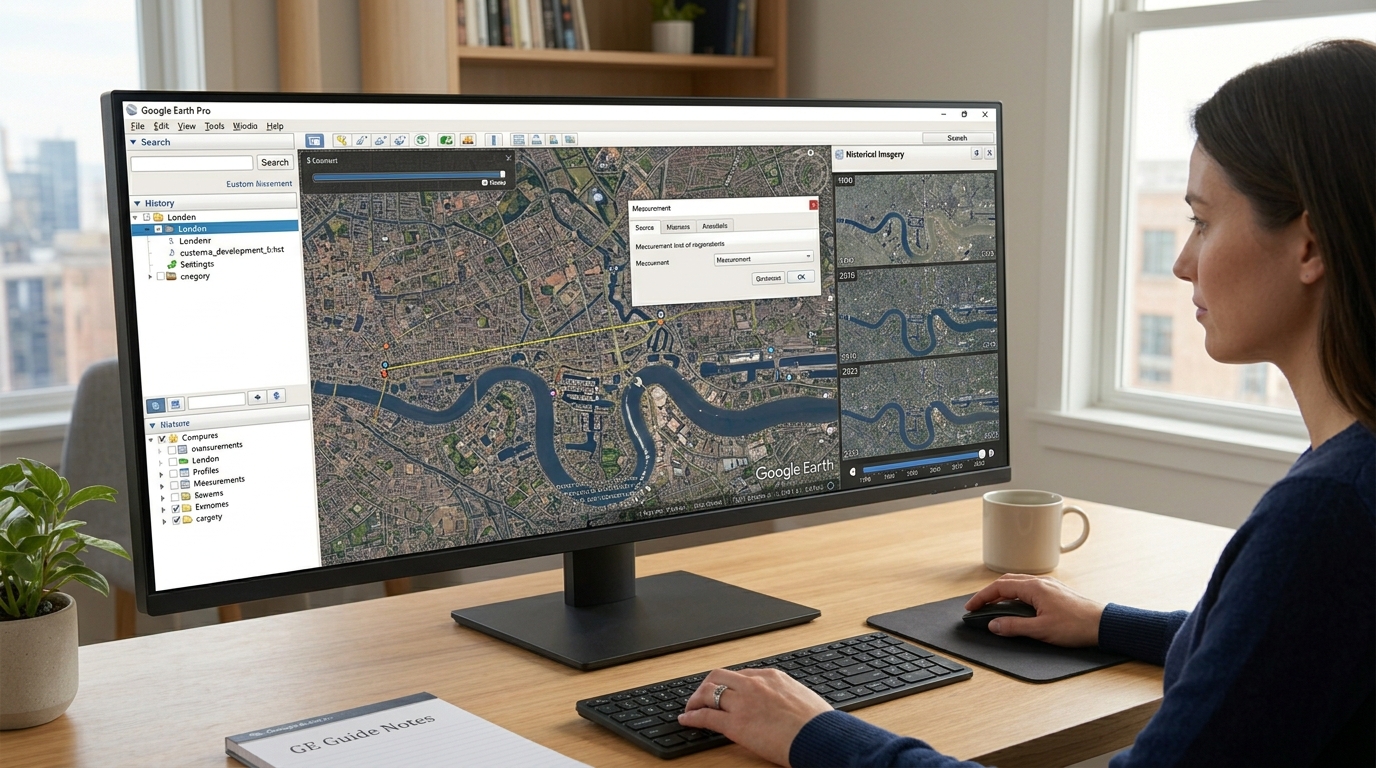
Google Earth just turned a quiet map session into a cockpit view.
Software Google Earth gains free flight simulator in the web version, and that single move changes what “exploring the planet” feels like. Instead of only dragging a globe, you can now skim over cities, mountains, and coastlines from the air in any modern browser.
The twist is that this is not trying to be a hardcore sim. It’s lighter, simpler, and far easier to launch than the heavy hitters — which is exactly why people are paying attention.
Why This Feels Bigger Than a Free Extra
The new Google Earth flight simulator is not just a toy bolted onto a famous product. It changes the emotional pitch of the platform. Google Earth software gains free flight simulator, and suddenly the web version becomes less like a reference tool and more like a place you can drift through.
That matters because Google Earth already has the raw material that flight games usually have to fake: real terrain, real city layouts, real coastlines, real mountains. The appeal is immediate. You are not flying over a stylized map. You are moving through a planet that already looks familiar, then looks strange again from altitude.
The surprise is not that Google added flight controls — it’s that the planet itself becomes the attraction.
And unlike a traditional simulator, this one does not ask you to learn procedures, study cockpit systems, or buy specialized gear before you can enjoy the first minute. That simplicity is the whole point. It also explains why the feature is getting attention beyond the usual flight-sim crowd. The next question is obvious: what exactly did Google launch?
What the Simulator Actually Does in Your Browser
Technically, this is a browser-based flight experience layered onto Google Earth’s aerial imagery and navigation engine. In plain English: you get a lightweight plane-like way to move across the globe without installing a massive game or connecting a yoke, pedals, or other hardware.
Software Google Earth gains free flight simulator support in the web app, and it works in Chrome, Edge, Firefox, and Safari. That cross-browser reach is a big deal. It lowers the barrier so much that the experience becomes almost frictionless: open the site, load the world, and start exploring.
This is where the comparison with Microsoft Flight Simulator and X-Plane 12 becomes useful. Those are built for depth, realism, systems, and immersion. Google Earth is doing something different. It is offering a casual flight layer over geography, not a pilot-school syllabus.
It is the difference between learning to fly and learning to look.
That distinction sounds small until you try it. One path asks for patience and hardware. The other asks for curiosity and a decent internet connection. And that connection is where the experience can get messy.
The Hidden Limit Nobody Talks About Enough
Google says the feature is designed for casual exploration, not high-fidelity aerodynamic training. That wording is doing a lot of work. It signals both the promise and the ceiling: the simulator is built to be accessible, but it is not trying to compete on realism.
In practice, the biggest variable is bandwidth. Google Earth software gains free flight simulator capability, but the images still have to load, and high-resolution aerial layers are only as smooth as your connection allows. If the network stutters, the world can blur, pop in late, or feel less responsive than you expect.
That is why the experience can feel magical on one Wi‑Fi network and merely decent on another. The flight itself is light; the scenery delivery is the heavy lift. The simulator is free, but the smoothness still costs bandwidth.
What to watch for:
- slow image loading in dense urban areas
- temporary blur while terrain tiles catch up
- lag when your connection drops under load
- a less fluid feel on weaker public Wi‑Fi
That limitation does not kill the feature. It just tells you what kind of experience this really is. And once you accept that, the fun part starts — because this is where Google Earth stops being a map and starts acting like a kind of digital sightseeing window.
Why Casual Exploration Might Beat Realism for Most People
Most people never need a simulator that can recreate every dial in a cockpit. They need something that gives them a reason to keep looking. That is where Google Earth software gains free flight simulator appeal: it offers immediate wonder without demanding commitment.
Think of the contrast like this. A hardcore sim is a marathon of systems. This is a detour with a view. One makes you competent. The other makes you curious. For a huge slice of users, curiosity wins because it arrives faster and asks less in return.
Here’s the part that feels almost backwards: the less this feature tries to imitate professional flight, the more people are likely to use it. That is not a weakness. It is the strategy. Casual tools often spread farther than technical ones because they invite play before they demand skill.
Mini-story: a friend opened Google Earth for “two minutes” just to test the new flight mode. Ten minutes later, she was tracing coastlines she had only seen in documentaries. Then the map lagged during a dense city flyover, and instead of quitting, she laughed and switched to open terrain. That tiny adjustment turned frustration into a habit.
That is the real trick here: the experience is forgiving enough that users can adapt around its limits. And once people do that, the feature becomes surprisingly sticky — which leads to the practical part: how to make it work well on your machine.
How to Get the Smoothest Experience Without Buying Anything
You do not need advanced hardware to try this, which is exactly why the launch is getting attention. Still, a few small choices can make the difference between a smooth glide and a jerky slideshow. Google Earth software gains free flight simulator access, but the way you use it still matters.
First, use a stable connection. That sounds obvious, but it is the most important variable here. Second, close anything else that is competing for bandwidth or memory. Third, start with patience in mind: the imagery may need a moment to settle before the world feels stable.
In a browser-based experience, your connection is part of the controls.
Common mistakes to avoid:
- testing it on weak public Wi‑Fi and blaming the feature
- opening too many tabs while loading high-resolution imagery
- expecting the same realism as a dedicated flight simulator
- judging the experience before the map tiles finish loading
If you want a technical reference point, Google’s own Earth platform documentation is worth a look, especially for understanding how the web version handles imagery and performance. See the official Google Earth web experience and the broader Google Earth Help Center. For browser performance context, Mozilla’s MDN Web Docs is also useful.
Those sources help explain a simple truth: this kind of feature lives or dies by the web stack around it, not just the idea itself. And that is exactly why the launch feels so current right now.
What This Says About Google Earth Right Now
Software Google Earth gains free flight simulator support at a moment when products that once felt “static” are being pushed toward richer interaction. Maps are no longer just for finding places. They are becoming places you can inhabit for a minute, even if only playfully.
That shift is subtle, but it matters. It nudges Google Earth toward a different identity: not just a geographic reference tool, but a lightweight exploration platform. And the best part is that it does this without asking users to buy a joystick, install gigabytes of assets, or learn an intimidating interface.
The future of casual software is not more complexity — it’s more reasons to stay.
There is one caveat, and it matters. This works beautifully for curiosity, discovery, and casual play, but it will always fall short for users who want flight physics, deep cockpit modeling, or professional-grade simulation. There is no need to pretend otherwise. Different tools, different jobs.
Still, the idea itself is strong: take the world people already know, then give them a new angle on it. That is the kind of feature people remember, and the kind they show someone else five minutes later.
Sometimes the best upgrade is not more power. It is a new way to look down.
FAQ
Is the Google Earth Flight Simulator Really Free?
Yes. The browser-based flight simulator is available at no cost inside the web version of Google Earth. You do not need to subscribe or install a separate app just to try it. What you do need is a modern browser and a connection stable enough to load the aerial imagery smoothly, because the experience depends on live map tiles and high-resolution visuals.
Which Browsers Support It?
Google says it works in major browsers, including Chrome, Edge, Firefox, and Safari. That broad support is one of the biggest reasons the feature feels accessible. You are not locked into one ecosystem or one device setup, which makes it easier for casual users to jump in and test it right away.
Is It Comparable to Microsoft Flight Simulator or X-Plane 12?
Not really, and that is by design. Those platforms aim for simulation depth, while Google Earth’s version is built for casual exploration. You get the feeling of flying over real-world imagery, but not the full systems complexity, hardware demands, or aerodynamic training experience that serious sim fans expect.
Do I Need Special Hardware to Use It?
No special hardware is required. You can use it with a standard keyboard, mouse, and browser, which is a major part of the appeal. That said, performance can still vary depending on your computer and your internet connection, especially when the imagery is loading in areas with dense detail.
What is the Biggest Drawback?
The biggest drawback is network sensitivity. If your connection is slow or unstable, the experience can feel choppy because the imagery may take longer to load. That does not make the feature bad; it just means your internet quality has a bigger role than it would in a lightweight offline game.
Editorial Notice
This content was structured with the assistance of Artificial Intelligence and subjected to rigorous curation, fact-checking, and final review by Editor-in-Chief Nivailton Santos. TechTool Judge reaffirms its unyielding commitment to journalistic ethics, ensuring that editorial judgment and data validation remain entirely under human responsibility and final editorial oversight.