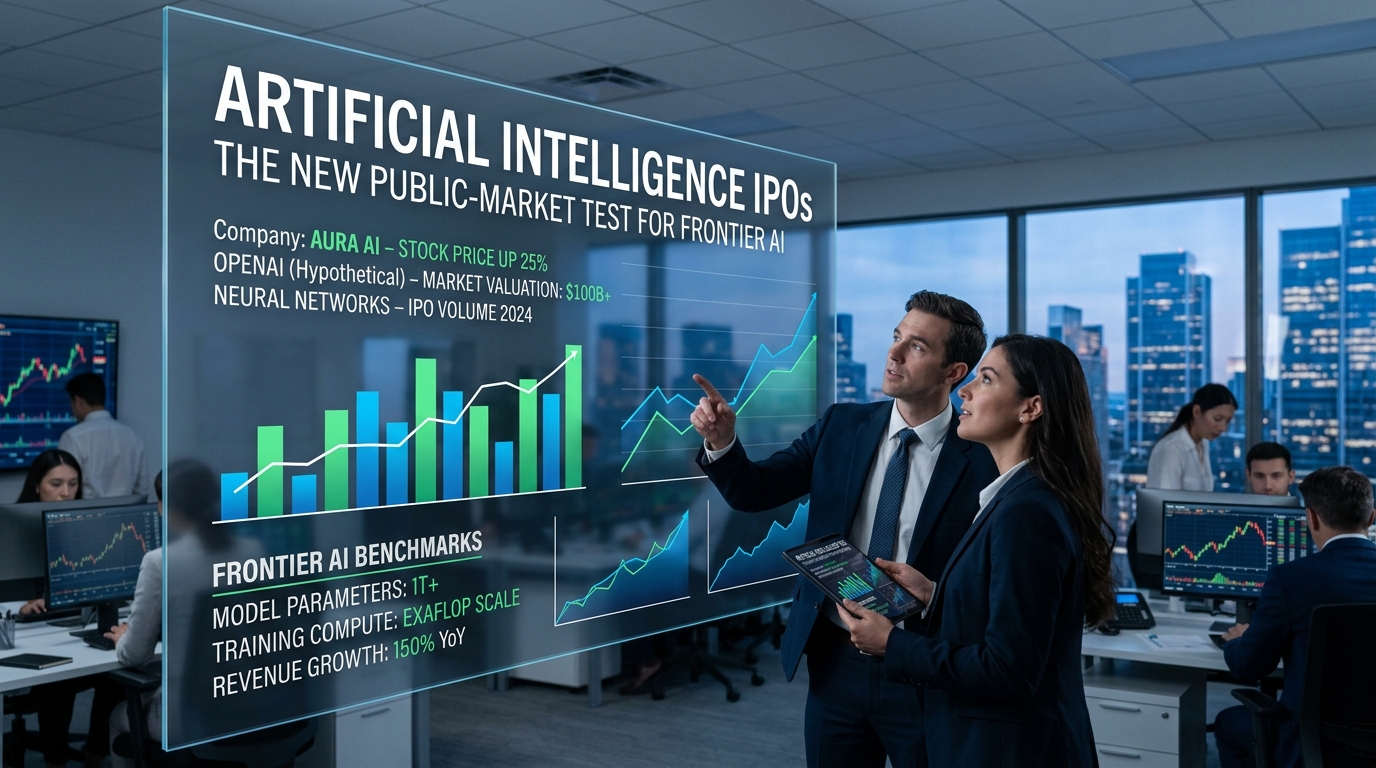
Artificial intelligence IPOs are no longer a hypothetical financing milestone; they are becoming a strategic signal about which company can convert frontier-model leadership into durable public-market economics. In this case, the real question is not just whether Anthropic or OpenAI goes public first, but which business can prove that model quality, distribution, and monetization will survive life as a listed company.
This matters now because the market is shifting from “who has the smartest chatbot?” to “who can own the next layer of value in the AI stack.” That shift changes how investors price compute intensity, model training costs, enterprise retention, regulatory exposure, and the durability of platform power. While Anthropic and OpenAI prepare for their IPO paths, investors are betting on who will lead the next phase of artificial intelligence.
Key Points
- The public-market story for frontier AI is no longer centered on research breakthroughs alone; it is centered on whether recurring revenue can outrun compute and infrastructure burn.
- OpenAI and Anthropic are competing on different strengths: OpenAI has scale, product reach, and Microsoft alignment, while Anthropic has a strong enterprise narrative and a safety-first brand.
- Investors will likely reward the company that proves the best unit economics in inference, retention in enterprise accounts, and the clearest path to governance that public shareholders can underwrite.
- The IPO race will be shaped by capital structure, exclusivity agreements, and regulatory scrutiny as much as by model performance.
- The winner of the next phase of AI may not be the company with the most powerful model, but the one that controls distribution, developer workflows, and workflow-level adoption.
Artificial Intelligence IPOs and the New Public-Market Test for Frontier AI
What an AI IPO Really Signals
Technically, an IPO is a company’s first broad sale of equity to public investors, with disclosures, governance rules, and recurring scrutiny from analysts and regulators. In frontier AI, that matters more than in many software categories because the business is capital intensive, the product cycle is fast, and the moat is harder to measure than monthly active users. The market is not just buying growth; it is buying confidence that the company can keep training, serving, and improving models without destroying margins.
That is the difference between a consumer app story and an infrastructure-plus-platform story. A public AI company must answer whether its model family is a feature, a platform, or a cost center. If the answer changes every quarter, the stock will trade with a discount. Investors will demand evidence that model quality translates into pricing power, not just usage spikes.
Why the Timing Matters for Anthropic and OpenAI
The timing is important because both companies sit near the top of the private-market valuation ladder, where expectations can outrun the operating reality. OpenAI has become the most visible consumer brand in generative AI, while Anthropic has built a reputation for enterprise-grade reliability and safety research. Those are valuable positions, but they do not automatically become public-market winners unless each company can defend margins, governance, and product retention under quarterly reporting pressure.
Who works in this field knows the pattern: private investors tolerate heavy burn when the strategic upside looks enormous, but public investors punish vague roadmaps. That is why the IPO discussion is really about narrative discipline. The company that can explain its path from foundation model to repeatable revenue, with fewer contradictions, will have the better reception when the window opens.
The Market is Pricing Leadership, Not Just Access
There is a subtle but important change in investor behavior. A year ago, capital chased access to the best model. Today, it is chasing proof of leadership across the stack: training efficiency, inference cost, enterprise adoption, developer ecosystem, and downstream products. In practice, the market is asking which company will own the workbench that teams use every day, not just which lab publishes the strongest benchmark result.
This is where Artificial intelligence IPOs become a proxy for power in the industry. The public listing is not the end of the race; it is the moment investors force the company to reveal which layer of value it actually controls. If a firm relies too much on partners for compute, distribution, or cloud infrastructure, the valuation ceiling is lower than the headline growth suggests.
OpenAI Versus Anthropic: Two Different Paths to Public Scale
OpenAI’s Scale Advantage and Its Trade-offs
OpenAI enters the public-market conversation with an enormous consumer footprint, broad name recognition, and a product suite that touches both individuals and enterprises. The company benefits from a distribution engine that many startups can only imitate: ChatGPT, API usage, and deep integration into Microsoft’s ecosystem. That gives it reach, and reach matters because adoption data often drives valuation discipline in public markets.
The trade-off is complexity. OpenAI’s structure, partnership obligations, and mixed mission expectations create governance questions that public investors will not ignore. A company can be strategically central and still be hard to underwrite if the path from product momentum to shareholder return is obscured by layered agreements or shifting organizational priorities. That is one reason public-market enthusiasm can cool quickly if disclosures are not clean.
Anthropic’s Enterprise Story and Safety Premium
Anthropic has taken a different route. Its Claude models are widely positioned as strong performers for enterprise workloads, long-context tasks, and safer deployment environments. That matters because enterprise buyers are often more valuable than consumer users: they pay for reliability, governance, and support, not novelty. If Anthropic can keep winning regulated industries and high-trust teams, it can build a more predictable revenue base than consumer-led peers.
There is, however, a limit to the safety premium. Safety is a differentiator, not a moat by itself. Enterprises still care about switching costs, workflow integration, and model performance on tasks that affect revenue or compliance. Anthropic will need to prove that “safer AI” is not just a brand promise but a measurable reason customers stay, expand, and renew.
Comparative Investor Lens
From an investor’s perspective, the two companies reward different theses. OpenAI offers scale, consumer mindshare, and the possibility of platform dominance across multiple product surfaces. Anthropic offers a tighter enterprise narrative, cleaner positioning around reliability, and potentially easier underwriting if its revenue quality stays high. Neither story is automatically better; the superior investment depends on which company converts technical leadership into more durable economics.
Factor OpenAI Anthropic Core advantage Scale, distribution, consumer awareness Enterprise trust, safety positioning Primary risk Governance complexity, capital intensity Narrower brand reach, competitive pressure Best-fit investor thesis Platform dominance and network effects High-retention enterprise monetization IPO challenge Explain structure and margins clearly Prove growth can scale beyond niche trust buyers
What Will Decide Valuation: Compute, Margins, and Monetization Quality
Compute Economics Are the Real Battleground
In frontier AI, compute is not a background expense; it is a strategic variable that shapes valuation. Training large models requires massive upfront investment, while inference—the cost of serving responses to users—can dominate ongoing operating expense at scale. A company that grows usage faster than it improves efficiency can appear successful while quietly compressing future margins. That is why the public market will pay close attention to GPU supply, cloud contracts, and model-serving efficiency.
Investors should watch the cost structure, not just revenue headlines. If one company can reduce the cost per useful answer faster than rivals, it gains pricing flexibility and better gross margin potential. If it cannot, growth may simply mean more spend on infrastructure. That is a dangerous equation in public markets, where every dollar of demand has to fight for a path to profitability.
Recurring Revenue Matters More Than Model Hype

The strongest AI companies will look less like research labs and more like enterprise software businesses with unusually high technical burn. That means investors want evidence of subscription retention, expansion revenue, and usage that sticks inside core workflows. A temporary surge in signups is not enough. The model must become embedded in procurement, support, software development, sales, or analysis workflows where replacement costs are real.
This is where SEC disclosure standards will force discipline. Once public, both companies would need to translate technical momentum into standardized financial reporting, risk factors, and segment logic. That is healthy. It strips away marketing language and exposes whether revenue quality is improving or just being subsidized by low-margin usage.
Distribution Moats Are Underrated
Distribution often explains more than model quality. Microsoft’s partnership network, cloud integration, and enterprise sales reach give OpenAI a powerful route to market. Anthropic’s adoption through developer tools and enterprise channels can be equally sticky if it keeps winning trust in high-value workflows. In both cases, distribution can turn a model into a business faster than raw benchmark leadership can.
The market knows this. That is why investors care about ecosystem attachments: API integrations, workplace software partnerships, agent tooling, and developer retention. A model without distribution is a laboratory asset. A model with distribution becomes a platform.
Why the Next Phase of AI May Reward the Stack, Not the Model Alone
From Frontier Models to Workflow Control
The next phase of artificial intelligence will not be decided solely by who has the biggest model. It will be decided by who controls the workflow layer where AI becomes unavoidable. That includes coding assistants, document generation, customer support, research tools, and agentic systems that execute multi-step tasks. The winner in that layer can capture more value than the company that only supplies the base model.
This is why investors should think in terms of stack control. The model is one layer. The orchestration layer, tooling layer, data layer, and distribution layer all affect long-term economics. A company that owns several of those layers can defend pricing and retain customers longer than a pure-model provider can.
Enterprise Adoption is the Quiet Compounding Engine
Consumer usage creates visibility, but enterprise adoption creates compounding. Once an AI system is embedded in internal processes, finance teams, compliance teams, and developer pipelines, switching becomes costly. That creates a more stable revenue base and lowers churn. It also forces the vendor to keep improving reliability, because one bad release can carry more operational downside than in consumer apps.
In practice, the strongest enterprise AI sales motions look less like software demos and more like process redesign. Teams do not buy a model; they buy a reduction in time, cost, or error rates. That distinction matters because it changes the sales conversation from “how impressive is the model?” to “what measurable business process improves, and by how much?”
Regulation and Trust Will Shape the Upside
AI regulation is still evolving, but public investors will price legal and policy risk well before lawmakers finish writing the rules. Issues around model safety, copyright, training data, misuse, and transparency can all affect revenue growth and valuation multiples. Here, the European Union’s AI Act tracker and ongoing policy discussion are worth watching because they show where compliance costs and product restrictions may rise first.
There is a nuance here that many commentary pieces miss: regulation does not hit every AI company equally. Firms with stronger governance, clearer enterprise use cases, and better documentation may actually benefit if compliance becomes a competitive filter. That does not eliminate risk. It just means that trust can become a monetizable advantage, not only a cost.
How Investors Should Read the IPO Race Without Getting Fooled by Hype
Use a Five-part Underwriting Framework
Investors should evaluate frontier AI candidates with the same discipline they would apply to a capital-intensive software platform or cloud infrastructure business. Start with model performance, but do not stop there. Then examine cost per inference, revenue concentration, customer retention, governance structure, and dependency on third-party infrastructure. A company can score well in one dimension and still be weak as a public equity.
- Model leadership: Does the company still set the pace on capability or usefulness?
- Unit economics: Is the cost to serve each query falling over time?
- Revenue quality: Are customers renewing and expanding usage?
- Governance clarity: Can public shareholders understand control and incentives?
- Distribution depth: Does the product sit inside daily workflows?
Watch for the Right Kind of Growth
Not all growth is equal. Growth driven by one-off consumer excitement is fragile. Growth driven by embedded enterprise usage, developer adoption, and cross-sell into adjacent products is more durable. That distinction is crucial because the public market prices durability. It pays up for businesses that can keep growing without repeatedly resetting the sales motion.
Artificial intelligence IPOs will therefore reward companies that can demonstrate usage quality, not just usage quantity. A company with smaller headline numbers but stronger retention and cleaner margins can ultimately deserve the better valuation. Public investors have learned this lesson in cloud and SaaS. They will apply the same discipline here.
What Could Break the Thesis
There are real risks, and not every bullish narrative survives contact with the market. If model gains slow while compute costs stay high, margins can disappoint. If enterprise adoption plateaus, revenue growth may become more cyclical than expected. If governance structures remain opaque, public investors may assign a discount no matter how strong the product is. There is also divergence among specialists on how quickly AI commoditization could arrive, and that uncertainty should temper any straight-line projection.
The point is not to be pessimistic. It is to be exact. In frontier AI, the winner is often the company that can keep improving while making the business easier to underwrite. That is a harder standard than “best demo.” It is also the standard that matters once the company enters public markets.
Próximos Passos Para Implementação
For investors, the practical move is to stop treating AI as a single trade and start evaluating it as a layered market. Separate model leadership from distribution, margin structure, and governance. Read disclosures like a credit analyst, not a fan. The companies that survive the IPO transition will be the ones that can explain how they turn expensive intelligence into repeatable cash flow.
For operators and strategists, the lesson is equally direct: build around workflow ownership, not vanity capability. Inference efficiency, enterprise retention, and compliance readiness will matter more as the market matures. If a company can prove that its AI is both trusted and economically efficient, it will have a much stronger hand when public investors decide which name deserves a premium.
The next market cycle will not be won by the loudest brand. It will be won by the firm that turns frontier ambition into a business public shareholders can actually model, price, and hold through volatility.
FAQ
What Makes an AI Company Attractive to Public-market Investors?
Public investors usually want a mix of technical leadership, visible revenue growth, and credible unit economics. In AI, that means the company must show that its model performance translates into recurring usage and that inference costs are moving down over time. Governance also matters more than in private markets because public shareholders need transparency around control, risk, and capital allocation. A strong story without a clean margin path rarely holds a premium for long.
Why Are OpenAI and Anthropic Being Compared So Often?
They represent two different answers to the same question: who captures the next layer of value in generative AI? OpenAI brings scale, consumer reach, and strong distribution through Microsoft-linked channels, while Anthropic offers a more enterprise-oriented and safety-centered position. Investors compare them because they are both close to the top of the frontier-model hierarchy, yet their commercialization strategies differ in ways that affect valuation. That makes them natural benchmarks for the market.
What is the Biggest Risk in Pricing an AI IPO?
The biggest risk is assuming that revenue growth will outpace infrastructure costs forever. Frontier AI can burn a lot of capital on training and serving models, and those costs do not always fall as fast as demand rises. If margins compress or customer retention weakens, the market can re-rate the stock quickly. Analysts should also stress-test governance complexity, because unclear control structures often lead to valuation discounts.
Does Model Quality Still Matter More Than Business Model?
Model quality matters, but it is no longer enough on its own. The market increasingly rewards companies that combine strong models with workflow integration, distribution, and pricing power. A superior model that lacks retention or efficient delivery can still underperform as a public company. In practice, the best businesses are the ones where model quality supports a durable commercial system rather than standing alone as the product.
What Should Investors Watch Before a Potential AI IPO?
Watch revenue mix, customer concentration, inference efficiency, and evidence of enterprise expansion. Also pay attention to cloud dependence, partnership terms, and whether the company can explain its governance structure without ambiguity. Those details often matter more than headline product launches. If the company can show consistent retention and improving margins, the IPO story becomes much more credible.
Editorial Notice
This content was structured with the assistance of Artificial Intelligence and subjected to rigorous curation, fact-checking, and final review by Editor-in-Chief Nivailton Santos. TechTool Judge reaffirms its unyielding commitment to journalistic ethics, ensuring that editorial judgment and data validation remain entirely under human responsibility and final editorial oversight.