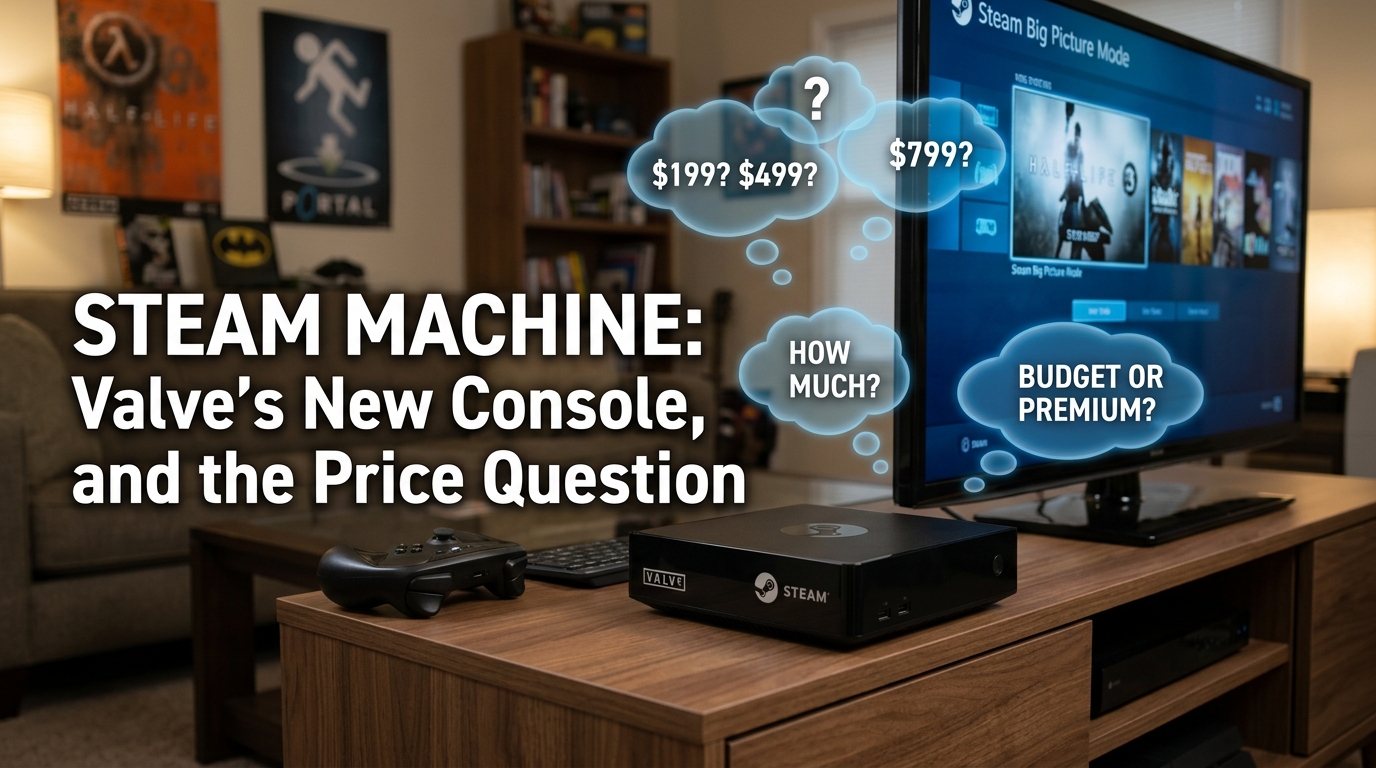
Steam Machine refers to Valve’s living-room gaming concept: a compact, PC-based console designed to run Steam games on a TV, usually paired with a controller and optimized for couch play. In practical terms, it is not a traditional console architecture like PlayStation or Xbox; it is a small-form-factor PC running SteamOS or a similar Linux-based stack, with the hardware profile determining what games it can actually handle at 1080p, 1440p, or 4K.
This matters now because the market has changed. The success of the Steam Machine idea depends less on the logo on the box and more on three things: GPU efficiency, Proton compatibility, and price discipline. Valve proved the living-room PC model can work with the Steam Deck, but a docked TV device lives or dies on a different equation: stronger cooling, better frame pacing, and a price that competes with both consoles and prebuilt mini PCs.
For readers looking at the new Valve console and its pricing, the real question is not “Will it exist?” but “What configuration will make sense at launch?” That means examining what Valve has officially shipped, what it has learned from SteamOS and Proton, and what a realistic retail range looks like for a device meant to sit between a console and a gaming PC.
Pontos-Chave
- Valve’s living-room strategy is best understood as a PC-console hybrid, not a closed console ecosystem.
- Price only works if the hardware delivers clear value over a Steam Deck docked to a TV or a similarly priced mini PC.
- SteamOS and Proton are the software pillars; without them, the device loses much of its appeal.
- The most important buying factor is not raw specs alone, but performance per dollar and game compatibility at launch.
- Any credible price estimate has to account for CPU, GPU, storage, cooling, and TV-friendly I/O such as HDMI and Bluetooth.
Steam Machine, Valve’s New Console, and the Price Question
What Steam Machine Actually Is
Formally, a Steam Machine is a compact gaming system built around PC hardware and tuned for Steam. The concept was first introduced to bring PC gaming into the living room with a console-like experience. In plain English, it is a small gaming computer that boots fast, connects to a TV, and is expected to feel as easy as a console while retaining the flexibility of a PC.
That distinction matters because it changes how you judge value. A PlayStation 5 competes on fixed specs and a closed ecosystem. A Steam Machine competes on software freedom, hardware flexibility, and the size of the Steam library. When people ask about the price of Valve’s new console, they are really asking whether Valve can package that flexibility without making the device too expensive for the mass market.
Why the Price is the Whole Story
Hardware launches in this category are judged by one simple test: can the device deliver enough performance to justify its cost over a console or a self-built PC? If the answer is no, the product becomes a niche experiment. If the answer is yes, the device can become a platform.
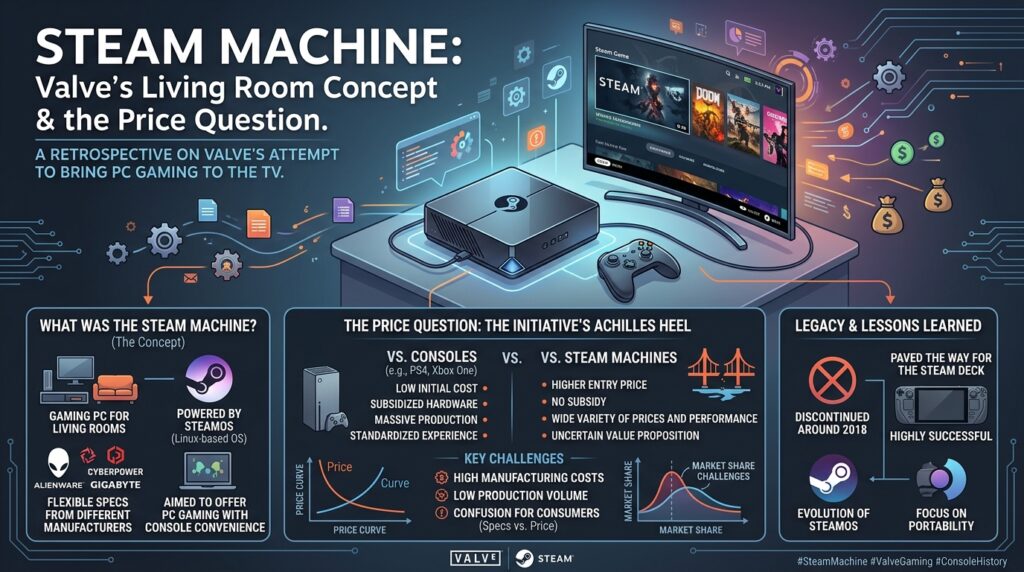
We have seen this pattern before. The original Steam Machines struggled because the market could not see a clean value proposition. Many models were underpowered, overpriced, or fragmented across vendors. Valve’s later hardware work, especially the Steam Deck, showed a better formula: standardize the experience, control the software layer, and keep the value story easy to understand.
What Valve Has Already Proven
Valve’s strongest proof point is not the old Steam Machine program. It is the Steam Deck. The Deck demonstrated that SteamOS, Proton, and aggressive hardware optimization can turn Linux gaming from a curiosity into a mainstream product line. That is the foundation any new living-room device would build on.
For reference, Valve’s official Steam Deck page is still the clearest public signal of its hardware philosophy: the Steam Deck product page on Steam. Valve’s software platform is also documented directly on SteamOS. Those pages matter because they show the operating model: Valve sells an ecosystem, not just a box.
How Valve’s Hardware Stack Shapes Real-World Pricing
Processor, Graphics, and Thermal Budget
The price of a console-class PC is driven first by its compute budget. A living-room device needs a CPU capable of feeding modern engines without stutter, plus a GPU that can hold steady frame times at TV resolutions. That usually means the bill of materials rises quickly once the design moves beyond handheld-class silicon.
Na prática, o que acontece é que living-room devices punish weak cooling. A silent console near the TV is a different engineering problem from a desktop tower under the desk. If Valve wants acceptable acoustics and sustained performance, it must spend more on thermal design, chassis volume, and power delivery. That pushes retail pricing upward before the software team has even tuned Proton.
Storage, RAM, and the Hidden Cost of Convenience
Storage is another price lever that buyers often underestimate. An entry-level 512 GB SSD may keep the headline price attractive, but modern AAA installs can consume that capacity fast. If Valve ships with 1 TB as standard, the bill rises, yet the user experience improves sharply. That tradeoff is familiar to anyone who has built or reviewed gaming hardware.
RAM matters too, especially on a system that must handle shader caching, background services, and browser-like launcher behavior without hiccups. Consoles hide these costs inside fixed hardware decisions; PC-based consoles expose them. The more Valve tries to make the device feel effortless, the less room it has to chase a bargain-basement price.
Connectivity and TV-Friendly Design
A true living-room machine needs more than an HDMI port. It needs stable Bluetooth for controllers, low-latency Wi‑Fi, reliable USB expansion, and a UI that resumes cleanly after sleep. Those details do not excite spec-sheet readers, but they determine whether the device feels polished or frustrating over time.
That is why mini-PC comparisons can be misleading. A generic small PC may look cheaper on paper, yet it often lacks the software integration and controller-first flow that make a console-like device worthwhile. The real value is total system design, not the cheapest chassis with the biggest number on the box.
What a Realistic Launch Price Would Need to Cover
Price Tiers That Make Sense
If Valve launches a new living-room device, the most credible pricing structure would likely resemble a tiered lineup. A base model could target the entry console segment, while a higher configuration could serve enthusiasts who want more storage and better sustained performance. That approach reduces confusion and lets Valve address both mainstream and premium buyers.
Configuration Likely Target What It Buys You Risk Entry model Console replacement buyer Lower upfront cost, 1080p/1440p gaming, Steam library access Limited headroom for future AAA titles Mid-tier model Mainstream PC-console buyer Better storage and cooling, smoother TV gaming May approach the price of stronger prebuilt mini PCs Premium model Enthusiast / early adopter Higher storage, stronger GPU budget, better longevity Can lose the “console value” argument
Where the Market Will Judge It
The market will not compare this device only with PlayStation and Xbox. It will also be compared with the Steam Deck docked to a TV, Intel NUC-style gaming PCs, and prebuilt SFF systems from OEMs. That creates a narrow pricing window. Too cheap, and it looks underpowered. Too expensive, and it becomes an enthusiast product with limited reach.
My view is blunt: Valve must keep the launch price low enough that buyers feel they are paying for convenience, not for a badge. If the device lands in a range where a console owner has to think twice, Valve loses the living-room battle before it starts. The sweet spot is usually where the buyer can justify the machine as both a console substitute and a compact PC.
Why Preorders and Regional Taxes Matter
Retail price is not the same as street price. Currency conversion, import taxes, and local distribution can push the final number well above the announced MSRP. That is why the phrase “see the prices” deserves caution: a launch price in the U.S. may look aggressive, while the same hardware in Europe or Latin America can land much higher once taxes and logistics are included.
For buyers, the meaningful number is landed cost. The official MSRP tells part of the story, but the actual purchase decision depends on availability, local warranty support, and whether the first wave of units is constrained. A great price on paper can still fail if stock is thin and resale pricing spikes.
Software is the Real Differentiator: SteamOS, Proton, and the Living-Room Experience
SteamOS as the Platform Layer
SteamOS is Valve’s operating system approach for gaming hardware, and it is central to any new console strategy. It gives Valve control over boot speed, updates, controller navigation, and the overall game-launch experience. Without that software layer, the product becomes just another small PC with a logo.
The OS also lets Valve optimize for one use case: playing games from Steam with minimal friction. That focus creates a cleaner experience than a general-purpose desktop, especially for users who want to power on, choose a game, and start playing within seconds.
Proton and Compatibility Reality
Proton is the compatibility layer that allows many Windows games to run on Linux. It is one of the most important technical achievements in Valve’s ecosystem, but it is not magic. Some games still need anti-cheat support, specific launchers, or patch-level workarounds. Buyers who assume every Windows title will run perfectly are setting themselves up for disappointment.
That said, Proton has changed the market. It removed much of the old stigma around Linux gaming and made a console-like PC viable for far more players than before. The current question is not whether Linux gaming works. It is whether Valve can make it work with enough consistency to satisfy mass-market expectations.
Sources That Help Frame the Technical Landscape
For a broader look at compatibility and the technical path Valve has been building, useful references include Valve’s own SteamOS documentation, the community-driven ProtonDB compatibility database, and reporting from established outlets such as The Verge’s hardware coverage. Those sources do not replace official specs, but they help separate marketing language from actual game support.
One limit is worth stating plainly: compatibility data can lag behind patches, driver changes, and game updates. A title that fails today may run well next month. That volatility is normal in PC gaming, but it also means any buying decision should be based on current test data, not old forum posts.
How to Evaluate Whether Valve’s New Console is Worth Buying
Use Case: TV Gaming First, Desktop Second
The right question is not whether the device is “powerful enough” in abstract terms. It is whether it suits your use case. If you want a TV-focused library machine that behaves like a console and gives you access to the Steam ecosystem, the concept makes sense. If you want maximum upgradeability or workstation flexibility, a standard PC remains the better tool.
That is where buyer discipline matters. People often overpay for hardware they do not use to its full potential. A living-room machine should be judged by frame pacing, noise, sleep behavior, and ease of use with a controller. Those are the metrics that define satisfaction after the first week.
What to Check Before Paying
- Game compatibility: Verify whether your most-played titles run well under Proton or require Windows-only anti-cheat support.
- Target resolution: Decide whether 1080p, 1440p, or 4K is realistic for the hardware class you are considering.
- Acoustics: Check fan noise under sustained load, not just idle behavior.
- Storage capacity: Modern game libraries fill SSDs fast, so 512 GB may be tight.
- Local pricing: Compare MSRP with final landed cost, including taxes and availability.
Why the Old Steam Machine Failure Still Matters
The original Steam Machine effort failed in part because it was too fragmented. Different manufacturers, different specs, different prices, and no single message for buyers. That history still matters because it shows how quickly a promising platform can lose trust when the value proposition becomes confusing.
Valve’s best path is to avoid fragmentation and ship a narrow, coherent lineup. The company has already shown that a strong software story can carry hardware farther than many expected. If it repeats the old mistakes, buyers will notice fast. If it keeps the product simple, the device has a real chance to work.
Próximos Passos Para Avaliar O Preço E a Compra
The most rational way to approach a Valve living-room device is to compare it against three benchmarks at once: a current console, a compact gaming PC, and a docked handheld setup. That comparison exposes the true value of the product and prevents buyers from focusing only on launch hype. A machine like this succeeds when it reduces friction, not when it wins a spec-sheet contest.
If Valve publishes official pricing, the first analysis should focus on total cost of ownership: hardware price, storage upgrades, warranty support, and the actual percentage of your Steam library that runs well on day one. The best decision will come from matching the device to the games you already play, not from chasing the biggest possible configuration.
Official references: Valve’s hardware and software stack can be reviewed through Steam Deck, SteamOS, and third-party compatibility tracking such as ProtonDB. Those three sources give the clearest picture of what a future Steam Machine must get right: ecosystem, compatibility, and price discipline.
Perguntas Frequentes
Is Valve’s New Console the Same Thing as the Original Steam Machines?
No. The original Steam Machines were a family of third-party PCs built around SteamOS, while any modern Valve living-room device would likely be a more tightly controlled product. That distinction matters because the original effort suffered from fragmentation. A single, unified device has a much better chance of delivering a consistent user experience and a clearer price-to-performance story.
What Price Range Would Make a Steam Machine Competitive?
The answer depends on the hardware tier and the local market, but the device needs to sit close enough to consoles to feel justified. If it drifts too far into premium-PC pricing, buyers will compare it with stronger mini PCs instead of consoles. The winning range is the one where convenience, Steam access, and living-room design outweigh the extra cost versus a standard console.
Will Every Steam Game Run on a Valve Console?
No, not every game will run perfectly. Proton covers a large share of the catalog, but anti-cheat systems, Windows-only launchers, and edge-case dependencies can still cause issues. In practice, the best approach is to check current compatibility for the games you care about most. Compatibility is strong overall, but it is not universal.
Why Does SteamOS Matter So Much for Pricing?
Because software can reduce support costs, improve onboarding, and make weaker hardware feel more polished. If Valve controls the operating system, it can optimize sleep behavior, boot times, and controller navigation in ways that a generic Windows mini PC cannot match. That makes the device easier to use and can justify a slightly higher price if the experience is genuinely better.
Should Buyers Wait for Official Pricing Before Deciding?
Yes. Without official MSRP, any estimate is only a projection based on hardware class, software strategy, and market positioning. Wait for confirmed specs, storage tiers, and regional availability before comparing it with consoles or compact PCs. The right buying decision depends on the final package, not the rumor cycle around the launch.
Editorial Notice
This content was structured with the assistance of Artificial Intelligence and subjected to rigorous curation, fact-checking, and final review by Editor-in-Chief Nivailton Santos. TechTool Judge reaffirms its unyielding commitment to journalistic ethics, ensuring that editorial judgment and data validation remain entirely under human responsibility and final editorial oversight.