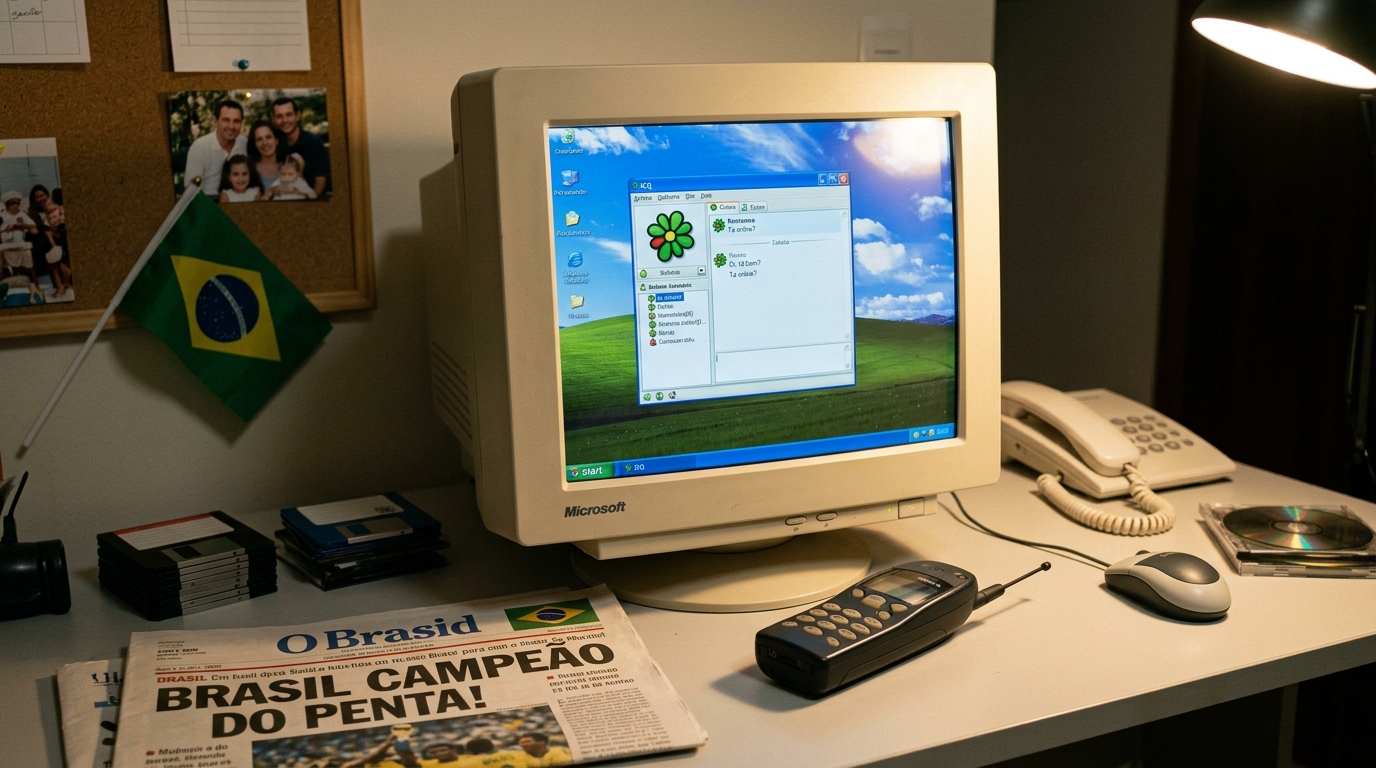
Brick cell phones, Windows XP, and ICQ: what was technology like when Brazil last won the World Cup? The answer is more than nostalgia. In 2002, consumer technology sat at a turning point: mobile phones were still voice-first and bulky, desktop computing was dominated by Windows XP, instant messaging happened on ICQ and MSN Messenger, and the web was slower, more fragmented, and far less mobile than it is now.
That matters because technology is easiest to understand when you place it in a real historical frame. Brazil’s 2002 World Cup victory gives us one of those clean reference points. It marks an era before the smartphone, before social media platforms became the default public square, and before cloud services reshaped how people stored files, communicated, and worked. If you want to understand how fast digital life changed, that year is a sharp benchmark.
It also matters because most people remember the early 2000s too vaguely. They remember the jokes about “brick” phones and the blue Windows XP wallpaper, but not the technical reality behind them: slow data networks, local file storage, disposable ICQ handles, and software installed from CDs. The difference between then and now is not just convenience. It is a different computing model.
Pontos-chave
- In 2002, the dominant consumer tech stack was built around desktop PCs, feature phones, and local software rather than cloud-connected mobile ecosystems.
- Windows XP represented a major usability leap because it unified the consumer-friendly Windows 9x line with the stability of Windows NT.
- ICQ and MSN Messenger defined everyday online communication, while social media as we know it did not yet exist.
- Mobile phones were usually “brick” devices in the literal sense: thick, durable, battery-efficient, and designed mainly for calls and SMS.
- The world Brazil won in 2002 was still pre-smartphone, pre-app store, and pre-broadband-for-everyone; that context changed how people worked, socialized, and consumed media.
Brick Cell Phones, Windows XP, and ICQ: What Was Technology Like When Brazil Last Won the World Cup?
The 2002 Digital Baseline Was Still Desktop-Centric
In 2002, the computer was still the center of digital life for most households and businesses. A typical user sat down at a desktop, opened a browser, checked email, chatted on ICQ, and saved files to a hard drive or floppy disk. Laptops existed, but they were expensive and not yet the primary computing device for ordinary consumers.
The technical definition of the era is straightforward: networked computing was real, but it was not yet ambient. You connected to the internet on purpose. You sat in one place to do it. That shaped behavior. Communication was scheduled, downloads were tolerated as background noise, and “always on” was more an aspiration than a norm. Who works in IT from that period remembers how often people planned around connection windows instead of expecting continuous access.
Mobile Phones Were Durable, Not Smart
“Brick” cell phones were large handheld devices built around voice calls, SMS, and long battery life. The term is informal, but the hardware profile is accurate: thick casing, physical keypad, monochrome or low-resolution color display, and internal radios tuned for 2G networks like GSM. Their value came from reliability, not software ecosystems.
That design tells you a lot about the market. Phones were communication tools first, personal computers second at most. A Nokia, Motorola, or Ericsson handset could last days on a charge and survive rough handling. In practice, the phone did one job extremely well. It did not try to be a wallet, camera, map, media player, and social feed all at once.
ICQ, MSN Messenger, and the Social Graph Before Social Media
ICQ was one of the defining instant messaging platforms of the late 1990s and early 2000s. Users logged in with numeric IDs, added contacts manually, and chatted in a way that felt private and direct. MSN Messenger and Yahoo! Messenger competed in the same space, each with its own culture and feature set. Presence indicators, custom status messages, and the famous “uh-oh!” notification sound formed part of the era’s digital vocabulary.
This is where the analogy to modern platforms breaks down. Today’s messaging apps are tied to phone numbers, synced across devices, and often folded into broader identity systems. ICQ-era messaging was looser and more anonymous. That anonymity was both liberating and messy. It allowed experimentation, but it also made contact management fragile. If you lost your account ID or changed machines without exporting settings, you could lose part of your online social life.
Windows XP and the Software Stack That Defined the Era
Why Windows XP Mattered Technically
Windows XP, released in 2001, was a major milestone because it brought the consumer Windows line onto the Windows NT kernel. In plain English: it combined better stability, improved memory management, and stronger multitasking than the older Windows 98 family. For many users, that meant fewer crashes and a system that felt more dependable under real-world use.
The visual design mattered too. Luna, the default XP interface, made computing look friendly rather than industrial. That was not just cosmetic. Interface design affects adoption. A system that feels approachable gets used more deeply, and XP became the operating system that normalized home computing for millions of people who were still new to the PC.
Installation, Drivers, and the CD-ROM Era
Software distribution in 2002 was still largely physical. You installed programs from CD-ROMs, and hardware drivers often came bundled on a disc in the box. If something did not work, users hunted for an updated driver on a manufacturer website or a magazine cover disc. That workflow was routine, and it was fragile by modern standards.
That fragility had a real technical cost. Peripheral compatibility depended on driver quality, and security patches were far from seamless. Automatic updates existed, but they were not the invisible background service people expect today. A user could run a machine for months with outdated software because the update process required attention and bandwidth. On dial-up, even downloading a service pack was a decision.
Part of the Stack Typical 2002 Reality What Changed Later Operating system Windows XP on desktop PCs Windows gave way to macOS, Linux growth, and mobile operating systems Storage Local hard drives, CDs, floppy disks still lingering Cloud storage and sync became default Software delivery Boxes, discs, downloads, manual installs App stores and subscription services replaced most physical distribution Connectivity Dial-up and early broadband Always-on mobile and home internet became common
The Security Model Was Simpler, and Riskier
Windows XP’s early years also reflected a weaker security culture. Personal firewalls were not universally enabled, antivirus software was often optional, and many users treated the internet as trusted by default. That made the system approachable, but it also left it exposed. The rise of worms, email-borne malware, and browser exploits was not an abstract concern; it shaped how support desks worked.
There is a common mistake here: people assume older systems were insecure because they were primitive. The reality is subtler. They were insecure because they were built for a different threat landscape. The networked world was smaller, and attack automation had not yet reached today’s scale. That model failed once internet usage became universal and hostile actors became industrialized.
How Brazilians Actually Experienced Technology in 2002
Internet Access Was Uneven and Often Slow
In Brazil, the digital experience in 2002 depended heavily on income, geography, and whether a household had a fixed line. Dial-up internet remained common, and broadband was still limited relative to later decades. That meant connection quality varied a lot: some users heard the screech of a modem every night, while others had early cable or DSL service in specific urban areas.
This context is important because it shaped what people did online. Heavy media consumption was constrained. Streaming was not the default because the bandwidth ceiling was too low for mass use. File sharing, web forums, email, and chat had much stronger weight than they do today. That is one reason the early 2000s internet felt more text-based and less video-driven.
Digital Life Was Split Across Devices and Services
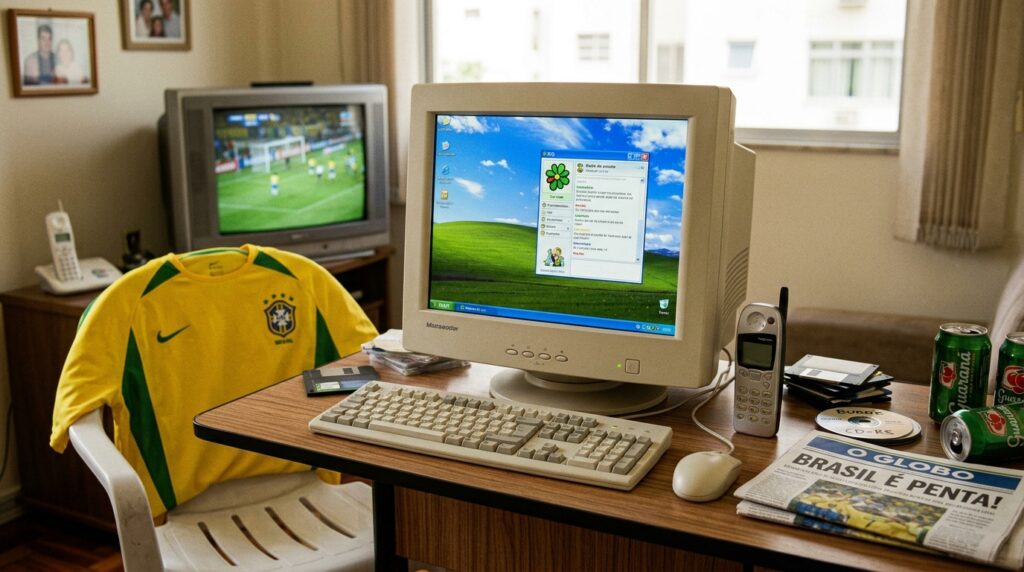
There was no single device that held your entire life. A person might have a desktop for home internet, a work PC in the office, a cell phone for calls, and perhaps a digital camera for photos. Syncing between those devices required cables, memory cards, or manual transfers. The absence of a unified ecosystem made users more self-reliant, but it also made everything slower.
In practice, what happens is that people built habits around these constraints. They checked messages at home, printed maps, carried paper notes, and kept phone numbers in memory or on SIM cards. That is a different cognitive load from today’s integrated stack. The modern assumption that every artifact is searchable, synced, and backed up did not yet exist.
Media, Games, and File Sharing Were Still Transitional
Entertainment was in a hybrid state. People bought CDs, burned discs, downloaded MP3s, and played PC games that fit the hardware of the time. Game installation still required patience, and software piracy was widespread partly because digital distribution had not matured into a legal convenience. The user experience was fragmented, but that fragmentation also created local habits and subcultures.
That transitional state is why 2002 feels so distinct. It is not “old internet” in the nostalgic sense alone. It is the last period before digital services converged around phones, platforms, and cloud accounts. Once that convergence happened, users stopped managing the plumbing and started living inside the service layer.
Why the 2002 Tech Stack Still Matters for Today’s Decisions
The Shift from Ownership to Access Changed Everything
The biggest technical change since 2002 is not faster processors or thinner screens. It is the migration from owned, local systems to accessed, networked systems. In the Windows XP and ICQ era, your software, files, and contacts were usually tied to a machine. Today they are tied to accounts, services, and synchronized identities.
That shift has real consequences for privacy, resilience, and dependence. The old model gave users more physical control. The new model gives them more convenience and continuity. Neither is free. If you rely on cloud sync, you inherit account risk, platform lock-in, and service outages. If you rely on local storage, you inherit backup discipline and device failure risk.
Legacy Design Choices Still Echo in Modern Products
Several patterns from that period still shape product design. Feature phones taught manufacturers how to optimize battery life and reliability. Windows XP taught software companies the value of approachable interfaces. ICQ and MSN Messenger foreshadowed presence indicators, typing notifications, and lightweight social interactions that now appear inside almost every chat app.
There is also an uncomfortable lesson for product teams: convenience often beats elegance. XP won because it felt usable. Messaging apps won because they reduced friction. Phones evolved because hardware had to collapse into a pocketable form factor. Technology history rewards the systems that match human behavior, not the ones that merely showcase technical sophistication.
What the Brazil 2002 Benchmark Really Tells Us
Using Brazil’s last World Cup win as a reference point is not just a cultural trick. It is a clean way to locate the moment before smartphones, app ecosystems, and cloud-native habits became normal. That year sits before Facebook, before the iPhone, before Android maturity, before WhatsApp as a global default, and before broadband became assumed in most urban households.
Sources such as the Internet World Stats historical usage data, the Microsoft lifecycle information for Windows products, and the Encyclopaedia Britannica overview of instant messaging help anchor that era in documented changes, not just nostalgia. The exact user experience varied by country and income, but the broad arc is not disputed: 2002 sat in the last pre-smartphone window of mass consumer computing.
Practical Ways to Use This Historical Snapshot
Use 2002 As a Baseline for Product and UX Thinking
If you work in product, design, or strategy, 2002 is a useful baseline because it reveals which expectations are learned, not natural. Users did not always expect instant search, always-on sync, or app-driven identity. Those expectations were built by platform shifts. Looking back at the XP-ICQ-phone era helps teams separate core human needs from current interface habits.
That matters when evaluating features. If a new tool only works when users are permanently connected, it assumes a modern network environment. If a service fails gracefully offline, it respects a constraint older systems had to handle by default. Teams that understand the historical baseline tend to design with more discipline, especially for performance and resilience.
Separate Nostalgia from Technical Accuracy
There is a temptation to romanticize the early 2000s as simpler or more authentic. That reading is incomplete. The systems were simpler in capability, not necessarily better in experience. They were slower, less integrated, and more failure-prone in ways users tolerated because they had no alternative. Reliability came from limited scope, not from superior architecture.
One limit matters here: no single country-wide technology story captures every household. Urban professionals, students, and rural users lived very different versions of 2002. Brazil’s economy, telecom rollout, and regional inequality shaped access in ways that any summary flattens. The broad comparison still holds, but the local details varied significantly.
Translate the Past Into Modern Decision-Making
The most useful lesson is not “technology was better then” or “technology is better now.” It is that every generation of tools trades one kind of friction for another. In 2002, friction showed up as slow installs, poor connectivity, and device fragmentation. Today it appears as subscription fatigue, platform dependence, and constant notification pressure.
If you are choosing tools now, use that tradeoff lens. Prioritize portability, backup, and account recovery. Test how a service behaves when the network fails. Check whether your data can move out cleanly. Those are the modern equivalents of asking whether a phone battery lasts or whether a machine can survive a reboot without drama.
Próximos Passos Para Aplicação
The clearest takeaway from the era of Windows XP, ICQ, and feature phones is that technological progress is not a straight line toward “better.” It is a series of tradeoffs that change the shape of daily life. Brazil’s 2002 World Cup win gives us a memorable marker for one of those turning points: the last major consumer-tech world before smartphones reorganized everything.
Use that benchmark when evaluating digital products, building historical comparisons, or explaining how fast computing changed. If a platform depends on always-on access, cloud identity, and constant synchronization, it belongs to the post-2007 world. If it still needs manual installs, local storage, and device-specific setup, it echoes the world of Windows XP and ICQ. That contrast is the real insight.
The most practical next step is to audit your current tools against those old constraints: offline behavior, backup quality, data portability, and account recovery. Those checks turn nostalgia into engineering discipline. They also reveal whether a modern service is genuinely resilient or only appears seamless when everything is working.
FAQ
Was Windows XP the Dominant Operating System in 2002?
Yes, Windows XP quickly became the defining consumer OS of the early 2000s, even though some users were still on Windows 98 or Windows 2000. Its importance came from combining better stability with a friendlier interface, which helped it spread across homes and offices. XP did not just replace older Windows versions; it normalized the idea that a PC could be both approachable and comparatively reliable.
Why Were Cell Phones Called “brick” Phones?
The label came from their size, weight, and shape. Many early mobile phones were thick, rectangular devices designed mainly for voice calls and text messaging, with limited screens and physical keypads. The term is informal, but it describes the hardware accurately: these phones were built to be durable and battery-efficient, not sleek or multifunctional like modern smartphones.
How Did ICQ Differ from Modern Messaging Apps?
ICQ used numeric user IDs, contact lists were managed manually, and messaging was centered on desktop usage rather than phone numbers and cloud sync. It supported presence indicators and one-to-one chat, but it did not operate as an all-in-one identity layer the way WhatsApp, Telegram, or iMessage do now. The experience was more fragmented, and losing access to a machine could mean losing easy access to your chat history.
Was Brazil’s Internet Environment in 2002 Already Broadband-based?
No. Broadband existed, but access was uneven and far from universal. Dial-up remained common in many households, and connection quality varied widely by region and income. That limited media-heavy services and made text chat, email, and lightweight web browsing far more important than streaming or mobile-first apps.
What is the Most Important Technology Shift Since Brazil Last Won the World Cup?
The biggest shift is the move from desktop-centered, locally stored computing to mobile, cloud-connected computing. In 2002, people used separate devices and services for different tasks; now most of those functions converge in one phone tied to a cloud account. That change altered communication, media consumption, security expectations, and the economics of software itself.
Can the 2002 Technology Model Still Be Useful Today?
Yes, as a design and planning reference. The older model highlights the value of offline functionality, long battery life, local resilience, and simpler workflows. It also exposes modern weaknesses such as platform lock-in and overdependence on constant connectivity. The model is not a blueprint for new products, but it is a strong stress test for them.
Editorial Notice
This content was structured with the assistance of Artificial Intelligence and subjected to rigorous curation, fact-checking, and final review by Editor-in-Chief Nivailton Santos. TechTool Judge reaffirms its unyielding commitment to journalistic ethics, ensuring that editorial judgment and data validation remain entirely under human responsibility and final editorial oversight.