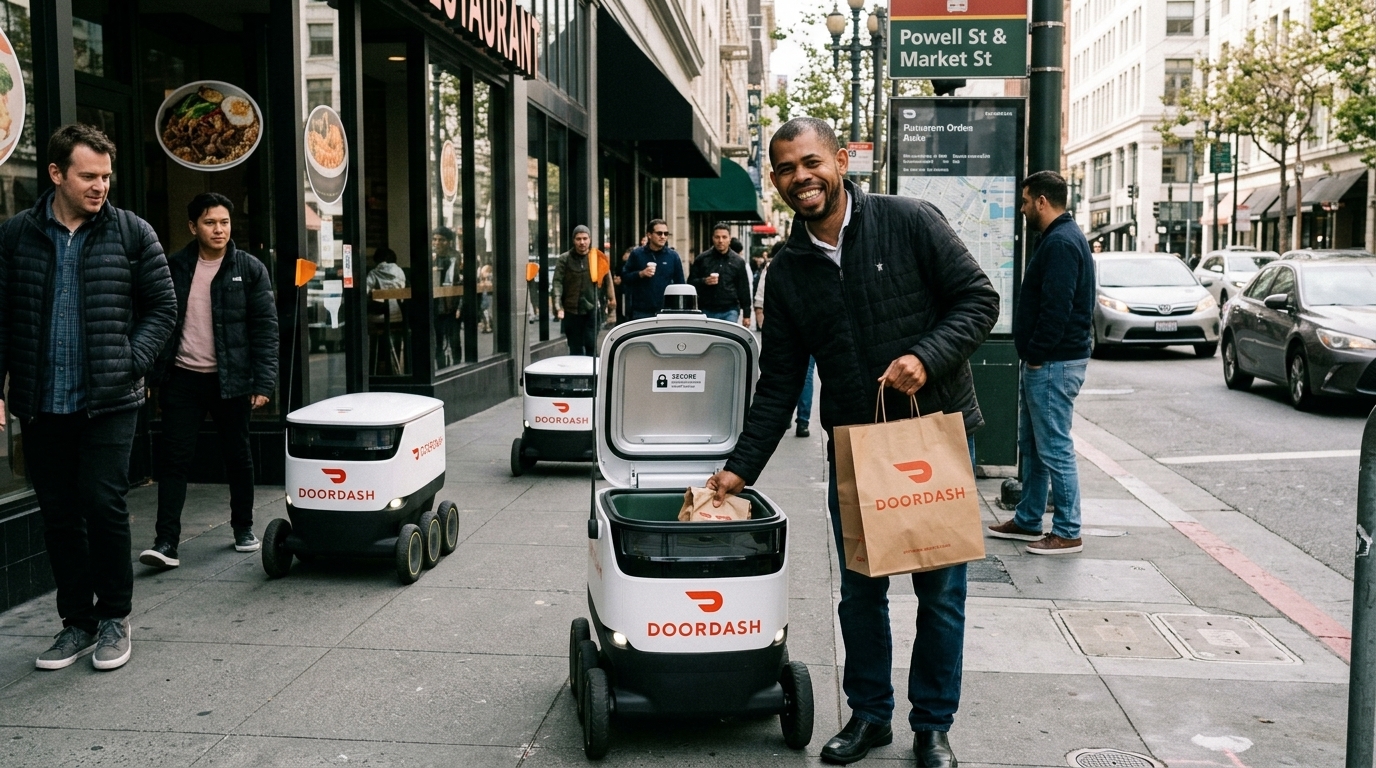
DoorDash delivery robots are compact autonomous vehicles designed to carry food and small packages from restaurants or retail locations to customers without a human driver in the loop. In practical terms, they combine onboard sensors, localization software, remote supervision, and route-planning systems to move on sidewalks or low-speed road environments, depending on local rules and the vehicle design. The point is not novelty; it is labor substitution at the last mile.
DoorDash delivery robots matter now because they sit at the intersection of two pressures that have only intensified: rising delivery costs and persistent shortages of reliable, affordable courier labor. Once a company crosses the threshold where a robot can move a delivery for less than a human can, the economics shift fast. That shift does not happen everywhere at once, and it does not eliminate all human delivery work. It does, however, change the bargaining power inside the on-demand delivery market.
The strategic question is larger than robotics. It is about how platforms like DoorDash, Serve Robotics, and other autonomy providers reshape urban logistics, municipal regulation, and gig-economy employment. In cities where pilots are already live, the pattern is clear: the machine is strongest on short, repetitive, predictable routes. The human courier remains better at stairs, complex handoffs, weather disruption, and dense edge cases. The tension is not hypothetical. It is already being negotiated block by block.
Key Points
- Delivery robots reduce the marginal cost of the last mile after the initial hardware, software, and deployment investment is absorbed.
- The most viable use cases are short-distance, low-speed, repeatable deliveries in dense urban zones with predictable sidewalk access.
- Labor displacement is real, but it is uneven: robots replace specific delivery tasks before they replace entire delivery jobs.
- Regulation, sidewalk safety, and municipal permitting will determine how fast autonomous delivery expands across U.S. cities.
- The long-term competitive advantage will likely belong to platforms that can blend robots, human couriers, and dispatch software into one operating model.
DoorDash Delivery Robots Are Reshaping Last-Mile Logistics in the United States
What the Technology is, in Technical Terms
A delivery robot is a low-speed autonomous ground vehicle built for last-mile logistics. It uses sensors such as cameras, lidar, ultrasonic systems, GPS, and inertial measurement units to perceive its environment, while software handles localization, obstacle detection, route selection, and stopping behavior. Some systems operate fully autonomously in constrained zones; others rely on remote human oversight for intervention when conditions degrade.
In plain English, the robot is a rolling courier with software on board. It does not think like a human driver, but it does not need to. It only needs to complete a narrow set of delivery tasks reliably enough to beat the cost and consistency of a human for certain routes. That is why this category has moved from experiment to deployment. The business case is not about replacing every driver; it is about capturing the deliveries that are easiest to automate.
Why DoorDash is Interested in Autonomy
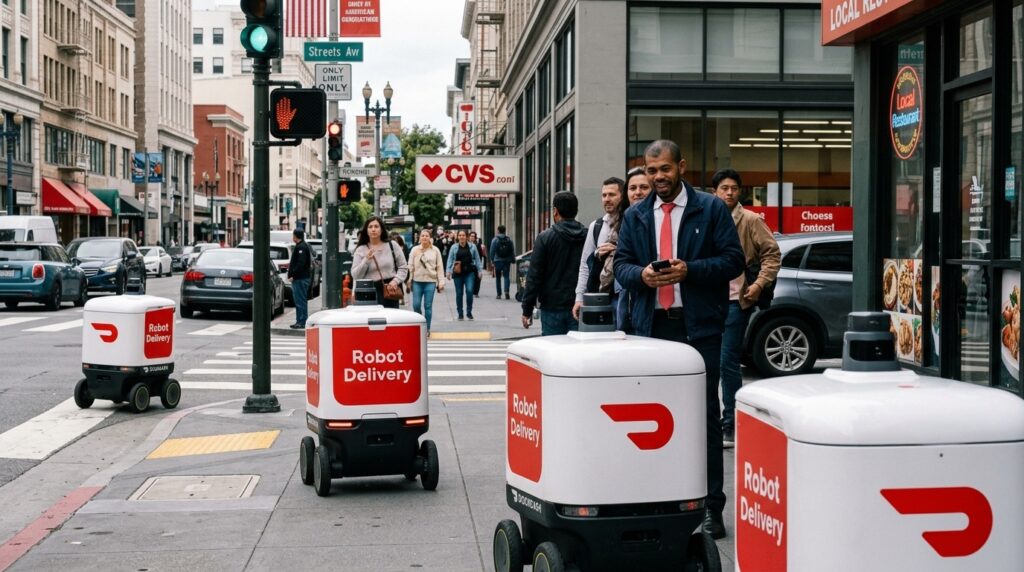
DoorDash operates in a market where the margin on each delivery is under pressure from courier pay, insurance, customer support, and promotional spending. Every incremental reduction in fulfillment cost matters. Autonomous delivery can lower the variable cost per trip over time, especially where route density is high and order size is small. The business logic resembles warehouse automation: high upfront spend, lower recurring labor expense, and better cost predictability once the system stabilizes.
DoorDash is not alone in this calculation. Logistics firms and retail chains are watching the same equation. If a sidewalk robot can complete short trips cheaply and consistently, it becomes a strategic asset, not a gimmick. That is why the category attracts capital, pilot programs, and municipal attention at the same time.
Where the Model Works Best
The strongest use cases are neighborhoods with short delivery distances, walkable street grids, and a high concentration of repeat orders. Dense urban zones create route efficiency. A robot can leave a restaurant, travel a few blocks, and return to service quickly. That cycle matters. It is the difference between an expensive demo and a deployable fleet.
This model performs worse in suburbs with poor pedestrian infrastructure, steep terrain, extreme weather, or complex crossings. It also struggles where curb access is chaotic or sidewalks are blocked by construction, parked vehicles, or street vendors. That limitation is important because it means expansion will be uneven. Not every city looks like a robotics-friendly test corridor.
Why the Economics Favor Robots over Time
The Cost Structure is Changing
The economics of autonomous delivery hinge on the difference between fixed and variable costs. A human courier has low startup cost but recurring labor expense on every trip. A robot has a much higher initial cost, but after deployment, the major recurring expenses are maintenance, battery charging, connectivity, and remote operations. If utilization stays high, the robot’s cost per delivery can fall below that of a person working the same route.
This is the core reason investors take the category seriously. Hardware gets amortized. Software scales. Fleet management improves. The more deliveries a robot completes, the more the capital cost spreads across each trip. That is not a guarantee of profitability, but it is a path to it.
What the Real Operating Costs Include
The public tends to underestimate the full stack. A robot fleet is not just vehicles on sidewalks. It includes charging infrastructure, replacement parts, fleet monitoring, cybersecurity, field technicians, insurance, compliance, and map maintenance. Remote assistance is also a non-trivial cost, because edge cases do not disappear just because the vehicle is autonomous.
Here is the practical rule: robots save money when route density is high and failure rates are low. They lose money when utilization drops, when vandalism rises, or when the operating environment forces too much human intervention. That is why the business case can look excellent in one district and weak a few miles away.
Cost Element Human Courier Delivery Robot Upfront investment Low High Recurring labor cost High Lower, but not zero Maintenance burden Low Moderate to high Weather sensitivity Moderate High Scalability per route Limited by labor supply Limited by infrastructure and regulation
Why This Can Beat Gig Labor on Certain Routes
Gig labor is flexible, but that flexibility is expensive for the platform. Human couriers need incentives, and those incentives rise when demand spikes, weather worsens, or order density falls. A robot does not ask for surge pricing. It does not decline a route because traffic is ugly. If the route is short and predictable, automation can undercut human delivery on cost while improving service consistency.
That said, this advantage has limits. A robot cannot yet match a skilled courier for complex apartment access, multi-stop batching, or difficult customer handoffs. The cost edge is real, but it is conditional. Companies that ignore those conditions usually overstate the immediate impact.
What Happens to Couriers When Automation Becomes Cheaper
Task Displacement is Happening Before Job Displacement
The first effect is not mass unemployment. It is task splitting. Robots take the easiest, lowest-friction deliveries first: short distances, small orders, stable routes, predictable pickup points. Human couriers are left with higher-complexity work that still requires judgment, physical dexterity, and social adaptation. That is a classic pattern in automation, and it is already visible in delivery operations.
In practice, what happens is that a platform begins to reserve the most automatable trips for machines and the more difficult trips for people. For the courier, that can mean fewer easy runs and a harder mix of assignments. For the platform, it means a more efficient dispatch model. For labor advocates, it means downward pressure on earnings even before jobs disappear outright.
The Labor Market Response Will Be Uneven
Some couriers will exit the market. Others will adapt by focusing on restaurant clusters, late-night runs, or areas where robots cannot operate effectively. A subset will move into hybrid jobs: fleet support, remote monitoring, maintenance, or exception handling. The number of those roles will be far smaller than the number of low-skill delivery jobs, which is why this transition carries labor risk.
There is a larger point here. Automation does not remove work; it reallocates it. The question is who captures the higher-value layer. If platforms own the fleet and the software, then workers may be pushed into lower-paying support roles rather than promoted into better ones. That is one reason policy makers are paying attention.
Where the Human Courier Still Wins
Humans remain better in unstructured environments. Stairs, locked buildings, missing apartment numbers, construction detours, bad weather, and customer confusion all favor a person on foot or on a bike. Robots can handle some of these situations with remote support, but every exception adds cost and delay. That is why the human delivery layer is not disappearing soon.
There is also a service quality issue. Customers often want flexible handoff behavior, not just package transport. A robot can improve cost efficiency, but it is not always the best tool for high-touch delivery. This is one of the major limits that makes full substitution unlikely in the near term.
Regulation, Safety, and Public Space Will Decide the Pace
Municipal Rules Are as Important as Engineering
Autonomous delivery systems operate in public space, which means city governments matter. Sidewalk access, crossing rules, speed limits, curb usage, and permit frameworks all shape deployment. A robot may work technically, but if a city restricts sidewalk operations or requires heavy permitting, scale becomes slower and more expensive. The engineering team cannot solve that problem alone.
Federal and state guidance also matters, especially where safety standards intersect with mobility policy. For a useful public reference, the National Highway Traffic Safety Administration’s automated vehicle safety resources provide the broader regulatory context for autonomous systems in U.S. transport. For local deployment questions, city codes often matter more than national headlines.
Safety is Measured by Incident Rate, Not Hype
The central safety question is not whether a robot is impressive. It is whether its incident rate is acceptable relative to its size, speed, and operating domain. Low-speed sidewalk robots reduce some risks because they move slowly and carry limited payloads. But they introduce others, including pedestrian conflicts, curb collisions, obstruction complaints, and trip hazards in crowded areas.
That is why safety must be evaluated in context. A robot that performs well on a university campus may struggle in a dense downtown district. A system can be safe enough for one operating domain and unsuitable for another. Regulators know this, which is why many approvals are narrow, conditional, and city-specific.
Public Acceptance is Not Automatic
Residents tend to support automation until it feels invasive. A robot blocking a sidewalk or crowding a crosswalk can trigger backlash fast. That social response matters because public tolerance determines whether pilots expand or stall. Many city councils are more comfortable with limited deployments than with wide, unrestricted access to pedestrian infrastructure.
For that reason, companies that invest in good sidewalk behavior, clear signage, and complaint handling usually progress faster than those that treat the public as an afterthought. The technology may be the headline, but legitimacy is what makes the system durable.
For broader labor and productivity context, the U.S. Bureau of Labor Statistics remains a reliable source for employment and wage trends across delivery-related occupations. That matters because any honest assessment of robot delivery has to compare technology gains with labor-market pressure, not just with engineering performance.
What the DoorDash Model Signals for Retail, Restaurants, and Urban Design
Restaurants Gain Efficiency, but Not Automatically
For restaurants, robot delivery can reduce handoff friction on certain orders, especially short-distance trips with tight margins. If the platform can lower delivery costs, more of the order value may be preserved for the merchant and customer. But the operational benefit depends on integration quality. A robot that arrives too early, too late, or without a clean handoff creates new bottlenecks instead of removing them.
In the field, the best deployments are the ones that fit restaurant workflow rather than forcing restaurants to adapt to the machine. Staff adoption improves when the pickup process is simple and the error rate is low. The failure mode is familiar: a flashy innovation that creates more work for the kitchen team.
Urban Design Will Quietly Shape Adoption
Sidewalk width, crossing density, block length, and curb discipline all influence whether robots succeed. Cities that were never designed for machine mobility will still host these systems, but they will do so unevenly. Wide, predictable corridors are easier to automate than fragmented, crowded streets. That means urban form becomes a competitive factor.
This is why some deployments cluster around campuses, business districts, and controlled neighborhoods. Those areas are easier to map, easier to supervise, and easier to regulate. A city does not need to be redesigned for delivery robots, but the more the built environment supports predictable movement, the faster the economics improve.
Platforms Will Move Toward Hybrid Fleets
The most credible long-term model is not robot-only or human-only. It is a hybrid fleet that assigns each delivery to the cheapest viable mode. Robots handle short, repeatable trips. Humans handle exceptions, complex drop-offs, and overflow demand. Dispatch software decides which asset to use in real time. That is where the real operational advantage lies.
This approach also gives platforms resilience. If a storm, road closure, or permit issue reduces robot performance, the human layer keeps the system running. That blend is more defensible than betting everything on full autonomy. It is also more honest about what the technology can and cannot do today.
How Businesses and Policymakers Should Respond Now
For Operators, the Decision is Route Selection, Not Ideology
Companies should evaluate delivery robots route by route, not by headline appeal. The right question is whether a given corridor has enough volume, sidewalk quality, and predictable demand to justify automation. If the route profile is weak, the robot becomes an expensive distraction. If it is strong, the robot can improve margin and service reliability.
Operators should also track uptime, remote-intervention rate, and cost per completed delivery. Those metrics tell the truth. If remote support keeps rising, the deployment is less autonomous than it appears. If uptime falls below the point where utilization justifies the fleet, the model is not mature enough for scale.
For Policymakers, the Focus Should Be Conditional Permission
Cities should not ask whether robots are good or bad in the abstract. They should ask where the risk is acceptable and what enforcement tools are available. Permits, speed caps, fleet limits, and data reporting can give cities leverage without banning the technology outright. That is the right balance when the goal is safety plus experimentation.
There is no universal rule that fits every city. Dense downtown corridors, suburban arterials, and campus districts present different risks. Local governments that treat them all the same will either over-restrict innovation or under-protect pedestrians. The smarter approach is zone-based deployment with measurable performance thresholds.
For Workers, the Best Defense is Mobility Across Roles
Couriers and gig workers need to think beyond a single platform task. The jobs most exposed to automation are repetitive, short-range, and low-complexity. The roles that remain valuable are the ones involving exception handling, customer interaction, dispatch support, and equipment servicing. Skill mobility matters more than ever.
That does not eliminate the risk. It does, however, show where adaptation is possible. Workers who understand routing, local geography, merchant coordination, and fleet operations will be better positioned than those who rely only on point-to-point delivery labor. The labor market is not ending; it is stratifying.
What to Watch Next as Autonomous Delivery Scales
The Real Signal is Not Pilot Size, but Repeatability
When evaluating the growth of DoorDash’s robotics strategy, the most important question is whether a city can support repeatable operations over months, not whether a demo works for a week. Repeatability reveals the true friction: battery life, weather, maintenance intervals, curb behavior, regulatory compliance, and customer satisfaction. Those are the variables that decide whether a pilot becomes a business unit.
Expect the next phase to favor selective expansion rather than blanket rollout. Robots will show up where the math is clean and the public space is manageable. That is a rational deployment pattern, not a weakness.
The strategic inflection point is not when a delivery robot appears on a sidewalk. It is when the robot’s fully loaded cost per completed order falls below that of a human courier for the same corridor, and the city still allows it to operate there.
That is the threshold to monitor. Once it is crossed in enough places, the market will not revert. The shift will be incremental, but the direction will be hard to reverse. DoorDash delivery robots are not replacing the entire courier economy tomorrow. They are carving out the easiest slices of it first, and that is how lasting transitions usually begin.
Próximos Passos Para Implementação
The right response is not alarm or enthusiasm. It is operational clarity. Businesses should map their delivery network by route density, weather exposure, sidewalk quality, and exception rate, then assign robots only where those variables support reliable autonomy. Cities should pair permission with reporting requirements so they can measure performance instead of guessing.
For labor stakeholders, the priority is to track which delivery tasks are being automated first and where the remaining work is migrating. That is where wage pressure and job redesign will appear before they show up in public debate. The companies that win this transition will not be the ones with the flashiest demos. They will be the ones that build a hybrid delivery system that is cheaper, safer, and easier to govern than the old one.
FAQ
Are DoorDash Delivery Robots Replacing Human Couriers?
No, not broadly. They are replacing specific delivery tasks, mainly short, predictable trips in dense areas where autonomous vehicles can operate at low speed with limited exception handling. Human couriers still dominate complex handoffs, poor-weather deliveries, and routes that require flexible judgment. The near-term pattern is substitution at the margin, not total replacement. That distinction matters because the labor impact builds gradually before it becomes visible at scale.
What Makes a Delivery Robot Cheaper Than a Human Courier?
The robot becomes cheaper when its upfront hardware cost is spread across enough completed deliveries and its operating costs stay low. After deployment, the main expenses are maintenance, charging, remote supervision, and fleet management. If utilization is high and failures are rare, the cost per order can undercut gig labor on certain routes. If the robot is idle too often, the economics weaken fast.
Which Cities Are the Best Fit for Autonomous Delivery?
Cities with dense, walkable neighborhoods, predictable traffic patterns, and supportive local permitting tend to be the easiest starting points. Wide sidewalks, shorter blocks, and controlled environments like campuses or business districts are strong candidates. By contrast, areas with harsh weather, poor pedestrian infrastructure, or fragmented local rules are much harder to scale. The built environment matters as much as the software.
Do Delivery Robots Create Safety Risks for Pedestrians?
Yes, but the risk profile is different from that of cars or bikes. Robots move slowly and carry less kinetic energy, which reduces severe injury risk, yet they can still block sidewalks, interfere with crossings, or create trip hazards. Safety has to be measured by incident rates and operating context, not by novelty. A robot can be acceptable in one district and inappropriate in another.
What Should Policymakers Require Before Approving Larger Deployments?
At minimum, they should require clear operating zones, speed limits, incident reporting, and a mechanism for public complaints. Some cities also benefit from permit caps or pilot-only approvals while data is collected. The goal is not to stop innovation; it is to keep public space usable and safe while the technology matures. Conditional approval is more useful than a binary yes-or-no approach.
Editorial Notice
This content was structured with the assistance of Artificial Intelligence and subjected to rigorous curation, fact-checking, and final review by Editor-in-Chief Nivailton Santos. TechTool Judge reaffirms its unyielding commitment to journalistic ethics, ensuring that editorial judgment and data validation remain entirely under human responsibility and final editorial oversight.