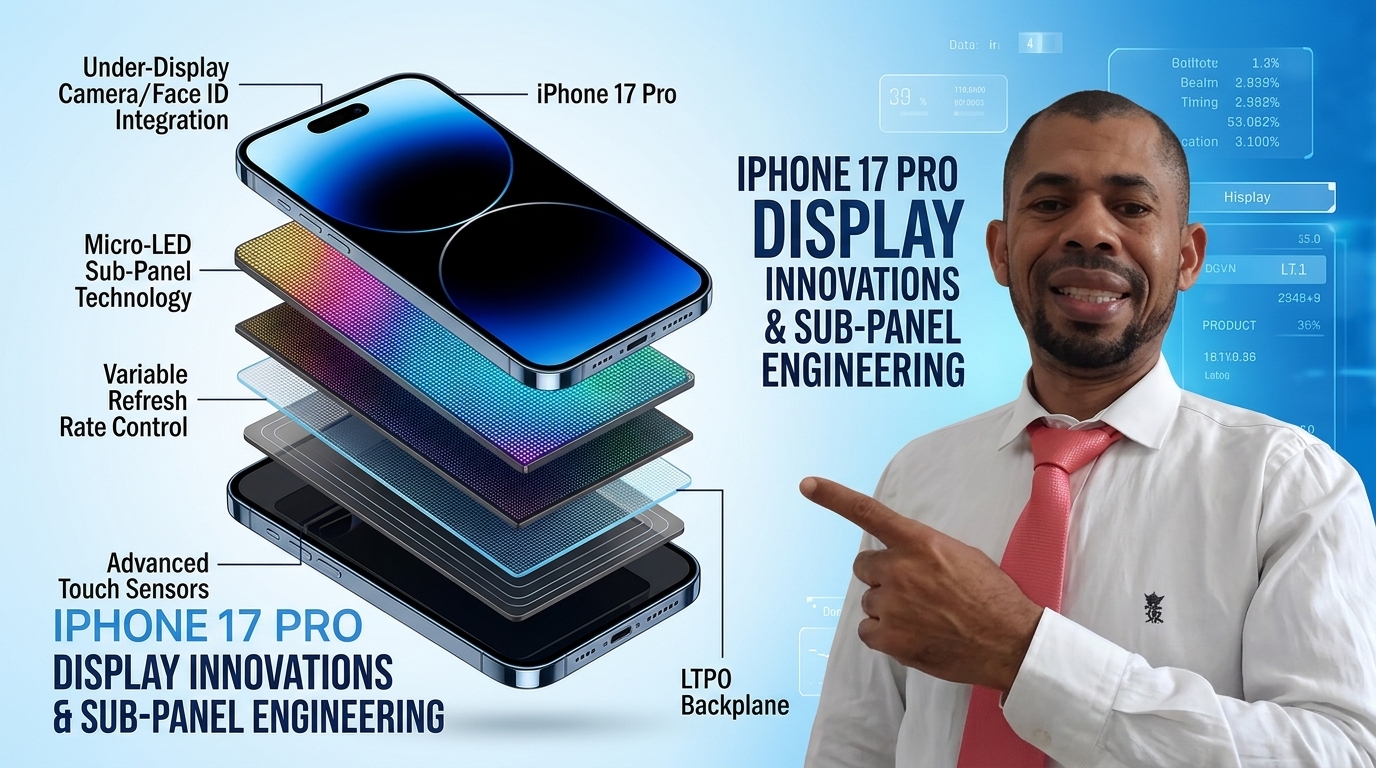
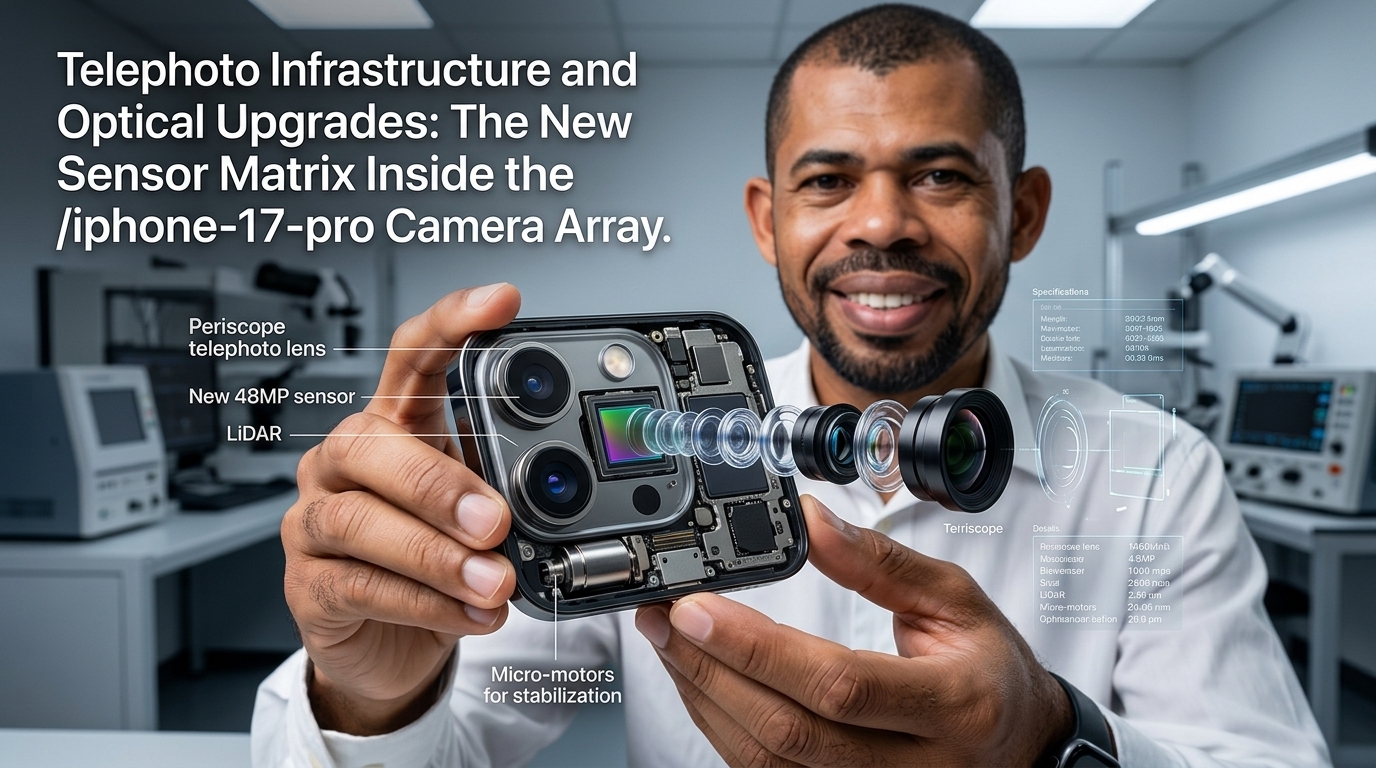
Telephoto Infrastructure and Optical Upgrades in the iPhone 17 Pro Camera Array refers to the full imaging stack behind Apple’s long-lens system: the telephoto module, its periscope-style optical path if used, the sensor format, stabilization hardware, lens coatings, autofocus architecture, and the image signal pipeline that turns distant scenes into usable detail. In practical terms, it is not just “a better zoom camera.” It is the integration of optics, mechanics, and computational imaging into one system that determines reach, sharpness, low-light viability, and video stability.
This matters now because telephoto quality has become a real differentiator in premium smartphones. Wide cameras are already very good. The gap between competitors shows up farther out: at 3x, 5x, 10x, and in motion-heavy video where shake and focus hunting expose weak hardware. When Apple changes the sensor matrix, the impact is felt in portrait compression, wildlife framing, stage photography, and handheld video, not just in spec sheets. That is why this topic deserves a technical reading instead of marketing-level coverage.
There is also a strategic angle. Apple has spent years tightening the link between optical design and computational photography. The result is a camera system that often looks conservative on paper but performs aggressively in real use. If the iPhone 17 Pro meaningfully upgrades telephoto infrastructure, the gains will likely come from the interaction between optics, sensor readout speed, and fusion logic rather than from a single headline number. That is where the real story sits.
Key Points
- The telephoto camera is defined by the entire optical chain, not by zoom magnification alone, and that chain determines detail retention, motion stability, and color consistency.
- Sensor size, pixel pitch, and lens design must be balanced; increasing one without adjusting the others can create flare, softness, or poor low-light behavior.
- Apple’s strongest advantage usually comes from computational fusion, where the telephoto module is integrated with the main sensor and software pipeline rather than treated as a standalone lens.
- The most meaningful upgrade in a premium phone camera is often a reduction in compromise: less crop penalty, cleaner edge detail, faster focus lock, and better video stabilization at distance.
- Any claim about a next-generation camera array should be read with caution until Apple’s official specifications and third-party lab testing confirm the optical and sensor changes.
Telephoto Infrastructure and Optical Upgrades in the IPhone 17 Pro Camera Array
What the Telephoto Module Actually Does
Formally, a telephoto module is a long-focal-length imaging subsystem that magnifies distant subjects by using a lens design optimized for reach rather than wide field of view. In a smartphone, that means the camera is solving a packaging problem under severe thickness constraints. The optical path must fit into a thin chassis, the sensor has to be positioned precisely, and autofocus and stabilization need enough travel to remain useful in real-world shooting.
In plain language, the telephoto camera is the phone’s distance specialist. It is what lets you isolate a face in a crowd, compress perspective for portraits, and capture stage performers without leaning on digital zoom. The problem is that telephoto lenses are unforgiving. Small mechanical errors show up as softness. Small sensor limitations show up as noise. That is why this module tends to separate good camera phones from merely expensive ones.
Why Infrastructure Matters More Than Zoom Marketing
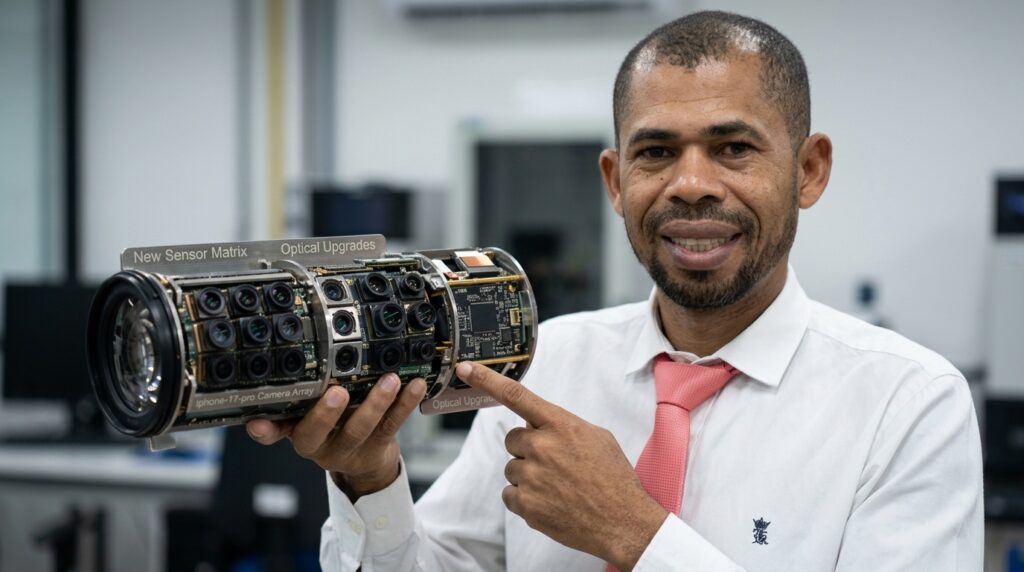
“Zoom” is the visible outcome. Infrastructure is the reason the result holds together. The telephoto stack includes lens elements, prism folding if the design is periscopic, actuator tolerances, sensor readout speed, optical image stabilization, and the software pipeline that merges exposures. If one piece lags, the image falls apart under low light or motion. A phone can advertise a large zoom number and still fail at the one thing users notice: clean, stable detail.
Who works with camera modules knows that the trade-off is never free. Longer focal lengths amplify handshake. Larger sensors demand more space. Better stabilization usually costs power and room. The real engineering work is deciding where to spend the budget so the camera is usable across portraits, night shots, and video. That trade-off is where the iPhone 17 Pro’s telephoto story, if upgraded, will live.
What to Watch in a Next-gen Sensor Matrix
The term “sensor matrix” is useful because modern smartphone imaging is no longer a single-camera problem. It is a coordinated matrix of wide, ultrawide, and telephoto inputs, each with different sensor sizes, lens characteristics, and processing paths. If Apple changes the telephoto sensor, it affects the entire matrix: exposure matching, color alignment, HDR blending, and focal-length switching behavior.
That is why a telephoto upgrade can be more consequential than a main-camera refresh. The main sensor already receives the most engineering attention across the industry. A stronger telephoto unit can close a visible gap in the lineup and improve the camera’s practical range, especially when a user moves from 2x or 3x into longer focal lengths. The camera array becomes more coherent, which matters more than isolated benchmarks.
Optical Design Choices That Decide Real-World Image Quality
Sensor Size, Pixel Pitch, and Lens Aperture
The core optical triangle is sensor size, pixel pitch, and aperture. A larger sensor captures more light and usually improves dynamic range, but it increases module size. Larger pixels can help low-light performance, yet they reduce pixel count if the sensor area is fixed. A wider aperture lets in more light, but it also raises challenges around aberration control and edge sharpness. That is the engineering bind behind every telephoto announcement.
For a premium phone, the goal is not maximum values in isolation. It is balance. If the sensor grows without a corresponding lens redesign, corners soften and flare rises. If the aperture opens too far, depth of field gets shallow enough to complicate subject tracking. In practice, the best telephoto cameras are those that choose a coherent operating range rather than a single impressive spec.
Component What It Improves Typical Trade-Off Larger sensor Light capture, dynamic range, cleaner shadows More space required, harder optical alignment Longer focal length Reach and subject compression More shake, tighter packaging constraints Wider aperture Better low-light intake Higher risk of aberration and edge softness Advanced stabilization Sharper handheld shots, steadier video Consumes power and internal volume
Periscope Architecture Versus Conventional Telephoto
A conventional telephoto lens stacks optical elements directly along the camera’s depth axis. A periscope design folds light through a prism or mirror so the lens path runs sideways, creating more effective focal length inside a thin body. That architecture is now the standard route for serious smartphone zoom because it gives designers more room to work with without forcing a thicker phone.
Not every periscope setup is equal. The quality depends on the prism, the alignment tolerance, and the way the sensor is matched to the lens. A weaker folding system can introduce ghosting, reduced contrast, or focus inconsistencies at the telephoto edge. If Apple expands the iPhone 17 Pro’s telephoto infrastructure, the key question is not whether it uses a folded path, but whether the folded path is engineered for consistency under motion and mixed lighting.
Coatings, Flare Control, and Contrast Retention
Lens coatings rarely get marketing headlines, yet they strongly affect image credibility. Poor coatings increase internal reflections, which lowers contrast and creates bright artifacts around lights. At telephoto focal lengths, these defects become more visible because the lens stack is longer and the angle of incoming light is more demanding. This is one reason city-night telephoto shots often separate polished optical systems from average ones.
Advanced coatings, combined with tighter element alignment, preserve midtone separation and keep highlights from washing out. That helps face detail, signage, and texture at distance. It also improves video, where moving lights can expose weaknesses faster than still photography. If the camera array receives a serious optical upgrade, this is one of the areas where users will feel it even if they never look at a spec sheet.
Sensor Fusion and the New Camera Array Logic
How the Main Sensor and Telephoto Sensor Work Together
The best modern phone cameras do not treat each lens as isolated hardware. They use sensor fusion, meaning the system combines data from multiple cameras to improve exposure, sharpness, and tonal consistency. The telephoto module can contribute focal-length-specific detail while the main sensor supplies tonal information, noise reduction cues, or fallback crops when light is poor.
This is why a telephoto upgrade should be evaluated as part of the whole camera array. If the main camera, ultrawide, and telephoto sensors are well matched, switching between focal lengths feels natural. If they are poorly matched, you get color shifts, exposure jumps, and inconsistent texture rendering. That mismatch is often what separates a technically competent camera from a genuinely good one.
Computational Photography is Not a Substitute for Optics
Computational photography can rescue a weak frame, but it cannot invent detail that the lens never captured. It can reduce noise, stack exposures, and sharpen intelligently, yet it still depends on a stable optical foundation. That is why the most successful camera phones combine strong optics with conservative processing, rather than asking software to do all the heavy lifting.
There is also a limit that people ignore. Heavy processing can flatten fine texture, especially in hair, fabric, and foliage at distance. It works well in some scenes and fails in others. That is not a defect of computation itself; it is a reminder that the optical front end still sets the ceiling. The iPhone 17 Pro camera array, if it improves, will likely do so by raising that ceiling first.
Reference Behavior, Color Matching, and HDR Continuity
One of the hardest problems in multi-camera systems is keeping color and tone consistent across lenses. When a user jumps from wide to telephoto, the scene should not suddenly become warmer, flatter, or more contrasty. This requires calibration across sensors, accurate profiling, and careful HDR continuity. It also requires a pipeline that understands different lens geometries without overcorrecting them.
For professionals, this matters more than headline megapixels. Consistent behavior across focal lengths means less time correcting footage and fewer surprises in stills. It also helps workflows where the phone is used as a quick capture tool rather than a deliberate camera substitute. In that sense, the sensor matrix is part hardware, part color science, and part discipline.
Low-Light, Motion, and Video: Where Telephoto Upgrades Are Proven or Exposed
Why Telephoto Fails First in Bad Light
Telephoto lenses gather less light than wide cameras because they operate with longer focal lengths and typically smaller apertures relative to the demands placed on them. As light falls, shutter speeds drop, noise rises, and stabilization has to work harder. That is why telephoto shots at dusk often look fine on the preview but soften after capture or processing. The camera is fighting physics.
Apple’s strength has usually been in reducing the visible penalty, not eliminating it. Better sensors, smarter fusion, and stronger stabilization can keep the telephoto camera useful later into the evening. But no phone breaks the light budget completely. This method works well for handheld social and travel use, but it fails when the subject is moving fast in very low light and the camera has to choose between blur and noise.
Stabilization Systems That Matter at Distance
Optical image stabilization, or OIS, physically moves lens or sensor elements to counter hand shake. At telephoto focal lengths, this matters far more than it does on a wide camera, because any small movement is magnified. In video, the challenge becomes even tougher: the system must smooth motion without creating strange warping or overcorrection. That balancing act is where hardware quality shows.
Strong stabilization is not just about steadier footage. It also allows the camera to hold longer exposures, which improves detail in stills and reduces the need for aggressive noise reduction. If the telephoto infrastructure inside the iPhone 17 Pro is improved, a better stabilization loop may be one of the most visible wins in daily use, especially for walking video and handheld portrait work.
Video Use Cases Expose Hardware Truth Quickly
Video is the harshest test because the camera cannot hide behind a single lucky frame. Focus hunting, rolling exposure changes, and stabilization artifacts become obvious as soon as the subject moves. A telephoto system that feels fine for still photos can fall apart in motion if the actuator is slow or the readout is not fast enough.
That is why field testing matters more than lab claims. Benchmarks can rank resolution, but they do not fully capture how a camera behaves while tracking a person on a stage or panning across distant architecture. In practice, that is where telephoto infrastructure earns its keep. The phone either holds detail and motion, or it reveals the limits of the design.
How Apple’s Imaging Stack Typically Balances Hardware and Software
The Role of the ISP and Image Pipeline
The image signal processor, or ISP, is the chip-side engine that handles demosaicing, noise reduction, sharpening, HDR merging, and color processing. In Apple’s system, the ISP is tightly integrated with the neural and computational parts of the pipeline, which allows the phone to adapt quickly to scene content. The result is usually less about raw spec gains and more about controlled image output.
That control matters with telephoto images because long-lens capture exaggerates defects. A good ISP can preserve texture without turning the image crunchy. It can also keep skin tones stable and recover highlight detail without making shadows look synthetic. The hardware sets the boundaries, but the ISP decides how gracefully the camera behaves inside them.
What Apple Has to Get Right in the IPhone 17 Pro Era
If Apple changes the telephoto system, three things matter most: optical precision, sensor readout speed, and cross-camera consistency. The company cannot afford a telephoto module that performs well only in bright light or only when the subject is static. Premium users expect distance shots to be as reliable as the main camera in ordinary conditions.
That expectation is why Apple usually avoids radical changes without a pipeline to support them. A bigger sensor is meaningless if autofocus lags. A sharper lens is wasted if the processing chain smears detail. The telephoto infrastructure has to be tuned as a system. Anything less looks good in marketing and mediocre in the hand.
Why the Camera Array Should Be Judged as a System
A strong camera array is not the sum of three independent cameras. It is a coordinated imaging platform. The wide, ultrawide, and telephoto units should share color behavior, depth cues, exposure logic, and stabilization philosophy. When they do, the phone feels coherent. When they do not, users sense it immediately, even if they cannot explain the technical reason.
That system view is the right way to evaluate any telephoto rumor or specification leak. If the upgrade improves focal-length switching, portrait rendering, and motion stability together, it is real progress. If it only increases a zoom figure, the practical gain may be narrow. Hardware truth tends to reveal itself in use, not in slide decks.
How to Evaluate the Upgrade Without Getting Lost in Spec Noise
Read the Right Metrics First
When assessing a phone telephoto upgrade, the most useful metrics are not the loudest ones. Focus on focal length, sensor format, aperture, OIS quality, autofocus speed, and whether the camera uses a folded optical path. If available, check readout speed and whether the camera supports high-quality video at the telephoto focal length. Those details predict daily performance better than a single zoom label.
Third-party lab data helps because it isolates variables. Sources such as DXOMARK camera testing and Apple’s own technical documents let you separate engineering from hype. Use them together, not separately. One tells you the vendor’s intent. The other tells you how the device performs under controlled testing.
Evidence from Official and Technical References
Apple’s iPhone technical specifications pages are the baseline for camera claims, and they are useful because they define focal lengths, apertures, and stabilization features in official terms. For imaging fundamentals, the National Institute of Standards and Technology offers useful measurement context on optics and calibration practices. For broader camera-system discussions, IEEE publications are often the best place to study the computational side of the problem.
Those references matter because smartphone camera marketing can blur the line between optical reach and digital crop. A zoom figure alone tells you very little unless you know how the system is built. Professional evaluation starts with the optical chain and ends with real capture behavior. Everything in between is marketing language until proven otherwise.
What a Serious Test Sequence Should Include
A credible evaluation should include daylight detail, mixed lighting, indoor motion, night handheld, portrait edge behavior, and video stabilization while walking. It should also compare lens switching across focal lengths so you can see whether the camera maintains consistent tone and sharpness. That kind of testing exposes the actual quality of the telephoto infrastructure, not just its best-case shot.
In the field, I have seen cases where a camera looked weaker on paper but performed better in motion because its stabilization and autofocus were tuned more intelligently. That is one reason experts avoid judging a telephoto module by a single sample image. The full picture only appears when the camera is pushed through a range of lighting and movement conditions.
What This Means for Photographers, Creators, and Power Users
Portraits and Subject Separation
A strong telephoto module is one of the easiest ways to improve portrait rendering without artificial-looking software blur. A longer focal length compresses perspective, which flatters facial structure and isolates the subject from the background. If the sensor and lens are well matched, skin texture stays believable and edge transitions around hair look cleaner.
For creators, this matters because telephoto portraits often look more premium than wide-angle portraits shot at close range. The difference is subtle but real. A better telephoto infrastructure gives you cleaner compression, more reliable subject framing, and fewer depth-map artifacts. That is the kind of upgrade users feel immediately, even if they never ask for it by name.
Travel, Sports, and Stage Work
Distance work exposes whether the camera system is built for practical use or showroom demos. Travel photography benefits from usable reach in tight spaces. Sports and stage work depend on focus speed and stabilization. A telephoto system that can hold detail while subjects move across the frame is much more valuable than one that only looks strong on static architecture.
The iPhone 17 Pro telephoto discussion becomes meaningful here because these use cases are not niche anymore. People use phones for concerts, school events, street scenes, and travel logs all the time. If the camera array is upgraded well, it reduces the need to carry a separate lens-equipped camera for many ordinary assignments.
Where the Upgrade Will Still Have Limits
There is no escaping the physical limits of a phone body. Heat, thickness, battery budget, and lens alignment still place a ceiling on what telephoto hardware can do. A stronger module may improve reach and clarity, but it will not replace a dedicated camera with larger optics and deeper controls. That distinction matters for professionals.
So the right expectation is measured, not inflated. If the camera improves, it will likely be a meaningful jump in usability, not a miracle. That distinction keeps the analysis honest. Telephoto phones have become very capable tools, but they remain tools with trade-offs. The best designs reduce those trade-offs without pretending they do not exist.
Próximos Passos Para Implementação
The most defensible way to judge this camera platform is to treat the telephoto module as part of a larger imaging system, not as a headline feature. Look for alignment between optics, sensor readout, autofocus, stabilization, and cross-camera color behavior. If those elements move together, the upgrade is real. If only the zoom number changes, the user benefit will be narrower than the marketing suggests.
For practical decision-making, validate performance in the scenes that expose weaknesses: night handheld, moving subjects, portrait edges, and zoom video. That is where a sensor matrix either proves its engineering value or reveals its compromises. Official specifications are the starting point, third-party lab data is the check, and hands-on field behavior is the final test.
The strongest expectation for a next-generation premium phone camera is not “more zoom.” It is cleaner reach, steadier motion, and more consistent imaging across the entire array. That is what separates a competent update from a camera system worth studying.
FAQ
What is the Technical Meaning of a Telephoto Camera in a Smartphone?
A telephoto camera is a long-focal-length imaging module designed to magnify distant subjects while preserving detail and perspective compression. In phones, it often uses a folded or periscope-style optical path to fit inside a thin body. Its real value is not just zoom distance; it is how well the system handles sharpness, stabilization, and subject isolation under real shooting conditions.
Why Do Telephoto Cameras Struggle More in Low Light Than Wide Cameras?
Telephoto cameras usually capture less light because of their focal length, aperture choices, and tighter optical design constraints. That makes them more dependent on stabilization and noise reduction, which can only go so far before image quality drops. The result is more visible softness, higher noise, and slower shutter speeds when light gets scarce.
Is Sensor Size More Important Than Zoom Magnification?
Yes, in most cases sensor size matters more than the zoom figure itself. A larger sensor improves light capture, dynamic range, and tonal stability, which often matters more than raw reach. A high zoom number with a weak sensor can still produce soft, noisy images, while a balanced telephoto system with moderate reach may look far better in actual use.
How Does Sensor Fusion Improve Telephoto Performance?
Sensor fusion lets the phone combine data from multiple cameras to improve detail, exposure, and color consistency. The telephoto sensor contributes focal-length-specific information, while the main sensor can help with tonal balance or fallback processing when conditions are poor. This works well when calibration is tight, but it can fail if the sensors are poorly matched or the processing is overaggressive.
What Should Professionals Test First on a New Telephoto System?
Start with autofocus speed, handheld stability, low-light detail, and color consistency across lens switches. Then test moving subjects, portrait edge rendering, and telephoto video while walking. Those scenarios reveal the true quality of the optics, sensor, and ISP pipeline much faster than static lab-style comparisons.
Editorial Notice
This content was structured with the assistance of Artificial Intelligence and subjected to rigorous curation, fact-checking, and final review by Editor-in-Chief Nivailton Santos. TechTool Judge reaffirms its unyielding commitment to journalistic ethics, ensuring that editorial judgment and data validation remain entirely under human responsibility and final editorial oversight.