Nuclear-Powered Data Centers, Small Modular Reactors, SMRs, AI Training Wave

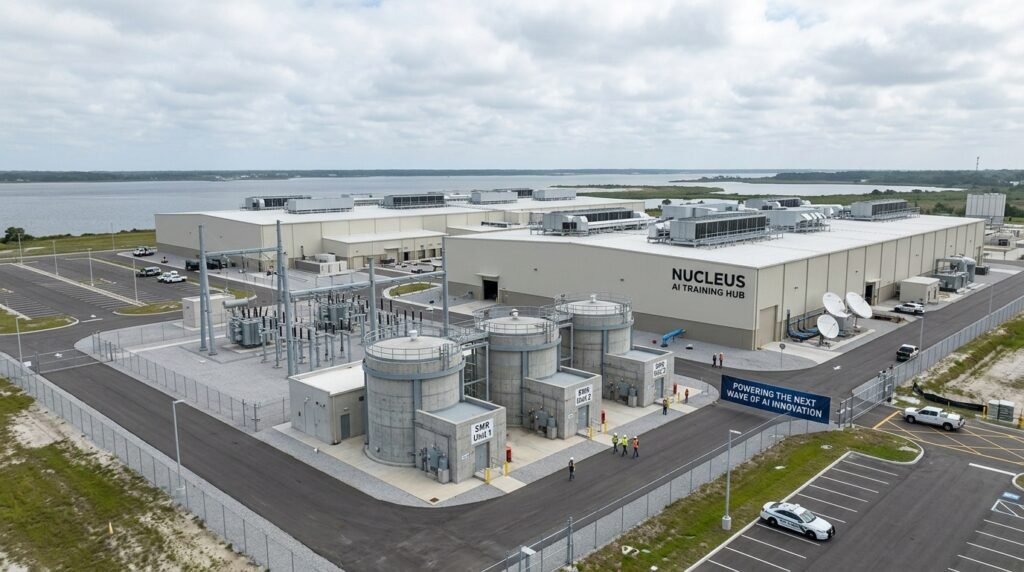
Nuclear-Powered Data Centers: Small Modular Reactors (SMRs) Fueling the Next AI Training Wave describes a new infrastructure model in which data centers pair high-density compute campuses with on-site or near-site nuclear generation, most often Small Modular Reactors (SMRs), to deliver firm, low-carbon power for AI training and other continuous workloads. Technically, the idea is straightforward: place a dispatchable baseload source next to a facility whose demand profile is large, constant, and expensive to interrupt.
This matters now because AI training is not just “more electricity.” It is a different load shape. Large language models, multimodal systems, and inference at scale push operators toward megawatt-level campuses with high uptime requirements, aggressive thermal management, and power quality standards that are hard to satisfy with intermittent generation alone. In practice, the bottleneck is no longer only chips or cooling; it is grid access, interconnection timelines, and the ability to secure power that is both reliable and carbon-constrained.
The SMR conversation has accelerated because hyperscalers, utilities, and regulators are all running into the same limit: transmission is slow, permitting is slow, and AI demand is fast. Nuclear does not solve every constraint, and SMRs are not commercially uniform yet, but they do address one core problem exceptionally well: firm power with a small land footprint. The question is no longer whether the concept is technically coherent. The real question is where it pencils out, how quickly it can be licensed, and which deployment models survive contact with economics, safety, and schedule risk.
Pontos-Chave
- SMRs fit data centers because they provide firm, high-capacity-factor electricity that matches the constant demand profile of AI training clusters better than weather-dependent generation.
- The commercial case is driven less by raw energy cost and more by avoided downtime, reduced curtailment risk, and faster access to dependable power where grid interconnection is constrained.
- The main barriers are not ideological; they are regulatory licensing, first-of-a-kind construction risk, fuel supply, and the difficulty of coordinating nuclear timelines with hyperscale deployment schedules.
- Not every campus should chase on-site nuclear. In many cases, the strongest model will be a utility-scale SMR tied to a dedicated power agreement rather than a reactor sitting inside the data center perimeter.
- The most credible near-term value lies in AI training campuses with stable, 24/7 load, long asset lives, and locations where transmission queues make conventional expansion impractical.
Nuclear-Powered Data Centers: Small Modular Reactors (SMRs) Fueling the Next AI Training Wave and Why the Load Profile Fits
What the Model is, Technically
A nuclear-powered data center is not a data hall “running on atoms” in the casual sense. Formally, it is a compute facility whose electricity supply is anchored by a nuclear reactor, often through a direct physical connection, a dedicated microgrid, or a long-term behind-the-meter arrangement. Small Modular Reactors are reactors typically designed at lower unit output than traditional large plants, with factory fabrication, modular deployment, and enhanced safety systems intended to simplify siting and construction.
For AI infrastructure, the attraction is load matching. Training clusters draw steady, high power over long periods. That is the kind of demand nuclear generation handles well. A reactor with a high capacity factor can support dense rack deployments, liquid cooling loops, and the electrical redundancy systems that modern facilities require. A grid that relies heavily on solar or wind can still serve these loads, but only when paired with substantial storage, firm backup, or substantial transmission reinforcement.
Why AI Training Pushes Operators Toward Firm Power
Training runs are intolerant of interruptions. A long model run can consume thousands of GPU-hours, and a power event can waste not only electricity but also time, cluster reservation windows, and engineering effort. Anyone who has worked around high-density compute knows the operational reality: when a large training job gets paused, restarted, or throttled, the cost is not limited to the utility bill. Scheduling cascades, cooling constraints, and network dependencies all compound the loss.
This is why the AI wave changes the power conversation. Traditional enterprise data centers could absorb a few minutes of instability. Frontier training infrastructure cannot. That is also why utilities and operators increasingly talk about “firm capacity” rather than just megawatt supply. Nuclear is attractive not because it is fashionable, but because it is one of the few zero-carbon sources that can run continuously at scale without depending on weather, daylight, or short-duration storage.
The Infrastructure Logic Behind Colocating Generation and Compute
Co-locating generation with compute reduces exposure to grid congestion, but it also changes the engineering stack. The facility must design around switchgear, islanding capability, protection schemes, and heat rejection in a way that respects both nuclear safety and IT uptime. In many deployments, the better pattern is not literal adjacency to the reactor core but a dedicated energy campus with private transmission and a tightly managed interconnection boundary.
The U.S. Department of Energy’s Office of Nuclear Energy has repeatedly emphasized advanced reactors and microreactor concepts as part of the future power mix, while regulators continue to refine the licensing pathway. That matters because the feasibility question is not only engineering. It is also whether project timelines, safety case documentation, and siting approvals can be aligned with the speed of AI buildouts.
Where SMRs Create a Real Advantage over Grid-Only Power
Capacity Factor, Dispatchability, and Uptime Economics
SMRs are compelling because they provide dependable output at a high capacity factor. For a data center operator, that means fewer energy contingencies and less dependence on market purchases during peak periods. The economic value is not just the wholesale price per megawatt-hour; it is the ability to avoid load shedding, supply shortfalls, and operational throttling when the grid tightens.
The business case strengthens further when you account for load growth over decades. Data centers are long-lived assets. Hyperscale and colocation campuses often outlive multiple generations of servers. A power strategy that seems expensive on day one can become rational when it supports several refresh cycles, especially if carbon policy, transmission scarcity, or carbon accounting penalties make grid-only expansion less attractive.
Grid Interconnection is Often the Hidden Constraint
The biggest bottleneck in AI infrastructure is frequently not the reactor itself; it is the grid queue. Across the United States and other developed markets, interconnection backlogs can stretch for years. That delay can kill a compute project or force a buildout to a less optimal region. A dedicated nuclear source reduces dependence on transmission upgrades that may otherwise dictate site selection.
That said, nuclear does not eliminate the need for grid coordination. Many facilities will still require utility backup, black-start planning, and regulatory approval for parallel operation. The strongest projects are likely to be those that treat the reactor as part of a broader energy system, not as a standalone badge of sustainability.
Why the Carbon Story is Stronger Than the Marketing Story
Nuclear power’s environmental advantage is often overstated in headlines and understated in serious planning documents. Its real strength is operational stability with very low direct emissions. That makes it especially useful for AI training workloads that are continuous and electricity-intensive. It also helps operators reduce exposure to renewable intermittency without relying entirely on battery duration that may be too short for multi-day reliability events.
The U.S. Nuclear Regulatory Commission is central here because licensing drives schedule certainty. Until a reactor design is certified and a siting path is clear, the concept remains partly a financing thesis. The climate case may be strong, but the project still succeeds or fails on permitting, construction execution, and the ability to deliver power on a timetable compatible with AI demand.
The Hard Parts: Licensing, Safety Case, Fuel Supply, and Construction Risk
Licensing Timelines Are Not a Footnote
Nuclear projects move on regulatory time, not venture capital time. That mismatch matters. AI firms can decide to expand a cluster in a quarter; reactor licensing can take much longer. SMRs are designed to reduce complexity, but they do not erase the need for detailed safety analysis, environmental review, emergency planning, and quality assurance documentation. Those steps are the price of nuclear credibility.
There is a real divergence between proponents and skeptics here. Advocates argue that modularization will cut schedule risk. Skeptics point out that first-of-a-kind projects often uncover supply-chain and civil-works complications that erase theoretical speed gains. Both are partly right. SMRs improve the architecture, but they do not repeal project management.
Fuel Cycle and Operational Sovereignty Matter
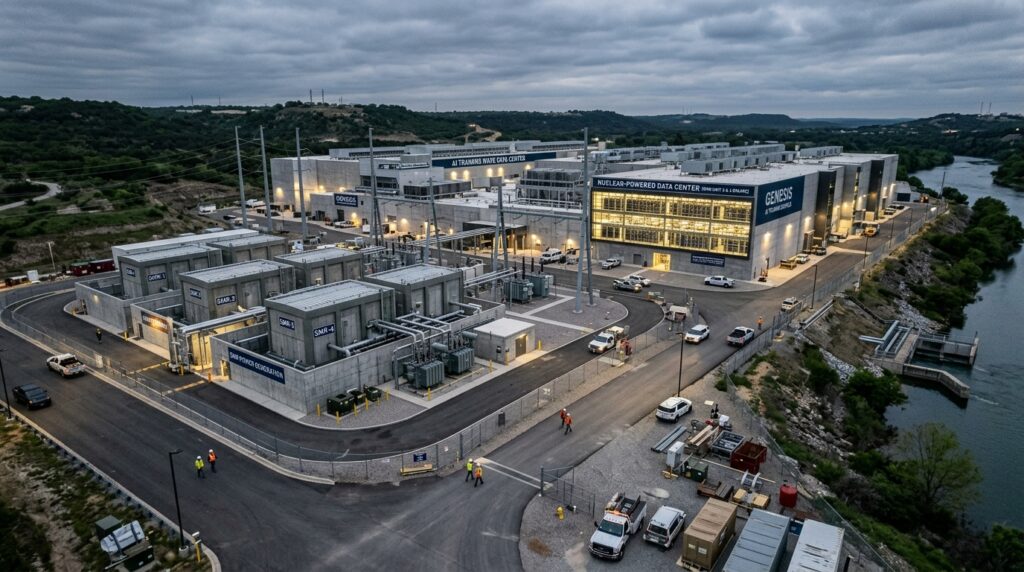
For advanced reactors, fuel availability can be a decisive issue. Some designs depend on specialized fuels, such as TRISO or HALEU, and the commercial supply chain for these materials is still maturing. A data center operator cannot build a strategic roadmap around a reactor concept if the fuel ecosystem remains underdeveloped or geopolitically exposed.
That is one reason the most practical early deployments may involve collaboration with established utilities or reactor developers rather than direct ownership by a cloud company. The operator wants power reliability; the utility and the reactor vendor bring the nuclear operating model. This division of labor is more realistic than expecting an AI firm to become a nuclear utility overnight.
Safety Systems and Public Acceptance Remain Decisive
SMRs promise passive safety features, smaller source terms, and more compact footprints than legacy reactor fleets. Those features improve the case for modern siting, but they do not eliminate public scrutiny. Communities near proposed sites will ask about emergency response, cooling water, waste handling, and long-term decommissioning. Those questions are not obstacles to be waved away; they are part of the license to operate.
In the real world, the projects that progress are the ones that answer those questions early and concretely. Anyone who has seen large industrial projects stall knows that uncertainty is more damaging than bad news. Transparent engineering, credible third-party review, and a realistic construction schedule matter more than polished branding.
Deployment Model Typical Strength Main Risk Best Fit Behind-the-meter SMR Direct supply, low exposure to grid congestion Permitting complexity and site integration Large, long-lived AI campuses Utility-owned SMR with power purchase agreement Lower operational burden for the data center owner Contract structure and delivery timeline Hyperscalers seeking firm, contracted power Microreactor / remote power concept Small footprint, localized resilience Commercial readiness and fuel availability Niche or remote compute sites
Economic Reality: When the Business Case Works and When It Does Not
SMRs Are Not Automatically Cheaper Than Everything Else
The strongest argument for nuclear-powered compute is not that SMR electricity will always beat gas or wind on headline price. It will not. The argument is that some workloads need firm power so badly that the total system cost of alternatives becomes higher once you account for storage, backup generation, congestion, and reliability penalties. A cheap megawatt is not useful if it arrives unpredictably.
That is the trap many energy comparisons fall into. They isolate generation cost and ignore the system. For AI training, the system includes cooling redundancy, uptime requirements, reserve margins, and the cost of delayed deployment. When all of that is included, nuclear becomes more competitive in specific use cases, especially where the local grid cannot absorb another massive load quickly.
Capital Intensity and Financing Structure Decide the Outcome
SMRs require large upfront capital and patient financing. That alone filters out many projects. A data center developer may love the engineering and still fail to make the numbers work if the cost of capital is too high or the reactor timeline is too uncertain. Financing prefers stable offtake, standardized designs, and regulatory clarity.
The likely winners are projects backed by creditworthy off-takers, utility partnerships, or sovereign-scale institutions that can tolerate long development horizons. Venture-funded enthusiasm does not change that. In practice, the most bankable model is often a long-term power purchase agreement tied to a utility or independent power producer with nuclear expertise.
Where the Economics Are Strongest Today
The near-term sweet spot is not every enterprise data center. It is large-scale AI training campuses, national labs, industrial AI clusters, and regions where grid expansion is already constrained. These are the places where lost uptime is expensive and the value of firm low-carbon power is easiest to justify.
Projects in this category also benefit from policy tailwinds. Federal support for advanced nuclear demonstration, state-level clean firm power goals, and corporate decarbonization targets can all improve the investment case. Still, the economics remain case-specific. This model works well in some contexts and poorly in others, and pretending otherwise is how capital gets misallocated.
What Operators, Utilities, and Policymakers Need to Align Next
Operators Need to Design for Power, Not Just Compute
Data center architects have spent years optimizing racks, networking, and cooling. The next stage requires power-native design. That means treating generation, storage, and grid interaction as first-class design variables. The operator who plans a training campus without locking down firm power is building on sand.
Facility teams should evaluate whether their AI roadmap needs 24/7 baseload, what redundancy tier they require, and whether a dedicated reactor partnership is realistic before site selection hardens. This is where the practical lesson becomes clear: power strategy cannot be bolted on after the site is chosen. It must shape the site itself.
Utilities Need Clearer Commercial Templates
Utilities sit in the middle of the opportunity and the bottleneck. They can help standardize interconnection, offtake structures, and regulatory interfaces so that AI loads do not overwhelm the local system. They can also reduce friction by defining how a nuclear-backed campus participates in grid support during non-peak periods.
This is where the best projects will separate themselves. If the utility sees the data center as a flexible strategic load rather than an uncontrolled demand spike, the project has a chance. If not, the interconnection queue alone can derail it.
Policymakers Should Optimize for Repeatability
Regulators should not confuse repeatability with speed alone. The real policy target is a licensing and siting framework that can be reused across projects without re-litigating every technical assumption from scratch. Standardization is what turns a demonstration into an industry.
That is also why sources like the National Academies of Sciences, Engineering, and Medicine matter in the broader policy conversation: they help frame advanced nuclear in terms of engineering maturity, safety, and deployment realism rather than slogans. The future of nuclear-powered compute depends on disciplined governance as much as it depends on reactor physics.
Próximos Passos Para Implementação
The strategic takeaway is not that every AI campus should adopt nuclear power. It is that the largest, most persistent, and most location-constrained workloads now justify a serious evaluation of SMRs as part of the energy stack. If the workload is intermittent, mobile, or small, the case weakens fast. If the workload is continuous, scale-heavy, and sensitive to grid delays, the case becomes much stronger.
The next move is disciplined screening: load profile, site constraints, licensing path, fuel readiness, and commercial structure. Teams that treat these as early decision gates will save years of effort. Teams that wait until the design is nearly fixed will discover that the power plan, not the compute plan, is what determines delivery.
For organizations planning the next training wave, the practical recommendation is to evaluate SMR partnerships alongside conventional utility expansion, storage, and long-term PPAs. The winning portfolio will likely be hybrid, but the firms that understand firm power first will secure the best sites, the cleanest schedules, and the most durable operating economics.
FAQ
Are SMRs Ready to Power Hyperscale AI Data Centers Today?
Not at broad commercial scale yet. Some designs are advancing through licensing and demonstration, but most are not deployed widely enough to support immediate, mass-market adoption. The near-term opportunity is strongest in projects that can tolerate long lead times and structure financing around future delivery rather than near-immediate commissioning.
Why Would a Data Center Choose Nuclear Instead of Solar Plus Batteries?
Because AI training often needs continuous, high-capacity power without long interruptions. Solar plus batteries can work for parts of the load, but they usually require substantial overbuild and storage duration to approximate nuclear-grade firmness. The total system cost can become unattractive once reliability and land use are included.
What is the Biggest Regulatory Challenge for a Nuclear-backed Data Center?
Licensing and siting. The reactor design, safety case, emergency planning, and environmental review all take time, and those processes must align with the data center’s deployment schedule. If the power source arrives too late, the compute facility loses the commercial advantage it was meant to create.
Do SMRs Solve the Grid Interconnection Problem Completely?
No. They reduce dependence on congested transmission, but they do not eliminate the need for grid coordination, backup planning, or interconnection approvals. In many projects, the best outcome is a dedicated power arrangement that still interacts intelligently with the broader grid rather than isolating itself from it.
Which Companies or Institutions Shape This Market Most?
Reactors are influenced by the U.S. Department of Energy, the Nuclear Regulatory Commission, utilities, and advanced reactor developers such as those working on modular or microreactor designs. On the demand side, hyperscalers and large colocation providers shape the market by signing long-term power commitments. The market moves when those groups align around schedule, safety, and finance.
Editorial Notice
This content was structured with the assistance of Artificial Intelligence and subjected to rigorous curation, fact-checking, and final review by Editor-in-Chief Nivailton Santos. TechTool Judge reaffirms its unyielding commitment to journalistic ethics, ensuring that editorial judgment and data validation remain entirely under human responsibility and final editorial oversight.