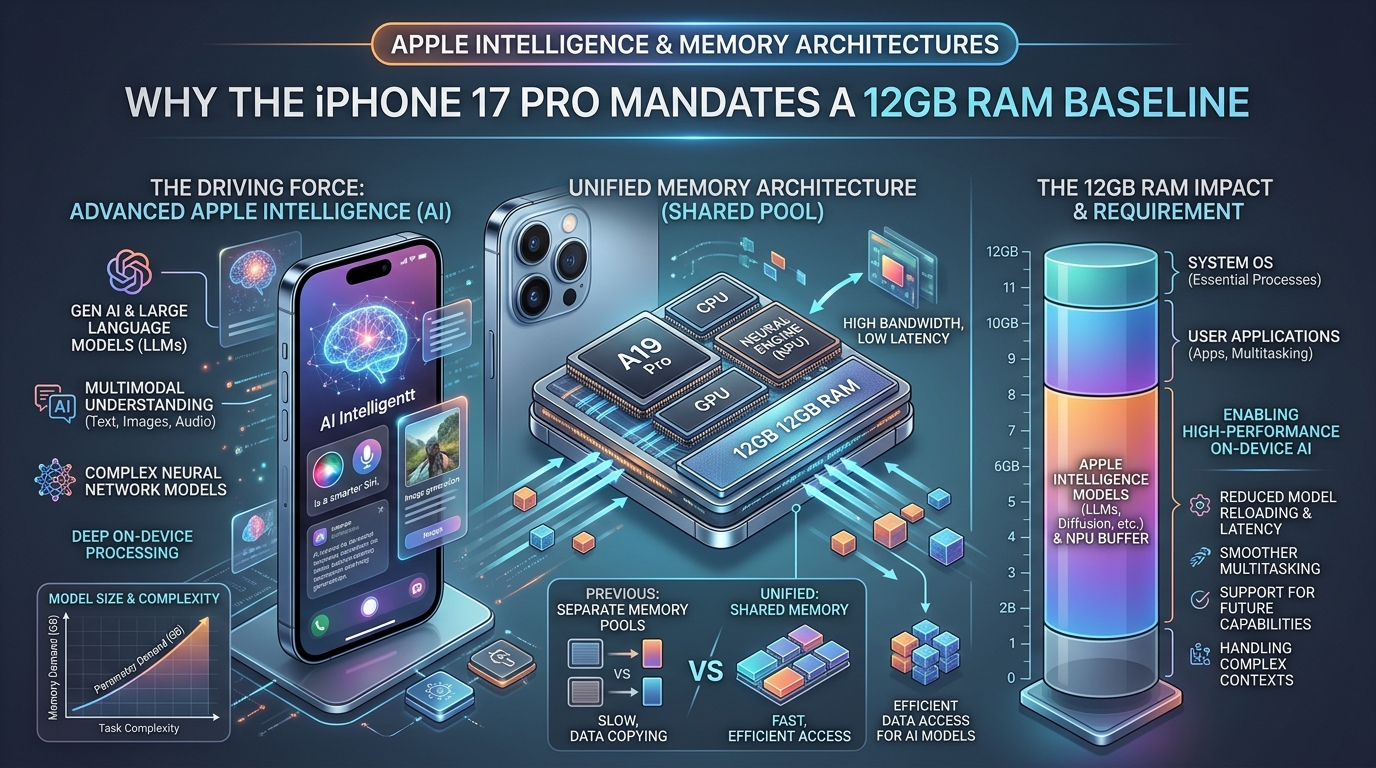
Apple Intelligence and Memory Architectures: Why the iPhone 17 Pro Requires a 12GB RAM Baseline is best understood as a hardware-software constraint, not a marketing slogan. In technical terms, it refers to the minimum unified memory capacity needed to run on-device generative features, large language model inference, image understanding, and multitasking without forcing constant memory swaps or aggressive process eviction. In plain English: Apple’s next Pro-class iPhone cannot carry a modern AI stack on 8GB alone without trade-offs that would be visible in latency, battery behavior, and app retention.
This matters now because Apple Intelligence is not a single feature. It is a pipeline: foundation models, multimodal inputs, private cloud fallback, Core ML execution paths, and system-level integration across Siri, Writing Tools, Photos, Mail, and third-party apps. The memory floor becomes a design decision, not a spec-sheet detail. If the iPhone 17 Pro ships with a 12GB baseline, that tells us Apple is optimizing for local model residency, lower context-switch overhead, and fewer performance cliffs under sustained AI use.
That shift also changes how people should evaluate the device. The relevant question is no longer whether the phone can “run AI,” but whether its memory architecture can keep models, app state, and GPU workloads resident long enough to feel instant. In practice, that is where 12GB starts to look less like excess and more like the minimum viable Pro configuration.
Key Takeaways
- Apple Intelligence is constrained by unified memory, not just raw CPU speed, because modern on-device AI needs persistent model residency and low-latency access to large working sets.
- A 12GB baseline on the iPhone 17 Pro would align with the memory demands of multimodal AI, heavier multitasking, and longer app retention under iOS’s memory pressure rules.
- The real bottleneck is not peak benchmark performance; it is sustained responsiveness when the system is juggling LLM inference, Photos analysis, and background app state at the same time.
- Apple can fall back to private cloud processing for some tasks, but that does not eliminate the need for more local memory when privacy, speed, and offline usability matter.
- For buyers, 12GB is less about “future-proofing” as a buzzword and more about avoiding a device that becomes memory-bound the moment Apple Intelligence expands beyond the first wave of features.
Apple Intelligence and Memory Architectures: Why the IPhone 17 Pro Requires a 12GB RAM Baseline
Unified Memory is the Real Constraint, Not Just “RAM”
In Apple’s architecture, RAM is part of the unified memory pool shared by the CPU, GPU, Neural Engine, and media blocks. That matters because AI workloads do not live in one isolated region of the chip. A generative reply, an image summary, and a background app refresh can all compete for the same pool, which means the system has to keep more data resident and accessible at once.
That is why a “12GB RAM baseline” is not a casual uplift. It is a structural response to how Apple Silicon behaves under mixed workloads. When memory is tight, iOS does what any modern OS does: compresses, evicts, and reloads. Those policies work well until a feature stack becomes memory-hungry enough that the user starts seeing delays, reloads, or reduced context window length in AI experiences.
Who works with mobile ML knows this pattern. The bottleneck is rarely whether the NPU can compute a token fast enough in isolation. The bottleneck is whether the system can keep the model weights, token cache, and app state in memory without constant churn. That is where larger unified memory starts paying for itself in user experience.
Why On-device AI Changes the Memory Equation
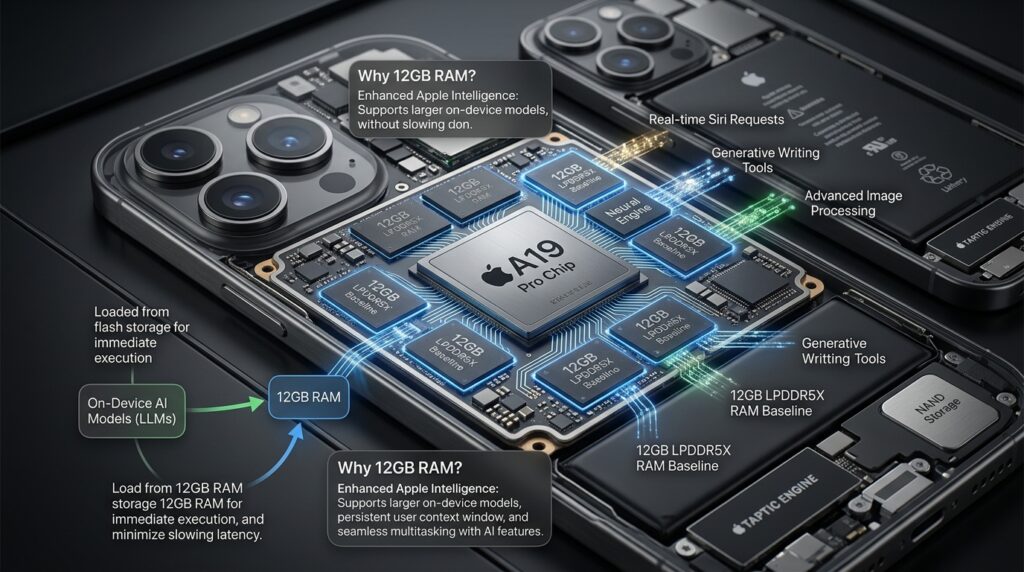
Classic mobile workloads were bursty. You opened an app, it rendered, then it slept. Apple Intelligence is different because it invites sustained model use: text rewriting, semantic search, summarization, visual analysis, and multi-step Siri tasks. Each of those operations adds working-set pressure, and working-set pressure is what makes memory capacity matter.
In technical terms, local inference benefits from higher memory headroom because it reduces paging and keeps intermediate activations closer to the execution units. In practical terms, the phone feels less “busy.” There is less stutter, fewer app reloads, and less of the hidden friction that users blame on “slow AI” when the real issue is memory contention.
This is where Apple’s own design philosophy becomes relevant. The company optimizes for latency, privacy, and power efficiency. A 12GB floor helps all three when the device is asked to do more on-device and less in the cloud. For a Pro model, that is a coherent direction, not overkill.
What the Baseline Says About Product Segmentation
Apple has long used memory as a segmentation lever, but AI makes the distinction more visible. If the standard model remains at a lower memory tier while the Pro version gets 12GB, the message is clear: the Pro device is the one meant to carry the full local intelligence stack without compromise. That mirrors how Apple separates cameras, thermal headroom, and display technologies across its lineup.
There is also a commercial logic here. When a platform feature becomes central to the brand, Apple needs the flagship device to feel unquestionably best at it. The iPhone 17 Pro’s memory ceiling cannot be too close to its floor. If the company wants users to trust Apple Intelligence as a daily tool, it has to remove the perception that the phone is one heavy task away from memory pressure.
How Apple Intelligence Uses Memory Across Siri, Photos, and Writing Tools
Siri No Longer Behaves Like a Simple Command Parser
Modern Siri is drifting toward an orchestration layer that routes requests through on-device models, system knowledge, and selective cloud services. That means it needs memory for intent parsing, short-lived context, and follow-up reasoning. A voice assistant that can answer in one turn is easy; one that can preserve context across multiple turns and app states is a different engineering problem.
When Siri handles a chained request, the device may need to retain conversation history, entity resolution data, and app state simultaneously. On a phone with insufficient memory, the OS can still make it work, but it often does so by sacrificing speed or pushing more work off-device. A 12GB Pro configuration gives Apple room to keep more of that interaction local and immediate.
Photos and Semantic Search Are Memory-intensive by Design
Photos analysis is one of the clearest examples of why extra memory matters. Semantic indexing, object recognition, natural-language search, and image generation all create persistent data structures. The system is not just displaying thumbnails; it is reasoning over a library of assets, embeddings, and metadata. That workload grows quietly over time, which makes it more punishing than a short benchmark burst.
Na prática, o que acontece é que users rarely notice the memory requirement until they start using multiple intelligence features in the same session. A photo edit, then a text summary, then a web search, then a message rewrite. If the device has to constantly evict one task to satisfy the next, the experience feels fragmented. The performance problem is not raw compute. It is state retention.
Writing Tools and Local Model Residency
Writing Tools looks light on the surface, but it benefits from model residency and rapid reentry. The system needs to transform text, preserve selection state, and often switch among rewrite, tone shift, and summarization without making the user wait for a cold start. Lower memory tiers tend to pay a penalty here because they cannot keep as much of the toolchain warm.
That is why a stronger memory baseline is not just about headline AI features. It is about making the invisible parts of the workflow feel native. If the model has to reload repeatedly, the feature stops feeling built in and starts feeling bolted on. Apple knows that distinction better than most hardware vendors.
Workload Memory Pressure Why It Matters Siri multi-turn tasks Moderate to high Needs context retention and fast re-entry Photos semantic indexing High Relies on embeddings, metadata, and long-lived caches Writing Tools Moderate Benefits from model warmth and low-latency switching Third-party AI apps High Competes directly with system features for unified memory
Why 8GB Stops Being Enough Once the System Becomes AI-First
8GB Can Run AI, but Not Without Trade-offs
It would be misleading to claim that 8GB cannot run Apple Intelligence at all. It can, in limited forms. The real issue is that the user experience begins to degrade once the phone is asked to handle multiple intelligence features, active apps, and background services at the same time. That is where the system starts making uncomfortable choices.
The OS may compress memory harder, delay background tasks, or reload apps more often. Each of those behaviors is acceptable once in a while. Together, they create a device that feels less premium than its price suggests. For a Pro model, that is the wrong compromise.
Why Generative Workloads Are Less Forgiving Than Traditional Apps
Generative AI is far less predictable than conventional mobile software. Traditional apps usually have bounded memory footprints and stable interaction patterns. An LLM request, by contrast, can expand its context, call tools, inspect images, and generate outputs of varying length. That variability is exactly why memory headroom matters so much.
Apple also has to account for future feature expansion. The first release of Apple Intelligence will not be the last. If the hardware starts near its limit on day one, later software updates will force sharper trade-offs. That is why a 12GB baseline is less about the current feature set and more about the operating envelope for the next several iOS cycles.
The Cloud Fallback Does Not Erase Local Memory Needs
Apple’s private cloud approach reduces the burden on-device for some tasks, but it does not remove it. Authentication, request preparation, preprocessing, tokenization, UI state, and partial inference still happen locally. The phone remains the control plane even when the cloud helps with heavy lifting.
There is a limit, though. Not every task benefits equally from cloud offload. Privacy-sensitive operations, intermittent connectivity, and latency-sensitive interactions still need local horsepower. The more Apple Intelligence becomes woven into everyday behavior, the more obvious that baseline memory becomes.
For context, Apple’s own platform documentation and machine learning frameworks make clear that Core ML and related on-device paths are designed to exploit Apple Silicon efficiently, not to eliminate hardware requirements. See Apple’s machine learning developer resources and the broader Apple Intelligence overview for the company’s positioning. For industry context on model size and deployment constraints, NIST research and guidance on trustworthy AI systems are useful reference points as well.
What 12GB Enables in the IPhone 17 Pro Hardware Stack
More Headroom for GPU and Neural Engine Contention
On Apple Silicon, the Neural Engine is not working alone. The GPU and CPU still play supporting roles in preprocessing, rendering, and postprocessing. A larger unified memory pool reduces friction when those blocks need to cooperate on the same task. That matters for image generation, transcription, and any feature that crosses from text to visual output.
The practical effect is smoother scheduling. Instead of forcing the system to evict data from one engine to feed another, Apple can keep more of the pipeline live. This is the kind of improvement users never see directly but feel every time a result appears faster than expected.
Battery Efficiency Can Improve When Memory Pressure Drops
More RAM does not automatically mean better battery life. That would be too simple. But in an AI-first phone, insufficient memory creates its own power costs through compression, reloading, and repeated data movement. Those operations are expensive. A better-sized memory pool can reduce that churn and, in some scenarios, improve efficiency under sustained use.
That said, the relationship is not linear. If Apple uses the extra memory to enable more aggressive background AI behavior, some workloads may consume more power overall. This is one of the few places where specialist debate remains valid. More memory helps, but the software policy around it determines whether users see better endurance or just more capability.
Thermals Become More Predictable Under Load
When memory is undersized, the SoC tends to work harder to compensate. More reloads mean more cycles, more energy, and more heat. In a thin device, that can translate into throttling sooner than expected. A 12GB baseline does not eliminate thermal limits, but it can reduce some of the avoidable overhead that pushes the system toward them.
Whoever has spent time profiling mobile workloads knows this pattern well: performance problems often look like compute problems, but they begin as memory problems. Apple’s Pro devices are expected to handle sustained pressure, and the memory configuration should support that expectation rather than undermine it.
How Buyers and Builders Should Read the 12GB Signal
For Buyers, the Question is Longevity, Not Bragging Rights
If the iPhone 17 Pro moves to 12GB, the real value is not a higher number in a spec comparison. It is the ability to stay useful as Apple Intelligence expands. Pro buyers tend to keep devices longer than casual upgraders, which makes memory headroom more important than peak benchmark scores.
That matters because software ages forward, not backward. Features that feel optional at launch often become default behaviors later. A phone that starts near the edge of its memory budget can feel dated long before its camera or chipset does. Twelve gigabytes reduces that risk.
For Developers, This Changes Optimization Priorities
App developers building around Apple Intelligence should treat memory residency as a first-class constraint. If the hardware baseline rises, it opens room for more ambitious local workflows, but it also raises user expectations. Apps that compete for attention in the same memory pool must manage cache usage, model size, and lifecycle events with more discipline.
That is especially relevant for third-party AI features. A consumer does not distinguish between system AI and app AI when both live on the same screen. If one app forces the system into memory pressure, the whole experience suffers. Developers who understand iOS memory warnings, background task behavior, and Core ML deployment patterns will have an advantage.
The One Caveat: More RAM is Not a Substitute for Software Quality
There is a limit to how far hardware can compensate for weak implementation. A 12GB iPhone still needs efficient scheduling, well-sized models, and sane fallback logic. If the software bloats, memory alone will not save the experience. That is where some analysts go too far: they treat RAM as a cure-all, when it is really a margin of safety.
That nuance matters. More memory enables better design; it does not guarantee it. Apple will still need to prove that its feature set is cohesive, fast, and battery-aware. The hardware gives the company room to succeed, but the software decides whether that room gets used well.
Próximos Passos Para Implementação
For anyone evaluating the iPhone 17 Pro through a technical lens, the right move is to ignore the headline and inspect the workload model. Ask whether the device can keep Apple Intelligence features local, responsive, and persistent while maintaining normal multitasking behavior. If the answer is yes, 12GB is not excess; it is the minimum viable ceiling for a Pro-tier AI phone.
For teams tracking Apple’s platform direction, the actionable lesson is clear: memory architecture now defines feature viability. The companies and developers that plan for larger working sets, longer context windows, and tighter integration between system services and local inference will be better positioned for the next wave of iOS behavior. The hardware is setting the floor. The software ecosystem now has to rise to it.
FAQ
Why Would 12GB Matter So Much on an IPhone When CPUs Have Become Faster?
CPU speed helps with peak compute, but AI-heavy mobile workflows are often limited by memory residency and data movement. Apple Intelligence needs room for model weights, caches, and multitasking state at the same time. If memory is too tight, the phone spends more time compressing, evicting, and reloading than actually serving the user. That is why 12GB can change the feel of the device more than a modest CPU bump.
Does Apple Intelligence Require All Processing to Happen On-device?
No. Apple uses a hybrid model that combines on-device processing with private cloud assistance for certain tasks. The local device still handles request preparation, UI behavior, privacy-sensitive steps, and many lightweight inference paths. Even with cloud fallback, memory matters because the phone remains the control point for the experience. The more seamlessly those layers interact, the more valuable extra unified memory becomes.
Is There Evidence That 8GB is Already a Bottleneck for AI Features?
There is no universal threshold that applies to every workload, but the engineering trend is clear: as features become more multimodal and persistent, 8GB gets tight faster. The bottleneck shows up first as app reloads, slower response times, and more aggressive memory compression under load. That does not mean 8GB is unusable. It means it leaves less headroom for future Apple Intelligence expansion.
Will More RAM Reduce Battery Life on the IPhone 17 Pro?
Not necessarily. More RAM can increase idle leakage in some designs, but it can also reduce power wasted on repeated memory churn, app reloads, and data transfers. The net effect depends on Apple’s memory controller, software policy, and workload mix. In an AI-first device, a well-sized memory pool can improve efficiency by preventing the system from working harder than it needs to.
Is 12GB Enough for the Next Few Years of Apple Intelligence Features?
Probably, but only if Apple keeps its software disciplined. Twelve gigabytes gives the iPhone 17 Pro a much healthier operating margin for local AI, multitasking, and future iOS updates. It is not a guarantee against bloat or feature creep. If Apple keeps expanding on-device intelligence without inflating the model footprint too aggressively, 12GB should remain a practical Pro baseline for several cycles.
Editorial Notice
This content was structured with the assistance of Artificial Intelligence and subjected to rigorous curation, fact-checking, and final review by Editor-in-Chief Nivailton Santos. TechTool Judge reaffirms its unyielding commitment to journalistic ethics, ensuring that editorial judgment and data validation remain entirely under human responsibility and final editorial oversight.