
TypeScript Overtakes JavaScript on GitHub — And It's Changing Which Frameworks Developers Choose


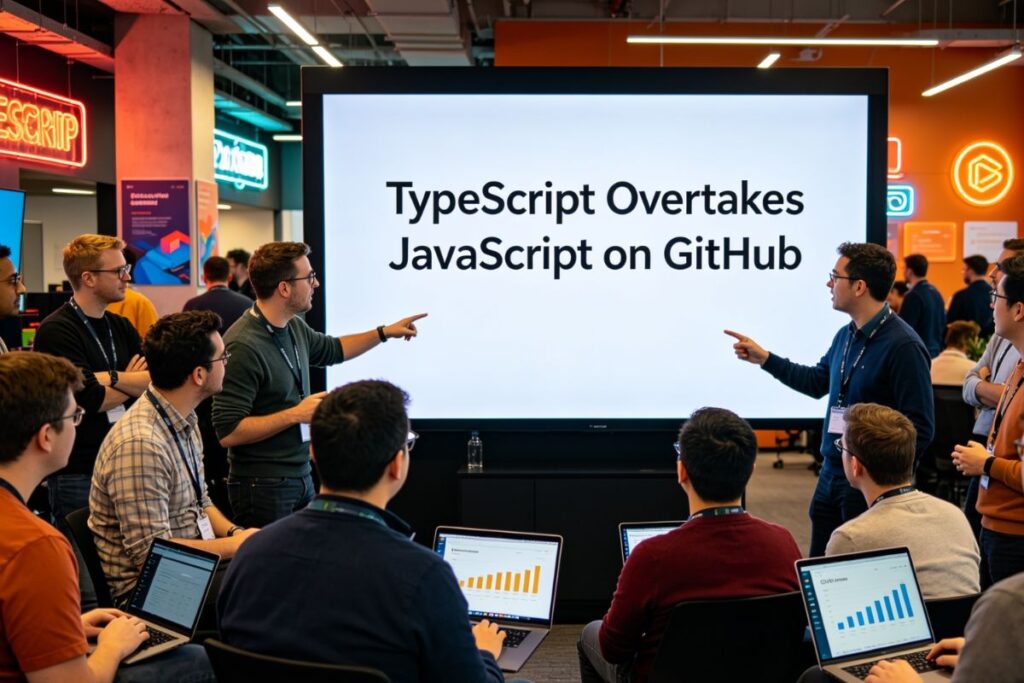
TypeScript Overtakes JavaScript on GitHub and Is Changing Which Frameworks Developers Choose is not just a headline about language popularity. Technically, it means TypeScript has become the most used language on GitHub by repository share and activity, reflecting how often developers now prefer static typing, editor tooling, and safer refactoring over the speed of plain JavaScript development.
That shift matters because language choice now influences framework choice more than many teams admit. When a codebase is expected to grow, integrate with APIs, and survive frequent refactors, teams often reach for frameworks and ecosystems that treat types as a first-class asset: Next.js, NestJS, Angular, Remix, tRPC-heavy stacks, and an increasing share of Vue and Svelte projects. In practice, the language is no longer a neutral layer; it shapes architecture, hiring, code review, and long-term maintenance.
GitHub’s own yearly Octoverse reporting has consistently shown TypeScript climbing inside real-world repositories, while the broader JavaScript ecosystem remains massive. That distinction matters. JavaScript still powers enormous amounts of production software, but TypeScript is winning the projects where predictability, team scale, and framework ergonomics carry the most weight.
Pontos-Chave
- TypeScript’s rise on GitHub reflects a practical preference for maintainability, not a rejection of JavaScript.
- Framework selection now often follows typing support, build tooling, and DX, not just runtime performance.
- Teams working on larger codebases are using TypeScript to reduce refactor risk and improve collaboration across functions.
- JavaScript remains essential, but it is increasingly the runtime foundation beneath typed application layers.
- The best framework choice depends on project size, team maturity, and how much safety the codebase needs from the type system.
TypeScript Overtakes JavaScript on GitHub and What That Really Means
GitHub Popularity is a Signal, Not a Verdict
GitHub language data measures repository usage, not universal truth. It does not mean TypeScript replaced JavaScript everywhere, and it does not mean every project should switch. What it does indicate is where new work is gravitating: typed applications, modern frontend stacks, Node.js services with strong contracts, and libraries that need safer public APIs.
The practical interpretation is sharper than the headline. Teams are choosing TypeScript when they expect a codebase to live long enough for change to become expensive. That is why the rise shows up most clearly in products with more than one developer, fast-moving feature work, and shared components across frontend and backend. The language is winning on collaboration costs, not on syntax elegance.
Definition First: What TypeScript Changes in the Development Model

TypeScript is a statically typed superset of JavaScript that adds compile-time type checking, interfaces, generics, enums, access modifiers, and advanced inference while still compiling to standard JavaScript. In plain English: it lets developers catch many category errors before code runs. That matters when APIs evolve, data shapes drift, and components depend on contracts that are easy to break in plain JavaScript.
This is why TypeScript often changes the framework conversation. Once teams value strictness, they start asking which framework gives the cleanest type integration, the least friction in build pipelines, and the best support for server/client boundaries. The result is not a single winner; it is a sorting mechanism that favors ecosystems with strong tooling discipline.
Why the Shift Accelerated After 2020
The timing is not accidental. Modern frontend development grew more complex: server-side rendering, partial hydration, edge runtimes, design systems, shared utility packages, and monorepos all increased the cost of weak contracts. At the same time, editors like VS Code made TypeScript feel less like an add-on and more like the default way to work.
Who works in this field knows the pattern. The first project survives with JavaScript. The second project adds shared components and a larger team. By the third project, the cost of unclear prop shapes, undocumented return values, and accidental breaking changes becomes impossible to ignore. TypeScript becomes less of a preference and more of a control system.
Why Framework Selection is Moving Toward Typed Ecosystems
Frameworks Are Now Judged by Type Experience
The framework decision used to revolve around rendering model, community size, and performance. Those still matter, but type experience has become a real differentiator. Good TypeScript support now means more than “it compiles.” It includes inference quality, prop validation, server action typing, route safety, and how cleanly the framework exposes its APIs to IDEs.
That is why Next.js, Remix, NestJS, Angular, and increasingly SvelteKit often show up in typed-first conversations. They reduce the amount of handwritten glue code and let the type system carry more meaning. A framework that forces constant casting or weakly typed boundaries creates friction that grows with team size.
Why Some JavaScript-first Frameworks Still Win
Not every team needs heavy typing. Smaller products, fast prototypes, and content sites can move faster with minimal ceremony. There is also a real productivity penalty when strictness is imposed too early, especially on teams without a shared TypeScript vocabulary. A type system can be a safety net or a bureaucratic trap, depending on maturity.
This is the nuance many articles miss: TypeScript helps when the project has enough structure to benefit from structure. If the codebase is disposable, the overhead may not pay off. If the codebase is strategic, typed frameworks usually become the better bet because they make change cheaper over time.
Where the Market is Clearly Heading
The current direction favors frameworks that treat types as an organizing principle rather than a compatibility layer. That includes full-stack meta-frameworks, backend frameworks with decorators and dependency injection, and libraries that export explicit contracts. Even React, which is still JavaScript at its core, is now overwhelmingly used through TypeScript in serious production work.
That shift affects hiring, too. Teams increasingly look for developers who can reason about types, not just syntax. The ability to design a reliable prop model, define DTOs, and maintain shared interfaces across layers is becoming part of the framework decision itself.
Decision Factor JavaScript-First Stack TypeScript-First Stack Speed to first prototype Often faster Usually slightly slower Refactor safety Lower Higher Editor assistance Good Excellent Large-team maintainability Weaker Stronger Learning curve Lower Higher
Where TypeScript Delivers the Highest Return
Large Codebases and Shared UI Systems
The biggest return comes in projects with many contributors and shared design systems. When component props, utility functions, and API responses are typed, the compiler becomes a reviewer that never sleeps. That does not eliminate bugs, but it does catch a meaningful class of mistakes before they reach QA or production.
In design systems, TypeScript pays off even more. Components become reusable contracts instead of informal patterns, and teams can refactor with less fear. The more surface area a system has, the more useful strict typing becomes.
API-heavy Apps and Backend Services
TypeScript is also strong in applications with frequent backend integration. DTOs, request validation, and response models are easier to align when the types mirror the API contract. NestJS is a clear example: it leans into TypeScript’s decorators, classes, and dependency injection model in a way that feels native rather than forced.
That alignment is one reason many teams standardize on TypeScript across both frontend and backend. It reduces context switching, gives developers a shared language for contracts, and simplifies code review when data structures move through multiple layers.
Where the Type System Can Slow You Down
There are limits. Aggressive strictness can slow early product discovery, especially when domain rules are unstable. Some libraries have incomplete typings, and some teams over-engineer types before they understand the product. TypeScript is a productivity multiplier only when the team knows what problem the type system should solve.
The best teams avoid type theatrics. They type the boundaries that matter most: public APIs, forms, domain models, and integration points. They do not try to model every temporary object in the universe. That discipline keeps the benefits without turning the build into a tax.
“TypeScript is not a better JavaScript. It is a different tradeoff: more upfront structure in exchange for less downstream risk.”
How the Ecosystem Around TypeScript is Reshaping Daily Work
Tooling Now Influences Framework Loyalty
Most developers experience the shift through editor behavior before they notice it in architecture decisions. IntelliSense, jump-to-definition, autocompletion, and inline diagnostics make typed frameworks feel safer and faster. That is a major reason TypeScript adoption spreads even when teams never formally debate language strategy.
VS Code, tsserver, ESLint, and modern bundlers have normalized a workflow where the type checker is part of the development loop. In practice, that means faster local feedback and fewer surprises during code review. The developer experience becomes a framework feature.
Monorepos and Package Boundaries Reward Explicit Contracts
Monorepo setups make TypeScript more valuable because packages depend on each other in visible ways. Shared types, utility packages, and generated client code all benefit from strict boundaries. When a package changes a contract, downstream consumers feel the break immediately instead of discovering it in production.
This is why tools like Turborepo and Nx show up frequently in TypeScript-centric organizations. They help teams manage complexity, but the real force is the type system itself. It turns a sprawling repository into a set of checkable agreements.
JavaScript Still Matters as the Runtime Layer
There is a common misunderstanding here. TypeScript does not replace JavaScript in the browser or Node.js runtime. It compiles down to JavaScript, which means JavaScript remains the execution substrate for nearly everything in this ecosystem.
That matters for teams making strategic decisions. The question is not whether JavaScript disappears. It is whether the organization wants to author new systems in a way that reduces ambiguity from the start. For many teams, the answer is yes.
How to Choose a Framework After This Shift
Use Project Shape, Not Hype, as the Deciding Factor
The right framework depends on the kind of product being built. If the goal is a small marketing site or a rapid prototype, a lighter JavaScript-centric stack may be enough. If the goal is a multi-year application with several developers, typed routing, shared business logic, and repeated refactors, a TypeScript-first framework is usually the better investment.
That decision should be based on measurable criteria: codebase size, team experience, expected lifespan, API complexity, and release cadence. Popularity alone is a weak guide. A framework that fits a startup sprint may be a poor choice for a regulated enterprise workflow.
A Practical Decision Matrix
Teams can simplify the choice with a small set of questions. Do we need strict contracts across layers? Will multiple developers edit the same domain logic? Are we building a component-heavy product? Do we expect the API to evolve often? If the answer is yes to most of these, TypeScript support should move to the top of the stack selection criteria.
That is the real effect of TypeScript overtaking JavaScript on GitHub: it changes what “good framework support” means. The winning stack is less about raw syntax comfort and more about long-term change tolerance.
- Choose a TypeScript-first framework when long-term maintainability matters more than initial speed.
- Choose a JavaScript-light approach when the project is small, short-lived, or highly experimental.
- Favor strong inference and clear contract types over frameworks that merely “support TypeScript.”
- Verify ecosystem maturity: docs, community patterns, build stability, and migration paths matter as much as language support.
For broader context on language adoption and engineering trends, GitHub’s Octoverse, the official TypeScript documentation, and MDN’s JavaScript reference are the most reliable starting points. Those sources do not tell you which framework to pick, but they do define the technical ground truth better than most commentary.
Próximos Passos Para Implementação
The strategic move is not to “switch everything to TypeScript” overnight. Start by identifying the parts of the stack where bugs are expensive: API boundaries, shared UI components, domain models, and utility packages. That is where typed contracts produce the fastest return. A gradual migration is usually stronger than a rewrite because it preserves shipping velocity while tightening the most failure-prone seams.
For framework selection, prioritize the ecosystem that reduces friction for the team you have, not the one that sounds most modern on social media. If the team is experienced and the product is large, typed frameworks should be near the top of the list. If the team is small and the product is disposable, over-investing in type architecture can be a distraction. The best choice is the one that lowers risk without creating ceremony the team will ignore.
The next step is to make types a design asset, not a compliance exercise. Define boundaries, measure defect reduction, and review how often the compiler catches changes that would otherwise reach production. That is how this shift becomes operational value instead of just a tooling preference.
FAQ
Is TypeScript Replacing JavaScript?
No. TypeScript compiles to JavaScript, so JavaScript remains the runtime language for browsers and Node.js. What is changing is how teams author applications: more of the code that is written for serious products now uses TypeScript to add compile-time safety, better IDE support, and clearer contracts. JavaScript is still foundational, but TypeScript is increasingly the preferred authoring layer for larger systems.
Why Do So Many Frameworks Favor TypeScript Now?
Because framework authors want stronger contracts, better editor integration, and fewer breaking changes for users. TypeScript helps surface mistakes early and makes APIs more discoverable in the IDE. For framework maintainers, it also reduces ambiguity in public interfaces and makes documentation easier to align with real usage.
Does TypeScript Always Improve Productivity?
No. It improves productivity when the codebase is large enough, the team understands the type system, and the project benefits from long-term maintainability. It can slow teams down when they apply it too aggressively to prototypes or unstable product ideas. The gain comes from reducing downstream defects, not from typing for its own sake.
Which Frameworks Benefit Most from TypeScript?
Frameworks with strong contracts and structured architecture tend to benefit the most: Next.js, Remix, Angular, NestJS, and typed Vue or SvelteKit setups. Libraries that expose reusable APIs also gain a lot because consumers get safer autocomplete and better compile-time checks. The best fit depends on whether the framework’s type support feels native or bolted on.
Should a Small Team Adopt TypeScript from Day One?
Often yes, if the product is expected to grow and the team can handle the initial learning curve. Starting with TypeScript avoids a migration later and helps establish clean boundaries early. If the project is experimental or short-lived, plain JavaScript may be the faster path. The decision should reflect product lifespan, not trend pressure.
Editorial Notice
This content was structured with the assistance of Artificial Intelligence and subjected to rigorous curation, fact-checking, and final review by Editor-in-Chief Nivailton Santos. TechTool Judge reaffirms its unyielding commitment to journalistic ethics, ensuring that editorial judgment and data validation remain entirely under human responsibility and final editorial oversight.